How to Choose the Best Dog Food for Labs
The best dog food for Labs is a complete, meat-based food with a named animal protein first, moderate fat and a calorie level you can control, because Labrador Retrievers are famously food-motivated and gain weight easily. Most pet Labs do best on measured meals of a moderate-calorie adult food. Working and hunting Labs need more calories and protein.

Should you choose grain-free food? Does dog food need to be breed-specific? Is wet or dry food best? With so many brands on the market, it can be hard to choose. The truth is that dog food doesn't need to be breed-specific or grain-free, and dry versus wet matters less than total calories and quality. Below you'll find what Labs need, a feeding chart, ingredients to look for and avoid, and how to feed working Labs.
Why Labrador Retriever Nutrition Needs Special Attention
Labrador Retrievers were bred to retrieve ducks and game for hunters, and many still work as hunting, service and search-and-rescue dogs. They are athletic, smart and very trainable, and they have a lot of energy when they are young.
They are also known for eating just about anything and always acting hungry. That makes them prone to obesity, and extra weight in a Lab adds stress to hips and elbows, two areas where the breed already has a higher risk of problems like dysplasia and arthritis. Keeping your Lab lean is one of the most effective things you can do for their long-term health.
So the right Lab diet balances two things: enough high-quality protein to keep muscle strong, and calories controlled tightly enough to keep them lean.
How Much Should a Labrador Eat?
Most adult Labs weigh 55 to 80 pounds. Use this chart as a starting point for a typical pet Lab, then adjust every two weeks based on body shape. You should feel the ribs easily and see a waist from above.
| Adult weight | Calories per day (typical pet Lab, estimate) | Cups of 25/11 (415 kcal/cup) | Cups of 30/20 (535 kcal/cup) |
|---|---|---|---|
| 55 lb | about 1,100-1,250 | about 2.6-3.0 | about 2.0-2.3 |
| 65 lb | about 1,240-1,410 | about 3.0-3.4 | about 2.3-2.6 |
| 75 lb | about 1,380-1,580 | about 3.3-3.8 | about 2.6-2.9 |
| 80 lb | about 1,440-1,650 | about 3.5-4.0 | about 2.7-3.1 |
Estimates: resting energy (70 × kg0.75) × 1.4-1.6, a common range for spayed/neutered, moderately active adults. Working and hunting Labs can need far more on active days. Treats count toward the total.
For a number tailored to your dog, use the Bully Max dog food calculator. If your Lab is already overweight, feed for the target weight and ask your vet for a plan.
For most pet Labs, a lighter recipe makes portion control easier. Bully Max 25/11 Lamb has 25% protein, 45% less fat and 415 calories per cup, so your Lab gets a satisfying bowl without excess calories.

A LIGHTER BOWL FOR HUNGRY LABS
Chicken-free lamb recipe with 25% protein, 45% less fat, and 415 calories per cup, so a food-motivated Lab gets a fuller bowl for the calories.
Foods and Ingredients to Watch in Your Labrador's Food
Many dog foods lean on cheap fillers. They aren't toxic, but they can make it harder to get enough quality protein without extra calories. Watch for:
- Soy, corn and wheat high on the list: these add calories and plant protein, which has a different amino acid profile from meat. Some dogs also have trouble digesting them.
- Artificial colors and flavors: they are added for appearance and taste and do nothing for your dog.
- BHA and BHT: synthetic preservatives that many owners prefer to avoid. Mixed tocopherols (vitamin E) are a common natural alternative.
- Added sugar and corn syrup: dogs don't need added sugar, and Labs certainly don't need the extra calories.
- Unnamed animal ingredients: "meat meal" or "animal fat" don't tell you the source.
What Dog Food Ingredients Are Good for Labrador Retrievers?
Look for these in your Lab's food:
- High-quality animal protein: named meats and meals such as chicken, chicken meal, turkey, lamb or fish near the top of the list. A named meal is a concentrated protein source (see what chicken meal is).
- Quality carbohydrates: brown rice, sorghum, barley, oats or sweet potato for energy.
- Healthy fats: named animal fat, fish oil or flaxseed for energy, skin and coat. Fat is also the biggest calorie source, so moderate it for less active Labs.
- Fiber: beet pulp, pumpkin or whole grains for digestion and to help a hungry Lab feel full.
- Omega-3 and omega-6 fatty acids: for skin, coat and joint comfort. A pump of wild-caught salmon oil is an easy way to add omega-3s.
- Vitamins and minerals: look for a "complete and balanced" statement for your dog's life stage.
- Joint support: glucosamine and chondroitin, from food or a supplement, are commonly used for large, active breeds.

What Dog Food Is Good for Hunting and Working Labs?
Labs that hunt, compete or work all day burn far more calories than a family pet. They need a protein-rich, calorie-dense food so they can eat enough without huge meals before work. Feed most of the day's food after work rather than right before hard exercise, and adjust portions on rest days.
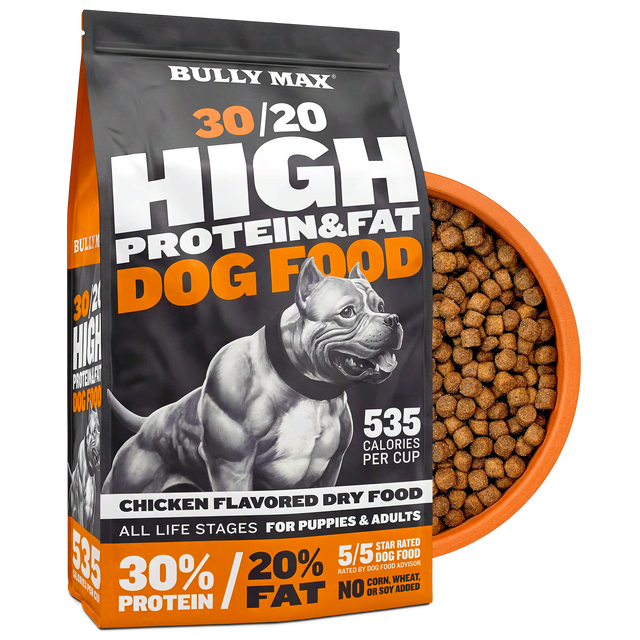
For hard-working Labs, Bully Max 30/20 offers meat-based protein, with 535 calories per cup to fuel long days.

TRY BULLY MAX 30/20 HIGH-PROTEIN DOG FOOD
Fuel strength and energy with meat-based nutrition, 30% protein, 20% fat, and 535 calories per cup.
Best Puppy Food for Labs: Feeding a Labrador Puppy
Lab puppies grow fast, and the goal is steady growth, not fast growth. Labs are prone to hip and elbow dysplasia, and growing too quickly or carrying extra weight as a puppy adds stress to developing joints. Genetics play a big part too, so ask your breeder about the parents' hip and elbow screening.

Choose a food made for large-breed growth
Most Labs reach 55 to 80 pounds, so look for a puppy food whose nutritional adequacy statement says it is complete and balanced for growth, including growth of large size dogs (70 lb or more as an adult). That statement means the calcium and phosphorus levels suit large-breed puppies. Don't add calcium or other supplements to a complete puppy food unless your vet tells you to. The same large-breed rules apply to other big breeds, as our guide to the best dog food for German Shepherds explains.
How often and how much to feed a Lab puppy
- 8 weeks to about 6 months: three to four measured meals a day.
- 6 to 12 months: two to three meals a day.
- Adults: two meals a day.
Start with the puppy feeding guide on the bag for your puppy's current weight and age, then adjust. Count training treats as part of the daily amount.
Keep your Lab puppy lean
By about 12 weeks your puppy should have a visible waist. You should be able to feel the ribs easily without seeing them. If your puppy looks round, cut back a little. If you can easily see ribs, hip bones or spine, increase the portion slightly and check with your vet to rule out worms or other health issues.

When to switch a Lab to adult food
Most Labs are ready for adult food at around 12 months. Ask your vet if you're unsure, and switch gradually over 7 to 10 days. See when to switch to adult dog food.
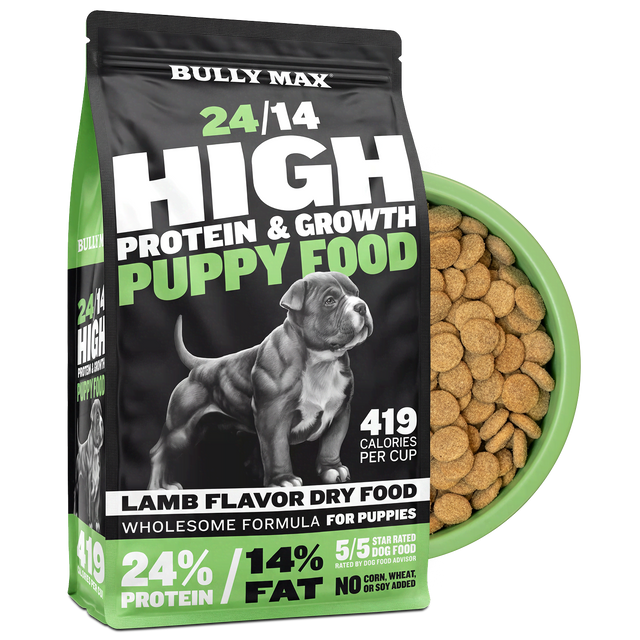
For a Lab puppy, our pick is Bully Max 24/14 High Protein & Growth Puppy Food. Like every Bully Max dog food, it is suitable for large-breed dogs, including large-breed puppies, under AAFCO guidelines. It has 24% protein, real lamb and TruMune to support digestion and immune health. For portions by age, see our feeding guide.

GIVE YOUR LAB PUPPY BULLY MAX 24/14
Made for growing puppies with 24% protein, real lamb, and TruMune to support digestion and immune health.
Supporting Your Lab's Joints
Labs work and play hard on their joints. Keeping them lean comes first. Pairing a quality food with a daily chew that includes joint, skin and coat support, like Bully Max 9-in-1 Vitality Chews, is a simple way to round out their routine. If your Lab is stiff or limping, see your vet. Our guide to osteoarthritis in dogs explains the warning signs.
Black Lab, Chocolate Lab or Yellow Lab: Does Coat Color Change the Diet?
No. Black, chocolate and yellow Labs are the same breed with the same nutritional needs, so the dog food that suits a black Lab suits a chocolate or yellow Lab too. What changes the right food and portion is your dog's age, weight, activity level and body condition, not coat color. Build matters more than color: a stockier English (show-type) Lab on a family schedule usually needs tighter portion control, while a leaner American (field-type) Lab that hunts or runs every day needs more calories.
For a Lab of any color, a named animal protein first, moderate fat and measured meals do the work. Omega-3 fatty acids from fish oil or salmon oil support skin and coat health.
Best Dog Food for Labs: FAQ
What is the best dog food for a Labrador Retriever?
A complete, meat-based food with a named protein first, moderate fat and a calorie level that keeps your Lab lean. For most pet Labs a lighter recipe like Bully Max 25/11 Lamb works well; working Labs may need a higher-calorie food like 30/20.
How much should a Lab eat per day?
A typical 65 lb pet Lab needs roughly 1,250 to 1,400 calories a day, or about 3 to 3.5 cups of a 415 kcal/cup food. Adjust for activity and body shape.
Which wet foods pair well with dry kibble for Labradors?
Any complete wet food can be used as a topper, but count its calories and cut the kibble to match. A just-add-water option like Bully Max 26/12 Instant Wet Dog Food (592 calories per cup) is calorie-dense, so a small spoon goes a long way.
How much should I feed a Labrador puppy?
Follow the puppy feeding guide on the bag for your puppy's weight and age, split into three to four meals a day until about 6 months, then two to three. Adjust so your puppy stays lean with a visible waist.
What is the best food for a Lab puppy?
A complete puppy food with named animal protein first and a label statement that covers growth of large size dogs (70 lb or more as an adult). Bully Max 24/14 Puppy Food is suitable for large-breed dogs, including large-breed puppies, under AAFCO guidelines. Feed measured meals and keep your puppy lean.
Do Labs need high-protein dog food?
Labs need good-quality protein to keep muscle. Active and working Labs do well on higher-protein foods. For less active pet Labs, total calories matter more than the protein number.
Should Labs eat grain-free food?
Not necessarily. Unless your vet advises otherwise, a food with quality grains is fine for most Labs.
How do I stop my Lab from begging and overeating?
Measure every meal, use part of the daily kibble as training treats, try a slow feeder or puzzle feeder and keep table scraps out of reach.
What should I feed a black Lab or chocolate Lab?
The same food as any Labrador Retriever. Coat color does not change a Lab's nutritional needs; pick a complete, meat-based food and set portions by weight, age and activity.
Is dry dog food good for Labradors?
Yes. A complete dry food makes measured portions simple, which matters for a breed that gains weight easily. You can add a spoon of wet food or a topper for variety as long as you count its calories and trim the kibble to match.
Keep Your Lab Fit for Life
Labs are happiest and healthiest when they are lean, active and well fed. Choose a meat-based food, measure meals, count treats and adjust for activity. For a typical pet Lab, try Bully Max 25/11 Lamb. For a working or hunting Lab, Bully Max 30/20 brings 30% protein and 535 calories per cup.
Ready to get started? A reduced-fat, chicken-free recipe gives your Lab high protein with 415 calories per cup.
READY TO START? TRY BULLY MAX 25/11 REDUCED FAT FOOD
Chicken-free lamb recipe with 25% protein, 45% less fat, and 415 calories per cup for dogs that need a lighter bowl.