How Many Calories Does a Dog Need? Daily Calories by Weight, Age and Activity
A typical adult dog needs about 25 to 30 calories per pound of body weight a day, but the honest answer comes from a formula: resting energy requirement (RER) = 70 × (body weight in kg)0.75, multiplied by 1.4 to 1.8 for most adult pets and 2 to 3 for puppies and hard-working dogs. A 20 lb dog needs about 585 calories a day, a 50 lb dog about 1,165, an 80 lb dog about 1,655. Below is the full table by weight, the multipliers for puppies, intact, working and overweight dogs, and how to turn the number into cups of food.
Family-owned since 2009 · Made in USA · Every batch triple tested · Zero recalls · 50,000+ 5-star reviews · Dog Food Advisor 5/5
The Formula Vets Use
Calorie needs do not scale in a straight line with weight. A 100 lb dog does not burn twice what a 50 lb dog burns, because bigger bodies are more efficient per pound. That is why the formula uses body weight to the 0.75 power. It has two steps:
- Resting energy requirement (RER). The calories a dog burns at rest in a comfortable room, digesting a normal meal. RER = 70 × (kg)0.75. For a 50 lb (22.7 kg) dog that is about 727 calories.
- Maintenance energy requirement (MER). RER multiplied by a factor for life stage and activity. The Merck Veterinary Manual lists 1.6 × RER for a neutered adult, 1.8 × RER for an intact adult, 1.4 × RER for a dog prone to obesity, 3 × RER for puppies under 4 months and 2 × RER for puppies over 4 months. Working dogs run higher.
Merck adds the caveat every owner should remember: any given dog may need as much as 30% more or less than the calculation. The formula is the starting point. The dog's ribs and the scale are the answer.
Dog Calorie Needs by Weight
Daily calories, by the formula above. "Typical adult" is a neutered pet at normal activity (1.6 × RER). "Easy gainer" is 1.4 × RER. "Intact or active" is 1.8 × RER. Puppy figures are for a puppy at that current weight.
| Dog weight | RER | Easy gainer (1.4×) | Typical adult (1.6×) | Intact or active (1.8×) | Puppy over 4 mo (2×) | Puppy under 4 mo (3×) |
|---|---|---|---|---|---|---|
| 10 lb | 220 | 305 | 350 | 390 | 435 | 655 |
| 20 lb | 365 | 510 | 585 | 660 | 730 | 1,100 |
| 30 lb | 495 | 695 | 795 | 895 | 990 | 1,490 |
| 40 lb | 615 | 860 | 985 | 1,110 | 1,230 | 1,845 |
| 50 lb | 725 | 1,020 | 1,165 | 1,310 | 1,455 | 2,180 |
| 60 lb | 835 | 1,170 | 1,335 | 1,500 | 1,670 | 2,500 |
| 70 lb | 935 | 1,310 | 1,500 | 1,685 | 1,875 | 2,810 |
| 80 lb | 1,035 | 1,450 | 1,655 | 1,865 | 2,070 | 3,105 |
| 100 lb | 1,225 | 1,715 | 1,960 | 2,200 | 2,445 | 3,670 |
| 120 lb | 1,405 | 1,965 | 2,245 | 2,525 | 2,805 | 4,210 |
Calories per day, rounded to the nearest 5. Estimates from RER = 70 × kg^0.75 and the Merck multipliers. Weather, coat, age, health and metabolism move the real number by up to 30%.
Read across, not down. A 60 lb dog that is intact and runs every day sits near 1,500; the same dog neutered and walked twice a day sits near 1,335; a stocky, inactive version of that dog near 1,170. The Bully Max dog food calculator does this for any weight.
How Many Calories Does a Pit Bull Need?
Most American Pit Bull Terriers and American Bullies land between 40 and 70 lb, so a typical adult needs roughly 1,000 to 1,500 calories a day, and a conditioned, intact dog in training can need 1,700 or more. The breed's build makes the math easy to check: a short coat and visible muscle mean you can see the first sign of over- or underfeeding. A fit pit bull shows a waist, a hint of rib and muscle over the back and thighs. If the ribs disappear, cut 10%. If the hips and spine show, add 10%. Our guide to pit bull weight and size gives the breed ranges.

Working, Sport and Weight-Pull Dogs
Merck defines MER for a moderately active animal and notes that fat is what accommodates the extra demands of work, stress, growth or lactation. In practice, a dog that trains hard several days a week, pulls weight, runs a slat mill or works in cold weather can need 2 × RER and sometimes more during the season. Two things change for these dogs. First, the calories: a 60 lb dog at 2 × RER needs about 1,670 a day. Second, where the calories come from: fat carries about 8.5 calories per gram against 3.5 for protein and carbohydrate (the factors used on pet food labels), so a higher-fat food delivers more energy per cup and a smaller meal before work. That is the reason PRO Series 31/25 exists: 31% protein, 25% fat, 600 calories per cup. Read calorie needs for dogs in competitive training for the seasonal plan.

2× RER DOG? FEED 600 CALORIES PER CUP
31% protein, 25% fat and 600 calories per cup. Built for working, sport and hard-to-keep-weight-on dogs.
Save 10% with autoship on every bag of PRO Series.
Puppies Need About Twice the Calories Per Pound
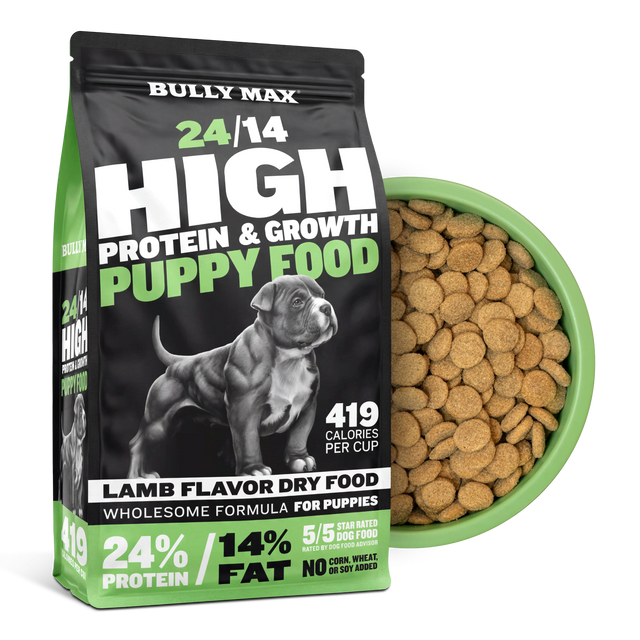
A 20 lb puppy under 4 months needs about 1,100 calories a day; a 20 lb adult needs about 585. The difference is growth. Feed puppies a growth formula by the chart on the bag, in 3 to 4 meals a day, and keep them lean: for large breeds especially, a fast-growing, heavy puppy is at higher risk of joint problems than a lean one. Bully Max 24/14 Puppy Food has 419 calories per cup and is suitable for large-breed puppies under AAFCO guidelines. See our puppy growth chart and best puppy food.
Turning Calories Into Cups
Once you have the calorie number, divide it by the calories per cup printed on your bag. Dog foods range from about 300 to 600 calories per cup, so the same dog eats very different amounts depending on the food. For a typical 50 lb adult at about 1,165 calories a day:
| Food | Calories per cup | Cups per day (est.) |
|---|---|---|
| Typical dry dog food | about 350 | about 3⅓ |
| Bully Max 25/11 Lamb, 45% less fat | 415 | about 2¾ |
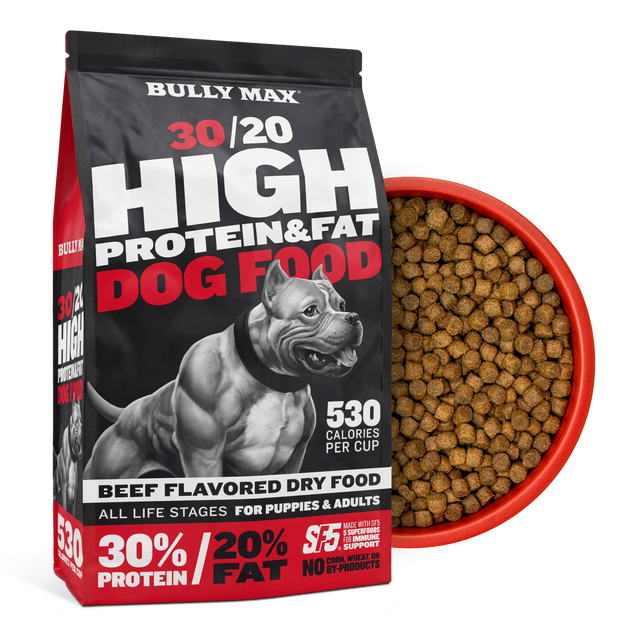
| Bully Max 30/20 Beef | 530 | about 2¼ |
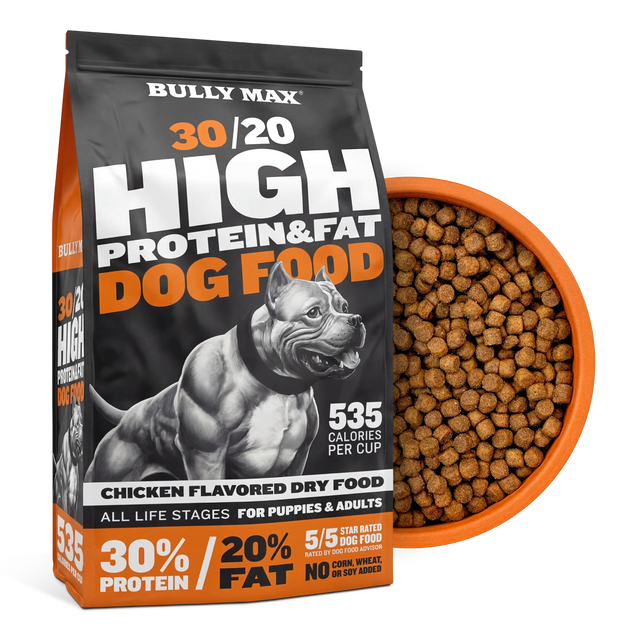
| Bully Max 30/20 Chicken | 535 | about 2¼ |
| Bully Max PRO Series 31/25 | 600 | about 2 |
Estimates. The printed Bully Max 30/20 chart lists 2 to 2½ cups for 36 to 50 lb dogs.

Calorie-dense food means fewer cups, smaller stools and a bag that lasts longer than its weight suggests. It also means the old scoop is wrong the day you switch. Reset the portion from the bag, then adjust to body condition every two weeks. For dogs that need to put weight on, see our guide to dog food for underweight dogs.
Do Not Forget Treats
Treats, chews and table scraps count. The usual rule is that treats should make up no more than 10% of daily calories, so a 50 lb dog on 1,165 calories has about 115 calories a day for everything outside the bowl. A few training treats fit. A daily rawhide-size chew plus cheese plus the crust of a sandwich does not, and it is the most common reason a dog "on the chart" is still gaining. If you use treats heavily for training, trim the meals to match.
In our customers' words
“My dog has been eating this since he was 6 weeks old. He is now 4 years old and is solid, muscle definition in his legs.”
— Bully Max customer, post-purchase survey
“The ability to provide a protein rich diet to my pup, who is naturally muscular and athletic”
— Bully Max customer, post-purchase survey
Signs You Have the Number Wrong
- Too many calories: ribs are hard to find, no waist from above, no tuck from the side, weight creeping up month to month.
- Too few: ribs, spine and hip bones visible, coat dull, energy down, weight dropping.
- The portion is right but the dog is still losing weight: see your vet. Parasites, dental pain and illness all present as "won't hold weight," and no calorie math fixes those.
Change the portion by about 10% at a time, wait two weeks, and check again. Our dog weight chart shows what ideal looks like for each body type, and how much should I feed my dog covers the whole feeding routine.
FAQ
How many calories does a dog need per day?
Use RER = 70 × (weight in kg)^0.75, then multiply by 1.6 for a typical neutered adult, 1.8 for an intact or active adult, 1.4 for an easy gainer, and 2 to 3 for puppies. A 50 lb typical adult needs about 1,165 calories; a 20 lb dog about 585; an 80 lb dog about 1,655.
How many calories per pound does a dog need?
Roughly 25 to 30 per pound for a mid-size typical adult, but it falls as dogs get bigger: about 29 per pound for a 20 lb dog, 23 per pound for a 50 lb dog and 20 per pound for a 100 lb dog. Use the table above rather than one number.
How many calories does a 50 lb dog need?
About 1,165 a day for a typical neutered adult, about 1,020 for an easy gainer, about 1,310 for an intact or active dog. On a 535-calorie food that is about 2¼ cups a day.
How many calories does a pitbull need?
Most adult pit bulls (40 to 70 lb) need about 1,000 to 1,500 calories a day. A conditioned dog in training can need 1,700 or more. Judge by body condition: waist, a hint of rib, muscle over the back.
How many calories does a puppy need?
About twice an adult of the same weight: 3 × RER under 4 months and 2 × RER over 4 months. A 20 lb puppy under 4 months needs about 1,100 calories a day. Feed a growth formula by the chart, in 3 to 4 meals.
How many calories should a dog eat to lose weight?
Ask your vet for a target weight, then feed for that target at about 1.4 × RER or less, with treats under 10% of calories. Weigh every two weeks. A lower-fat food such as Bully Max 25/11 Lamb (415 calories per cup) lets you keep the bowl full while cutting calories.
Feed by the Number, Judge by the Dog
Run the formula, divide by the calories per cup on your bag, split it into two meals, keep treats under 10%, and adjust 10% at a time until the ribs feel right. If you want more calories in fewer cups, Bully Max 30/20 delivers 535 per cup from meat-based nutrition, and PRO Series 31/25 delivers 600. See why active dogs do well on 30/20.
More calories per cup, fewer cups per day
30% protein, 20% fat and 535 calories per cup, so a 50 lb dog eats about 2¼ cups a day instead of 3⅓. Meat-based, made in the USA, zero recalls.

TRY BULLY MAX 30/20 HIGH-PROTEIN DOG FOOD
Fuel strength and energy with meat-based nutrition, 30% protein, 20% fat, and 535 calories per cup.
Save 10% with autoship and get each bag delivered on a schedule.
Family-owned since 2009 · Made in USA · Every batch triple tested · Zero recalls · 50,000+ 5-star reviews · Dog Food Advisor 5/5
Sources
- Merck Veterinary Manual, Nutritional Requirements of Small Animals and the table Daily Maintenance Energy Requirements for Dogs and Cats: RER = 70 × (kg)^0.75; MER 1.8 × RER intact adult, 1.6 × neutered, 1.4 × obesity prone, 3 × puppies under 4 months, 2 × over 4 months; individual variation up to 30%; fat accommodates the demands of work, growth and lactation. merckvetmanual.com
- WSAVA Global Nutrition Committee, Interpreting Food Labels: calorie content statements on pet food labels use 3.5, 8.5 and 3.5 kcal per gram for protein, fat and carbohydrate. wsava.org
- Bully Max 30/20 Chicken, 30/20 Beef, PRO Series 31/25, 25/11 Lamb and 24/14 Puppy product pages: calories per 8 oz cup and feeding charts.
- Bully Max post-purchase survey, Dec 2024 to Jun 2025 (customer quotes).