Puppy Growth Chart and Feeding Chart for Bully and Large Breeds
A puppy growth chart shows the typical weight range for your puppy’s age, based on how big it should be as an adult. For the first five months, puppies gain about 2 to 4 grams a day for every kilogram of expected adult weight, then growth levels off: small and medium breeds finish at 8 to 12 months, large and giant breeds at 10 to 16 months or later. Use the breed charts and the 24/14 feeding chart below, then adjust to keep your puppy lean.
Family-owned since 2009 · 50,000+ five-star reviews · Dog Food Advisor 5/5 · Zero recalls
Raising a bully or large-breed puppy? Our puppy formula is built for steady, lean growth:

GROW THEM STEADY WITH BULLY MAX 24/14
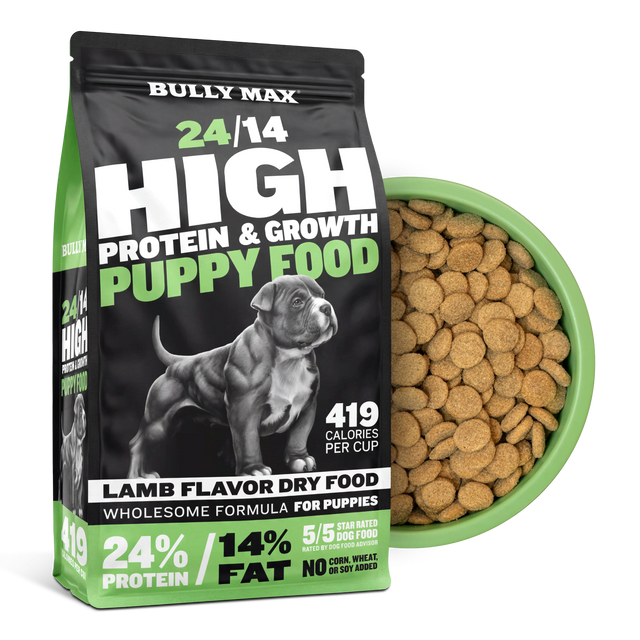
24% protein, 14% fat and 419 calories per cup, with TruMune to help support digestion and immune health. Suitable for large-breed dogs, including large-breed puppies, under AAFCO guidelines.
Puppies eat more every month. Subscribe & save 10% with Autoship.
Puppy growth chart at a glance
- Know the target: your puppy’s expected adult weight, from the breed standard or the parents.
- Birth to 5 months: the fastest growth. Weigh every 1 to 2 weeks.
- 6 months on: growth slows. Small and medium breeds finish at 8 to 12 months, large and giant breeds at 10 to 16 months or later.
- Lean beats heavy: ribs easy to feel, a visible waist. The chart is a guide; body condition is the check.
- Feeding: start from the 24/14 chart (cups per day by current weight), then adjust about 10% at a time.
- Large breeds: choose a food that covers growth of large-size dogs (70 lb or more as adults).
How to Read a Puppy Growth Chart
A growth chart answers one question: is my puppy roughly where it should be for its age? It does that by comparing your puppy’s weight today with the weight it is expected to reach as an adult. That is why every chart starts with a target adult weight, and why a single chart for “all puppies” is never very useful. A French Bulldog and a Cane Corso are both done with the fast part of growth by about five months, but one is aiming for 25 lb and the other for 100.
Three things to keep in mind:
- Ranges, not targets. Healthy puppies of the same breed differ a lot. Litter size, sex, genetics and activity all move the numbers. A puppy at the low or high end of a range can be perfectly fine.
- The curve matters more than one weigh-in. Weigh on the same scale every one to two weeks and look at the trend. Steady gain is what you want. A sudden stall or a jump is worth a closer look.
- Body condition is the real check. If you can feel the ribs easily under a thin layer of cover and see a waist from above, your puppy is in good shape, whatever the chart says. If your puppy is losing weight, not eating or has diarrhea or vomiting, call your vet.

Puppy Weight Chart by Age (Any Breed)
The Merck Veterinary Manual puts typical puppy growth at an average of 2 to 4 grams per day for every kilogram of expected adult weight during the first five months, with growth leveling off after six months. Turned into a share of adult weight, that gives the typical ranges below. Multiply your puppy’s expected adult weight by the percentages to get a typical range for its age.
| Age | Days old | Typical share of adult weight |
|---|---|---|
| 8 weeks | 56 days | about 11% to 22% |
| 3 months | 91 days | about 18% to 36% |
| 4 months | 122 days | about 24% to 49% |
| 5 months | 152 days | about 30% to 61% |
| 6 months and up | Growth starts to level off. Small and medium breeds usually finish growing at 8 to 12 months, large and giant breeds at 10 to 16 months, and some big breeds keep filling out to about 24 months. |
Typical ranges, worked out from the Merck Veterinary Manual growth rate (2 to 4 g per day per kg of expected adult weight, first 5 months), not counting birth weight. Finish ages: Merck Veterinary Manual; Salt et al., PLOS ONE (2017); VCA Animal Hospitals. Individual puppies vary.
Example: a puppy expected to weigh 60 lb as an adult would typically weigh about 14 to 29 lb at 4 months (24% to 49% of 60 lb). Most puppies sit toward the middle of the range.
Puppy Growth Charts for Bully and Large Breeds
About two thirds of the Bully Max customers we surveyed raise American Bullies, pit bulls or Staffies, and another 10% each raise French Bulldogs and Cane Corsos. Here is the same growth rate applied to each breed’s adult weight. The low number is a small adult growing at the slow end of the range, the high number a big adult growing at the fast end, and “mid” is the middle of both.
| Breed | 8 weeks | 3 months | 4 months | 5 months | Adult weight | Usually done growing |
|---|---|---|---|---|---|---|
| French Bulldog | 2–7 lb mid ~4 |
3–11 lb mid ~7 |
4–15 lb mid ~9 |
5–19 lb mid ~11 |
18–31 lb | 8 to 12 months |
| American Pit Bull Terrier | 3–13 lb mid ~8 |
5–22 lb mid ~12 |
7–29 lb mid ~16 |
9–36 lb mid ~21 |
30–60 lb | 8 to 12 months; some males to 16 |
| American Bully, pocket or standard | 4–16 lb mid ~9 |
7–25 lb mid ~15 |
10–34 lb mid ~20 |
12–43 lb mid ~25 |
40–70 lb | 8 to 16 months |
| American Bully, XL | 8–27 lb mid ~16 |
13–44 lb mid ~26 |
17–59 lb mid ~35 |
21–73 lb mid ~43 |
70–120 lb | 10 to 16 months, filling out to about 24 |
| Cane Corso | 10–25 lb mid ~17 |
16–40 lb mid ~27 |
21–54 lb mid ~36 |
27–67 lb mid ~45 |
88–110 lb | 10 to 16 months, filling out to about 24 |
| Other large breeds (70 to 100 lb adults) | 8–22 lb mid ~14 |
13–36 lb mid ~23 |
17–49 lb mid ~31 |
21–61 lb mid ~39 |
70–100 lb | 10 to 16 months |
Typical ranges, not targets. Adult weights from the breed standards named in the chart notes below; growth rate from the Merck Veterinary Manual (first 5 months); finish ages from the Merck Veterinary Manual and Salt et al. (2017). American Bully weights are example ranges because the ABKC and UKC standards set height classes, not weights. Use your puppy’s parents as the best guide.
Breed standard sources: French Bulldog, FCI standard no. 101 and AKC standard; American Pit Bull Terrier, UKC standard; Cane Corso, FCI standard no. 343; large size, AAFCO Dog Food Nutrient Profiles.
American Bully growth chart
American Bullies come in pocket, standard, classic and XL classes, defined by height at the shoulder. Weight varies widely inside each class, so your best target is the weight of your puppy’s parents. Most pocket and standard bullies finish below 70 lb and are mostly grown by about a year. Many XLs reach 70 lb or more, which puts them in the large-size group: plan for growth into the second year and a food that covers large-size growth. For a full breakdown by class, see our American Bully puppy food and weight chart.

Pit bull (APBT) growth chart
The UKC standard gives a preferred adult weight of 35 to 60 lb for males and 30 to 50 lb for females, so most American Pit Bull Terriers are medium-sized dogs that finish growing at around 8 to 12 months. Working-bred APBTs often stay lighter and leaner than show-bred dogs. Our guide to average pitbull weight, height and size covers adult sizes in more depth.

French Bulldog growth chart
Frenchies are small, compact dogs. The AKC standard says an adult should not exceed 28 lb, and the FCI standard gives 8 to 14 kg (about 18 to 31 lb). They do most of their growing in the first six months and are usually adult-sized by about a year. Frenchies put on weight easily, so watch the waistline as growth slows.

Cane Corso growth chart
The FCI standard puts adult males at 45 to 50 kg (about 99 to 110 lb) and females at 40 to 45 kg (about 88 to 99 lb). That makes the Corso a large-size breed under AAFCO, with a long growth period: most of the height comes in the first year, and many keep filling out into their second. Keep a Corso puppy lean and resist pushing extra food for size. See our guide to the best dog food for Cane Corsos for adult feeding.
Other large-breed puppies
AAFCO defines a large-size dog as one expected to weigh 70 lb or more as an adult. Rottweilers, many XL bullies, mastiff breeds and big shepherds fall here. These puppies are the most sensitive to growing too fast, so measured meals and a food made for large-size growth matter most. Our large breed puppy food guide goes deeper.
Puppy Feeding Chart: How Much to Feed a Puppy
Feed by your puppy’s weight today, not its age, and recheck every couple of weeks as it grows. The chart below is the feeding chart from the Bully Max 24/14 High Protein & Growth Puppy Food page, with calories worked out at 419 calories per cup.
| Puppy’s weight today | Cups of 24/14 per day | Calories per day (estimate) |
|---|---|---|
| 1–2 lb | ¼–½ | 105–210 |
| 2–5 lb | ½–¾ | 210–314 |
| 5–9 lb | ¾–1¼ | 314–524 |
| 9–14 lb | 1¼–1¾ | 524–733 |
| 14–18 lb | 1¾–2¼ | 733–943 |
| 18–23 lb | 2¼–2½ | 943–1,048 |
| 23–27 lb | 2½–3 | 1,048–1,257 |
| 27–32 lb | 3–3¼ | 1,257–1,362 |
| 32–36 lb | 3¼–3¾ | 1,362–1,571 |
| about 51 lb* | 3¾–4¼ | 1,571–1,781 |
| about 66 lb* | 4¼–4¾ | 1,781–1,990 |
| about 81 lb* | 4¾–5¼ | 1,990–2,200 |
Feeding amounts are estimates from the 24/14 feeding chart: use a standard 8 oz (240 ml) cup, split the total into meals, and adjust to keep your puppy lean. *Rows marked with an asterisk add ½ cup for each additional 15 lb, as the chart directs. Calories = cups × 419. Amounts vary with age, breed and activity; ask your vet if you are unsure.
Example: a 25 lb puppy gets about 2½ to 3 cups of 24/14 a day, or roughly 1,050 to 1,260 calories, split into three meals. If your puppy is getting round, cut back about 10%. If the ribs and hip bones start to show, add about 10%. For a personal estimate, try our dog food calculator.

How many meals a day?
| Age | Meals per day |
|---|---|
| 8 to 12 weeks | 4 |
| 3 to 6 months | 3 |
| 6 to 12 months | 2 to 3 |
| Adult | 2 |
A common schedule. Large breeds often stay on 2 meals a day for life rather than one big meal.
Treats count toward the daily total. VCA Animal Hospitals recommends keeping treats under 10% of a puppy’s daily calories.
Bully Max Formulas Compared
Most puppies should stay on a growth formula until they are close to adult size. Here is how 24/14 compares with our adult formulas and with the AAFCO minimum for puppy food.
| Formula | Protein (min) | Fat (min) | kcal per cup | Best for |
|---|---|---|---|---|
| 24/14 High Protein & Growth Puppy | 24% | 14% | 419 | Growing puppies, including large-breed puppies |
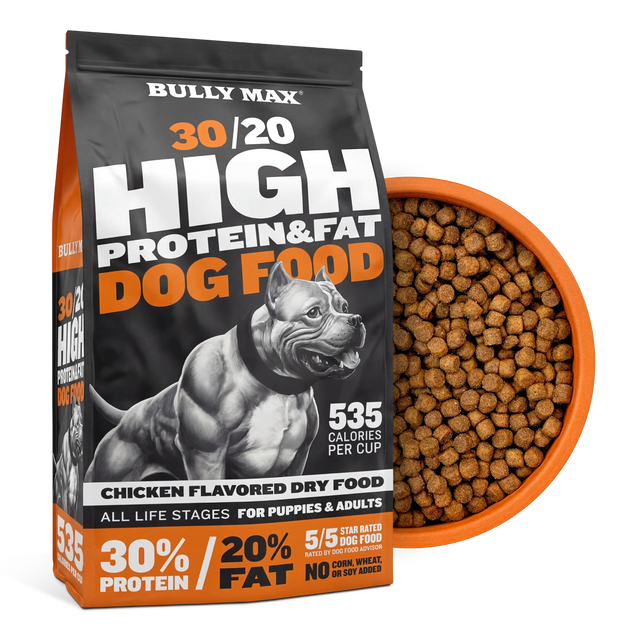
| 30/20 High Protein Chicken | 30% | 20% | 535 | Active adult dogs building lean muscle |
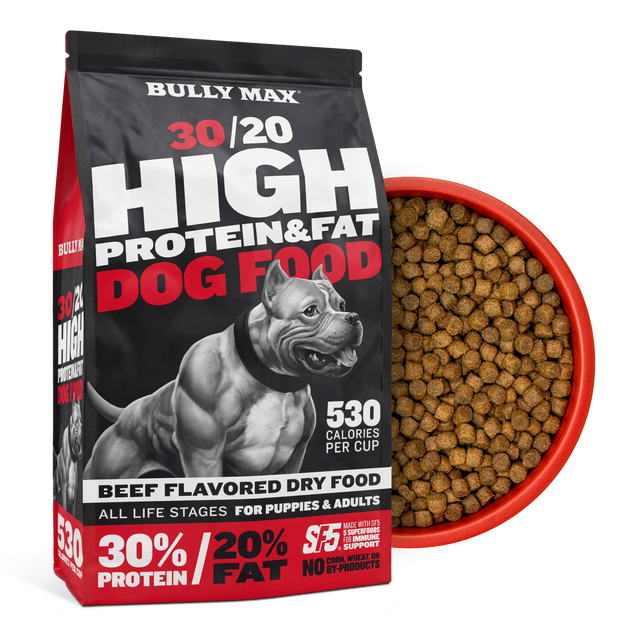
| 30/20 High Protein Beef | 30% | 20% | 530 | Active dogs that need a chicken-free option |
| PRO Series 31/25 High Calorie | 31% | 25% | 600 | Working, sport and hard-to-keep-weight-on dogs |
| 25/11 Lamb (45% less fat) | 25% | 11% | 415 | Less active or weight-conscious adults |
| AAFCO growth minimum (dry matter) | 22.5% | 8.5% | n/a | The floor for any puppy food |
Bully Max figures are guaranteed-analysis minimums, as fed, from each product page. AAFCO minimums are on a dry matter basis, so the as-fed numbers above understate each formula’s dry matter protein and fat.
Our 24/14 puppy formula is complete and balanced for all life stages, and its label states it is formulated to meet the AAFCO Dog Food Nutrient Profiles for all life stages including growth of large size dogs (70 lb or more as an adult). Like every Bully Max dog food, it is suitable for large-breed dogs, including large-breed puppies, under AAFCO guidelines. Not sure when to move on? Read when to switch to adult dog food.
Feed your puppy for steady growth
Bully Max 24/14: 24% protein, 419 calories per cup, real lamb, TruMune. Set it on Autoship and save 10% on every order.
Shop 24/14 Puppy FoodWhat Owners Say About Raising Puppies on Bully Max
Proof first. Bully Max has over 50,000 5/5 reviews and a 5/5 rating from Dog Food Advisor, and has fed millions of dogs. We are a family-owned U.S. company founded in 2009, our food is made in the USA, every batch is triple tested for safety, and we have zero recalls. In our post-purchase survey, the most common reason people chose us was reviews and visible results, and about 5% bought specifically for puppy growth.
“I took a chance, my dogs have reached the breed standard in weight at 7 months. Great muscle and definition.” — Bully Max customer, post-purchase survey
“I tried feeding one pup from a litter of 8 the bully max food to see the difference. I’m very impressed.” — Bully Max customer, post-purchase survey
“My dog has been eating this since he was 6 weeks old. He is now 4 years old and is solid, muscle definition in his legs.” — Bully Max customer, post-purchase survey
Hear from Bully Max owners in their own words:

FOR PICKY PUPPIES: 26/12 WET PUPPY FOOD
Just add water: high-protein wet puppy food with real chicken as the first ingredient. Use it as a topper and count it in the daily total. One bag makes 5.5 lbs.
Is Your Puppy Growing Too Fast or Too Slow?
| Signs of too much | Signs of too little |
|---|---|
| No visible waist; ribs hard to feel | Ribs, hip bones or spine easy to see |
| Gaining faster than the top of the range | Falling below the range or losing weight |
| Soft, large or frequent stools | Always hungry, low energy |
| Leaving food in the bowl | Dull coat, slow growth |
General signs. A puppy that loses weight, stops eating, or has vomiting or diarrhea needs a vet visit, not a food change.
Big puppies that eat too many calories, or too much calcium, can grow faster than their joints can keep up with. A complete puppy food already contains the calcium your puppy needs, so don’t add calcium powders or bone meal on top. If you want a daily puppy supplement, choose one with a small, known amount of calcium and ask your vet first.

OPTIONAL: PUPPY TABS FOR DEVELOPMENT & GROWTH
A daily tab with spirulina, collagen peptides, choline, fish oil and ginger. Give at the label amount only, and ask your vet before adding any supplement to a growing large-breed puppy.
For healthy adult targets once growth is done, see our dog weight chart, and for choosing a food in the first place, our guide to the best puppy food for large and bully-breed puppies.
FAQ
How big will my puppy get?
The best guide is the weight of the parents, then the breed standard. As a rough check during the first five months, a puppy gains about 2 to 4 grams a day for every kilogram of expected adult weight, so a puppy that is 30% to 50% of its expected adult weight at 4 to 5 months is in the typical range.
How much should my puppy weigh at 4 months?
Typically about 24% to 49% of its expected adult weight. For a pit bull expected to reach 50 lb, that is roughly 12 to 24 lb. For a Cane Corso expected to reach 100 lb, roughly 24 to 49 lb. See the breed chart above for more.
How much should I feed my puppy?
Feed by current weight. On Bully Max 24/14, the feeding chart starts at ¾ to 1¼ cups a day for a 5 to 9 lb puppy and 2¼ to 2½ cups for an 18 to 23 lb puppy. Treat these as estimates and adjust to keep your puppy lean.
When do puppies stop growing?
Small and medium breeds usually finish growing at 8 to 12 months. Large and giant breeds take 10 to 16 months, and some keep filling out until about 2 years old.
When should my puppy switch to adult food?
When it is close to adult size, which is about 12 months for medium breeds and 12 to 18 months or more for large breeds. Bully Max 24/14 is complete and balanced for all life stages, so you aren’t forced into an early switch.
Start Your Puppy on the Right Food
Know the target, weigh every couple of weeks, feed measured meals from the chart and keep your puppy lean. For bully and large-breed puppies, start with Bully Max 24/14 High Protein & Growth Puppy Food, add 26/12 Wet Puppy Food for a picky eater, or browse our high protein puppy food collection.
Try it for 30 days on Autoship
Puppies go through food fast. Put 24/14 on Autoship, save 10% on every order and never run out mid-growth spurt.
Start Autoship and save 10%Sources
- Merck Veterinary Manual, “Feeding Practices in Small Animals” (puppy growth rate of 2 to 4 g/day per kg of anticipated adult weight in the first 5 months; growth completed by 8 to 12 months in small and medium breeds and 10 to 16 months in large and giant breeds).
- Salt C, et al. “Growth standard charts for monitoring bodyweight in dogs of different sizes.” PLOS ONE, 2017 (larger breeds take up to 24 months to reach adult bodyweight).
- VCA Animal Hospitals, “Nutritional Requirements of Large and Giant Breed Puppies” (up to two years to adult weight; treats under 10% of calories).
- AAFCO Dog Food Nutrient Profiles (large size = 70 lb or more as an adult; growth minimums).
- Breed standards: UKC American Pit Bull Terrier; FCI no. 343 Cane Corso Italiano; FCI no. 101 and AKC French Bulldog.
- Bully Max 24/14 High Protein & Growth Puppy Food product page (feeding chart, 419 kcal per cup).