What Does 30/20 Dog Food Mean? Protein, Fat and Calories Explained
30/20 dog food is a dry food with a guaranteed analysis of at least 30% crude protein and 20% crude fat. Those two numbers are printed on the bag, and together they tell you the food is built for muscle, energy and weight rather than for a couch dog. Bully Max 30/20 is the formula that made the term common among bully-breed owners: 30% protein, 20% fat and 535 calories per cup, meat-based and made in the USA. This guide explains what the numbers mean, how 30/20 compares with a typical adult kibble, which dogs it fits, and how much to feed.
Family-owned since 2009 · Made in USA · Every batch triple tested · Zero recalls · 50,000+ 5-star reviews · Dog Food Advisor 5/5
Where the Numbers Come From
Every bag of dog food sold in the United States carries a guaranteed analysis. It lists minimum crude protein, minimum crude fat, maximum crude fiber and maximum moisture, as fed. "30/20" is shorthand for the first two lines: protein 30% minimum, fat 20% minimum. It is not a brand name and it is not a feeding ratio. Several performance foods use the same shorthand because it is the fastest way to say "high protein, high fat".

For scale, AAFCO's nutrient profile for adult maintenance calls for a minimum of 18% protein and 5.5% fat on a dry-matter basis, and 22.5% protein and 8.5% fat for growth and reproduction. A 30/20 food clears both by a wide margin. That is the point. It is formulated for dogs that use the extra protein and fat: working dogs, sport dogs, hard keepers, intact males, dogs in training and dogs that need to put on healthy weight.
What 30% Protein Does
Protein supplies the amino acids a dog uses to build and repair muscle, grow coat, make immune cells and recover from work. A dog cannot store amino acids the way it stores fat, so the supply has to come in every day. Ten amino acids are essential for dogs, meaning they must come from food. Meat proteins supply all of them in usable proportions, which is why the source of the protein matters as much as the percentage. Bully Max 30/20 is meat-based with real chicken; the Beef recipe starts with beef meal and is chicken-free.
Thirty percent is roughly a third more protein than the 22 to 24% found in many adult kibbles. For a 60 lb dog eating 2.5 cups a day, that is about 25 grams of extra protein every day compared with a 23% food fed at the same calories. Our guide to how much protein a dog needs covers the science and the exceptions.
What 20% Fat Does
Fat is the dense fuel. Pet food labels count 8.5 calories per gram of fat against 3.5 per gram of protein or carbohydrate, so raising fat from 12% to 20% adds calories without adding bulk. A 20% fat food usually lands between 500 and 560 calories per cup; a 12% fat food usually lands between 340 and 400. Fat also carries the fat-soluble vitamins and supplies the omega fatty acids that show up in a dog's coat. Where the fat comes from matters too: chicken fat, beef fat and fish oil are the sources you want to see named.
Fat is also the reason 30/20 is the wrong food for some dogs. A dog that is overweight, inactive, or has a history of pancreatitis should be on a lower-fat food. Read high fat dog food: who it is for and who should skip it before you switch a dog with a medical history.
The Number That Is Not on the Front: Calories per Cup
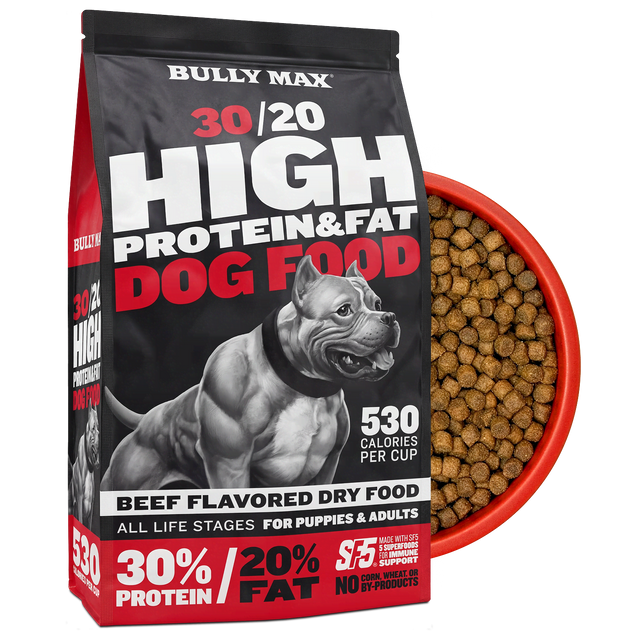
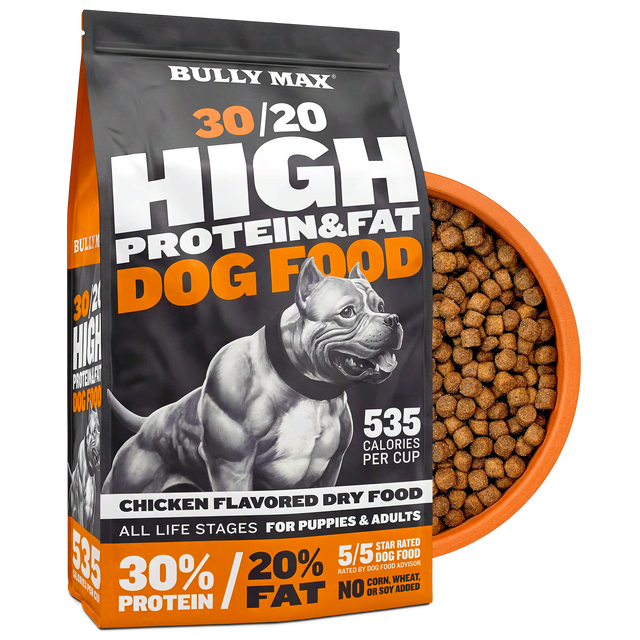
Protein and fat percentages tell you the mix. Calories per cup tell you how much to feed. Two foods can both read 30/20 and differ by 100 calories per cup depending on moisture, fiber and kibble density, so always find the "calorie content" line near the guaranteed analysis. Bully Max 30/20 Chicken is 535 kcal per cup; 30/20 Beef is 530. Here is what that means for a bowl:
| Food | Protein / fat | kcal per cup | Cups per day for a 60 lb moderately active adult (est.) |
|---|---|---|---|
| Typical adult kibble | 23% / 12% | about 350 | about 3.8 |
| Bully Max 30/20 Chicken | 30% / 20% | 535 | about 2.5 |
| Bully Max PRO Series 31/25 | 31% / 25% | 600 | about 2.2 |
Estimates. Daily need for a neutered, moderately active 60 lb adult taken as 1,335 kcal (1.6 x resting energy requirement); your dog's need can run 20% either way. Typical kibble figures are general market ranges, not a specific brand.
A calorie-dense food means a smaller bowl, which helps dogs that fill up before they meet their needs, and it means the bag lasts longer than the price per pound suggests. Use the dog food calculator or the worked example in how much to feed a 60 lb dog to set the first portion, then adjust to body condition every two weeks.
Watch: 30/20 in 30 Seconds
The short version, from the Bully Max channel: what the formula is designed to support and the 535-calorie number that sets the portion.

BULLY MAX 30/20 HIGH-PROTEIN CHICKEN
30% protein, 20% fat and 535 calories per cup from real chicken, with TruMune to support digestion and immune health. No corn, wheat or soy.
Save 10% with autoship on every bag of 30/20.
Which Dogs 30/20 Is For
- Bully breeds and other muscular, short-coated working breeds. American Bullies, pit bulls, Staffies, Cane Corsos, Presas, Mastiff types, Rottweilers, Dobermans, Shepherds and Malinois carry muscle that needs protein to maintain and energy to move. See which dogs are bully breeds.
- Dogs that train, compete or work. Weight pull, protection sports, slat mill and treadmill conditioning, hunting, herding, long daily runs. The handlers in our working-dog guide feed 30/20 or PRO Series in season.
- Hard keepers and underweight dogs. A lean, high-drive dog that eats the chart amount and stays thin needs denser food, not a bigger bowl. Start with is my dog underweight to score body condition first.
- Intact males, nursing dams, dogs in cold weather. All three raise energy needs. Ask your vet about feeding during pregnancy and lactation.
Which dogs it is not for: overweight dogs, inactive seniors, dogs on a vet-prescribed low-fat diet, and dogs with a pancreatitis history. For those, Bully Max 25/11 Lamb (25% protein, 11% fat, 415 calories per cup) keeps the protein up and the fat down.

30/20 Chicken vs 30/20 Beef
Bully Max makes two 30/20 recipes. They share the protein and fat targets and differ in the protein source:
| 30/20 Chicken | 30/20 Beef | |
|---|---|---|
| Protein / fat | 30% / 20% | 30% / 20% |
| Calories per cup | 535 | 530 |
| Protein source | Real chicken | Beef meal first; chicken-free, no pork |
| TruMune postbiotic | Yes | No |
| Grains | No corn, wheat or soy | No corn, wheat or by-products |
From each product's label data on shop.bullymax.com. Chicken-free means no chicken in any form, including natural flavor.
30/20 Beef is formulated to meet AAFCO nutrient profiles for all life stages, including growth of large-size dogs (70 lb or more as an adult). Pick Beef if your dog does better off chicken or you want one bag that covers a large-breed puppy through adulthood. Pick Chicken for the TruMune postbiotic and the slightly higher calorie count. The full breakdown is in chicken vs beef dog food and chicken-free dog food.
How 30/20 Compares With Other Performance Foods
Several brands sell a 30/20 sport formula. Reading them side by side comes down to four lines: first ingredient, calories per cup, what the fat comes from, and what the food does not contain. We did that exercise for Bully Max vs Purina Pro Plan Sport 30/20. The short version: the protein and fat match on paper, and the differences are in ingredients, calorie density and price per feeding.
Every Bully Max formula by protein, fat and calories
30/20 is the middle of the Bully Max range. Here is where it sits:
| Bully Max formula | Protein | Fat | kcal/cup | Best for |
|---|---|---|---|---|
| 30/20 High Protein Chicken | 30% | 20% | 535 | Active adults that need muscle and energy |
| 30/20 High Protein Beef | 30% | 20% | 530 | Dogs that need a chicken-free food; all life stages |
| PRO Series 31/25 High Calorie | 31% | 25% | 600 | Hard keepers, underweight, working and sport dogs |
| 25/11 Lamb, 45% less fat | 25% | 11% | 415 | Less active dogs, weight control, Frenchies and small breeds; chicken-free |
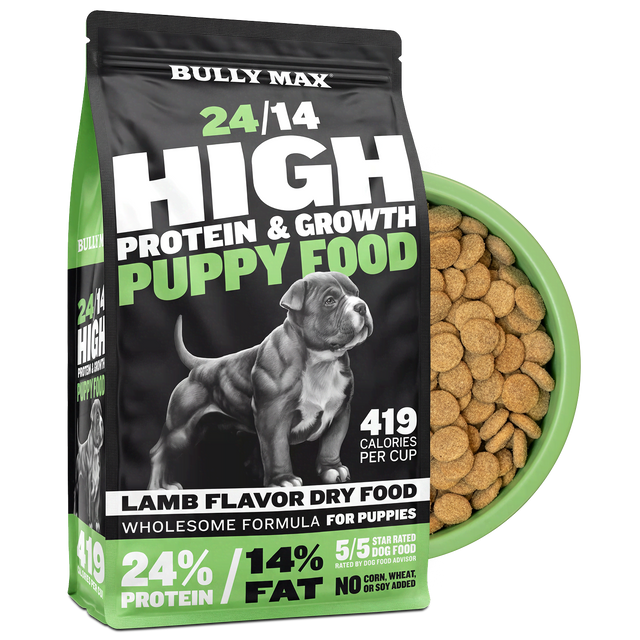
| 24/14 High Protein & Growth Puppy | 24% | 14% | 419 | Puppies, including large-breed puppies |
Protein and fat are guaranteed-analysis minimums; calories per 8 oz cup. Figures from each product's label data on shop.bullymax.com.
In our customers' words
“The ability to provide a protein rich diet to my pup, who is naturally muscular and athletic”
Bully Max customer, post-purchase survey
“I have a big dog and I need a brand that’s made for big dogs”
Bully Max customer, post-purchase survey
“Quality of ingredients and high reviews”
Bully Max customer, post-purchase survey
How to Switch to a 30/20 Food
- Recalculate the portion before day one. Find your current food's calories per cup, multiply by the cups you feed, and divide by 535. Most owners cut the scoop by a third.
- Mix over 7 to 10 days. A quarter new food for two or three days, then half, then three quarters, then all. Hold a step if stool softens.
- Feed two meals a day. A 20%-fat food is easier on the gut in two smaller meals than one large one.
- Judge at six weeks. Coat and energy change first; muscle and weight take 6 to 12 weeks. Weigh every two weeks and adjust the portion 10% at a time.
The day-by-day schedule and the stool guide are in how to switch your dog to Bully Max. Loose stool past two days, vomiting, or a dog that goes off food is a vet call.
FAQ
What does 30/20 mean in dog food?
A guaranteed analysis of at least 30% crude protein and 20% crude fat, as fed. It is shorthand printed by several performance-food brands, not a brand name.
Is 30/20 dog food good for puppies?
Only when the specific product's AAFCO statement covers growth. Bully Max 30/20 Beef is complete and balanced for all life stages including large-breed growth. For a dedicated puppy formula with controlled calcium, Bully Max 24/14 Puppy (419 calories per cup) is the usual choice until 12 to 18 months.
Is 30% protein too much for a dog?
Not for a healthy adult. Dogs digest and use animal protein efficiently, and a 30% meat-based food is well inside the range healthy dogs eat. Dogs with diagnosed kidney or liver disease need a vet-directed diet, so ask first if your dog has a medical history.
How many calories are in 30/20 dog food?
Bully Max 30/20 Chicken is 535 calories per cup and 30/20 Beef is 530. Other 30/20 foods range from about 480 to 560; check the calorie content line on the bag.
Will 30/20 make my dog fat?
Only if the portion is not recalculated. Fed by calories for the dog's target weight, it builds muscle and condition. Fed with the old scoop from a 350-calorie food, it adds about 50% more calories than before.
Is Bully Max 30/20 grain free?
No. Bully Max 30/20 Chicken contains no corn, wheat or soy; 30/20 Beef contains no corn, wheat or by-products. Neither is marketed as grain free.
The Short Answer
30/20 is a label, and a useful one: it means a food built to feed muscle and work. The numbers that decide whether it fits your dog are calories per cup, the protein source and your dog's body condition. If you have a bully breed or a working dog that is lean, active or hard to keep weight on, start with Bully Max 30/20 High Protein Chicken, feed by calories, and judge the result at six weeks. If you want the same protein with less fat, 25/11 Lamb is the step down; if your dog burns through 30/20, PRO Series 31/25 is the step up.
Sources
- AAFCO Dog Food Nutrient Profiles (adult maintenance and growth/reproduction minimums for crude protein and crude fat, dry-matter basis). aafco.org
- WSAVA Global Nutrition Committee, Interpreting Food Labels: modified Atwater factors of 3.5 kcal/g protein, 8.5 kcal/g fat and 3.5 kcal/g carbohydrate. wsava.org
- Merck Veterinary Manual, Nutritional Requirements of Small Animals: essential amino acids for dogs; typical fat content of commercial adult foods. merckvetmanual.com
- Bully Max 30/20 Chicken, 30/20 Beef, PRO Series 31/25, 25/11 Lamb and 24/14 Puppy product pages: guaranteed analysis, calorie content and AAFCO statements.
- Bully Max YouTube: High-Calorie Dog Food Explained: Bully Max 30/20 Stats (RiW3dVAZZb8).
- Bully Max post-purchase survey, Dec 2024 to Jun 2025 (customer quotes).