Best Puppy Food: How to Choose for Large and Bully-Breed Puppies
The best puppy food is a complete and balanced formula for growth, with a named meat first, enough protein and fat to build muscle, and the right calcium for your puppy’s adult size. For large and bully-breed puppies, that last part matters most: the food must cover growth of large-size dogs (70 lb or more as adults) under AAFCO guidelines, and you should feed it in measured amounts to keep growth steady and lean.
Best puppy food at a glance
- Check the AAFCO statement first: it must say “growth” or “all life stages”. For big breeds, it should include growth of large size dogs.
- Look for: a named meat or meat meal first, protein well above the AAFCO growth minimum, moderate fat and a calorie count you can measure against.
- Large and bully breeds: steady, lean growth. No extra calcium on top of a complete food.
- How much: start from the bag and our estimate table below, then adjust to body condition every week or two.
- When to switch: most large and bully breeds stay on puppy food until roughly 12 to 18 months.
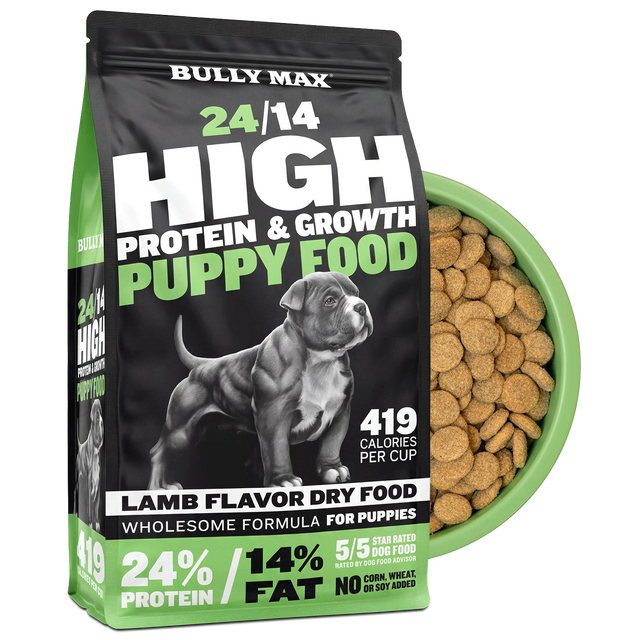
- Our pick: Bully Max 24/14 High Protein & Growth Puppy Food, 24% protein, 14% fat, 419 kcal/cup.
What Makes a Puppy Food the Best?
Most “best puppy food” lists rank brands. A better way to choose is to check the five things that actually decide whether a food fits your puppy. Any food that passes all five is a real contender. Any food that fails the first one is off the list.
1. The AAFCO statement covers growth
Every complete dog food in the U.S. carries a nutritional adequacy statement, usually in small print near the guaranteed analysis. For a puppy, it needs to say the food is formulated for growth or for all life stages. Foods labeled for “adult maintenance” are not designed for puppies.
If your puppy will weigh 70 lb or more as an adult, look for wording that includes growth of large size dogs. AAFCO set a lower calcium ceiling for these foods because big, fast-growing puppies are more sensitive to too much calcium.
2. Real protein from named meat
Puppies build muscle, organs and bone at a pace they will never match again. Ingredients are listed by weight, so the first few lines tell you where most of the protein comes from. Look for a named meat or meat meal, like lamb meal or chicken meal, near the top rather than vague terms like “meat meal” or “animal by-products”. Our guide to dog food ingredients to look for and avoid goes deeper.
3. Protein and fat above the minimum
AAFCO’s minimums for growth are 22.5% protein and 8.5% fat on a dry matter basis. Those are floors, not targets. Most quality puppy foods sit comfortably above them. Active bully breeds generally do well on a food with solid protein and moderate fat, which supports muscle without pushing too many calories into a body that should grow slowly.
4. Calcium and phosphorus in the right range
This is the number most owners never check, and the one that matters most for large breeds. Look at the calcium and phosphorus figures on the label or the manufacturer’s website and compare them with the AAFCO ranges below. If the label doesn’t list them, ask the company.
| Nutrient (dry matter) | AAFCO growth | AAFCO adult maintenance |
|---|---|---|
| Protein, minimum | 22.5% | 18% |
| Fat, minimum | 8.5% | 5.5% |
| Calcium | 1.2% minimum; 1.8% maximum for large-size growth (2.5% for other puppies) | 0.5% minimum |
| Phosphorus | 1.0% minimum | 0.4% minimum |
| Calcium to phosphorus ratio | 1:1 to 2:1 | 1:1 to 2:1 |
Source: AAFCO Dog Food Nutrient Profiles. Label guaranteed analyses are “as fed”, so dry matter values are a little higher than the bag numbers.
5. Calories you can measure
Calories per cup range widely between puppy foods. A food with the calories printed clearly lets you feed accurately and adjust as your puppy grows. Higher calories are not automatically better for a growing large breed. What matters is feeding the right total each day.
Large and Bully-Breed Puppies: What’s Different
About two thirds of the Bully Max customers we surveyed own American Bullies, pit bulls or Staffies, and another 10% own Cane Corsos. Those breeds range from mid-sized to giant, and that size range is why one puppy food rule doesn’t fit all.
Grow them steady, not fast
Big puppies can grow too fast when they eat too many calories or too much calcium. Rapid growth puts extra stress on developing joints. The goal is a lean puppy that follows its genetic growth curve, not the heaviest puppy in the litter. You should be able to feel the ribs easily under a thin layer of cover and see a waist from above.
Don’t add calcium to a complete food
A complete puppy food already contains the calcium your puppy needs. Adding calcium powders, bone meal or large amounts of dairy can push the total past the safe range for large breeds. If you think your puppy needs a supplement, talk to your vet first.
Which size is your puppy?
AAFCO defines a large-size dog as one expected to weigh 70 lb or more as an adult. XL American Bullies, Cane Corsos, Rottweilers and many mastiff breeds land there. Many standard American Bullies, American Pit Bull Terriers and AmStaffs finish below 70 lb, while Staffordshire Bull Terriers and pocket bullies are smaller still. When in doubt, choose a food that covers large-size growth. It works for medium puppies too.

For breed-by-breed detail, see our guides to large breed puppy food, the best pitbull puppy food, American Bully puppy food and weight chart, Rottweiler puppy food and the best dog food for Cane Corsos.
Dry vs. Wet Puppy Food
Both can be complete and balanced. The right choice depends on your puppy and your routine.
| Dry puppy food | Wet puppy food | |
|---|---|---|
| Calories per serving | Dense: more calories per cup, easy to measure | Lower per bite once water is added |
| Taste and picky eaters | Most puppies eat it happily | Strong aroma, often wins over fussy puppies |
| Hydration | Puppy drinks water separately | Adds water to the diet |
| Cost and storage | Usually lower cost per day, keeps well sealed | Usually higher cost per day; prepared food must be refrigerated or thrown out |
| Best use | The everyday base diet | A topper, a mixed bowl, or a full meal for picky puppies |
General comparison. Whatever mix you choose, count the calories from both so the daily total stays on target.
Many owners feed dry food as the base and add a spoonful of wet food on top for a puppy that is slow to finish its bowl. That works well as long as you cut back the dry portion to make room for the extra calories.
How Much to Feed a Puppy
Start with the feeding guide on the bag, then fine-tune with your hands and eyes. Every puppy is different, and growth spurts, activity and spay or neuter status all change how much food your puppy needs. The table below shows estimated daily calories by current weight, and what that means in cups of Bully Max 24/14 at 419 calories per cup.
| Puppy’s weight today | Under 4 months (estimate) | 4 months to adult (estimate) |
|---|---|---|
| 5 lb | 390 kcal · 0.9 cups | n/a |
| 10 lb | 650 kcal · 1.6 cups | 440 kcal · 1.0 cups |
| 15 lb | 880 kcal · 2.1 cups | 590 kcal · 1.4 cups |
| 20 lb | 1,100 kcal · 2.6 cups | 730 kcal · 1.7 cups |
| 30 lb | 1,490 kcal · 3.6 cups | 990 kcal · 2.4 cups |
| 40 lb | 1,850 kcal · 4.4 cups | 1,230 kcal · 2.9 cups |
| 50 lb | n/a | 1,450 kcal · 3.5 cups |
| 60 lb | n/a | 1,670 kcal · 4.0 cups |
Estimates only, using a standard formula (resting energy × 3 under 4 months, × 2 from 4 months) and 419 kcal per 8 oz cup of Bully Max 24/14. Large-breed puppies often do best toward the lower end. Adjust every week or two to keep your puppy lean, and check with your vet.
Example: a 30 lb puppy at five months needs roughly 990 calories a day by this estimate, or about 2.4 cups of 24/14, split into three meals. If your puppy is getting round, trim the amount by about 10%. If the ribs and hip bones start to show, add about 10%. For a quick personal estimate, try our dog food calculator.

How many meals a day?
| Age | Meals per day |
|---|---|
| 8 to 12 weeks | 4 |
| 3 to 6 months | 3 |
| 6 months and older | 2 |
A common schedule. Large breeds often stay on 2 meals a day for life, which also avoids one huge meal.
Treats count too. Keep them to about 10% of daily calories and use them mostly for training. Our puppy schedule guide shows how to fit meals into the rest of your puppy’s day.
When to Switch From Puppy to Adult Food
Switch when your puppy is close to adult size, not on a fixed birthday. Small breeds finish growing first, giant breeds last.
| Expected adult size | Typical switch age |
|---|---|
| Small (under 25 lb) | About 9 to 12 months |
| Medium (25 to 50 lb) | About 12 months |
| Large (50 to 90 lb) | About 12 to 18 months |
| Giant (over 90 lb) | About 18 to 24 months |
General ranges. Your vet can help you time it based on your puppy’s growth.
Make the change over 7 to 10 days by mixing the new food in gradually. Our full guide on when to switch to adult dog food walks through the signs and the transition.
Our Pick: Bully Max 24/14 High Protein & Growth Puppy Food
Proof first. Bully Max has over 50,000 5/5 reviews, a 5/5 rating from Dog Food Advisor, and has fed millions of dogs. We’re a family-owned U.S. company founded in 2009. Our food is made in the USA, every batch is triple tested for safety, and we have zero recalls.
Our 24/14 puppy formula was built for the same bully and large-breed puppies most of our customers raise. It is complete and balanced for all life stages, and suitable for large-breed dogs, including large-breed puppies, under AAFCO guidelines.

| Bully Max 24/14 Puppy | |
|---|---|
| Protein / fat (min) | 24% / 14% |
| Calories | 419 kcal per cup |
| Main protein | Lamb meal, with pork |
| Life stage | Complete and balanced for all life stages, including growth of large-breed puppies |
| Gut and immune support | TruMune, a postbiotic that helps support digestion and immune health |
| Sizes | 5, 10, 15, 20, 30 and 40 lb bags |
From the 24/14 product page. Always check the bag in your hands for the current label.
Why owners choose it:
- Protein for growth. 24% protein with lamb meal first supports lean muscle as your puppy grows.
- Calories you can control. At 419 calories per cup, it’s easy to measure and adjust as your puppy grows.
- One food, puppy to adult size. Because it covers all life stages, you aren’t forced into an early switch.
- Picky puppies eat it. About 14% of our surveyed customers said a reason they buy is that their picky dog finally eats, and about 5% bought specifically for puppy growth.
“Researched a bunch of puppy food and decided to give this one a shot and she loves it” (Bully Max customer, post-purchase survey)
“My dog has been eating this since he was 6 weeks old. He is now 4 years old and is solid, muscle definition in his legs.” (Bully Max customer, post-purchase survey)
Hear from Bully Max owners in their own words:

START YOUR PUPPY ON BULLY MAX 24/14
Lamb meal first, 24% protein, 14% fat and 419 calories per cup, with TruMune to support digestion and immune health. Suitable for large-breed puppies under AAFCO guidelines.
For picky puppies: 26/12 Wet Puppy Food
Some puppies need a little help at the bowl, especially in the first weeks at home. Bully Max 26/12 Wet Puppy Food is a dry mix you prepare with water, so you make only what you need. Real chicken is the first ingredient, with 26% protein and 592 calories per cup of dry mix before water is added. Use it as a topper on 24/14 or as a full meal, and count its calories in the daily total.

MAKE MEALTIME EASIER FOR PICKY PUPPIES
Just add water: high-protein wet puppy food with real chicken as the first ingredient. One bag makes 5.5 lbs.
Do Puppies Need Supplements?
Most puppies eating a complete and balanced puppy food don’t need supplements. The food is designed to cover their needs. Some owners still like to add a daily puppy supplement for extra support, and that’s a conversation to have with your vet, especially for large breeds. If you want to know what a daily multivitamin actually contains and what puppy vitamins should and should not include, read our guide to dog vitamins and multivitamins.
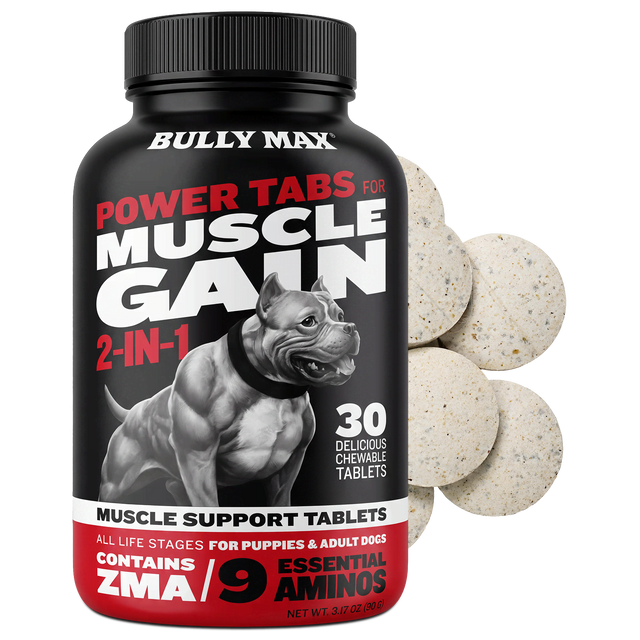
Bully Max Puppy Tabs for Development & Growth are a supplement, not a food. Each tab includes spirulina, collagen peptides, choline, fish oil, turmeric and ginger, plus a small amount of calcium (45 mg per tab). Give them at the label amount only, and don’t combine them with other calcium supplements.

SUPPORT HEALTHY PUPPY GROWTH
An optional daily tab with spirulina, collagen peptides, choline, fish oil and ginger. Ask your vet before adding any supplement to a growing puppy.
Common Puppy Feeding Mistakes
- Free-feeding. Leaving food out all day makes it hard to know how much your puppy eats and easy to overfeed. Feed measured meals.
- Feeding an adult-only food. Check the AAFCO statement. It should say growth or all life stages.
- Chasing size with calories. A heavier puppy is not a stronger puppy. Lean growth is the goal for big breeds.
- Adding calcium. A complete food already has it. Extra can do harm in large breeds.
- Switching foods often. Constant changes upset young stomachs. Pick a good food and stick with it. If you do switch, follow a slow plan like our guide on how to switch your dog to Bully Max.
- Ignoring the scale. Weigh your puppy every couple of weeks and adjust portions. For healthy-weight targets, see our dog weight chart.
If your puppy has diarrhea, vomiting, low energy or stops eating, call your vet. Puppies can get dehydrated quickly. For more on early care, see our beginner’s guide to puppy health.
Choose the Best Food for Your Puppy
Start with the label: growth or all life stages, large-size growth for big breeds, named meat first, solid protein and clear calories. Then feed measured meals, keep your puppy lean and switch to adult food when your puppy is close to full size.
- Large or bully-breed puppy? Start with 24/14 High Protein & Growth Puppy Food.
- Picky puppy? Add 26/12 Wet Puppy Food as a topper.
- Want everything in one place? Browse our high protein puppy food collection.
Puppies go through food fast. Set your puppy’s food on Autoship and save 10% so you never run out mid-growth spurt.
FAQ
What is the best puppy food?
The best puppy food is complete and balanced for growth or all life stages, lists a named meat first, has protein and fat comfortably above the AAFCO growth minimums, and fits your puppy’s adult size. For puppies expected to reach 70 lb or more, choose a food that covers growth of large size dogs. Bully Max 24/14 is our pick for large and bully-breed puppies.
How much food should a puppy eat?
It depends on weight, age and activity. As an estimate, a 20 lb puppy under 4 months needs about 1,100 calories a day, and a 40 lb puppy over 4 months needs about 1,230 calories a day. Use the table above as a starting point, split the total into 3 or 4 meals, and adjust to keep your puppy lean.
How long do puppies eat puppy food?
Until they are close to adult size: about 9 to 12 months for small breeds, around 12 months for medium breeds, 12 to 18 months for large breeds and up to 24 months for giant breeds. A food complete for all life stages, like Bully Max 24/14, can be fed beyond that if it suits your dog.
Can adult dogs eat puppy food?
Adult dogs can eat a food labeled for all life stages. A growth-only puppy food is usually higher in calories than an adult dog needs, so watch the portion and your dog’s weight.
Can puppies eat adult dog food?
Only if the food is labeled for growth or all life stages. A food labeled only for adult maintenance may not meet a puppy’s needs, and for large breeds the calcium level matters too. Check the AAFCO statement on the bag.
Is grain-free puppy food better?
Not for most puppies. Grain allergies are less common in dogs than reactions to animal proteins, and in 2018 the FDA began looking into reports of heart disease (DCM) in dogs eating many grain-free diets. Bully Max foods are not grain-free. If your vet has a specific reason to avoid a grain, follow that advice.
Questions about feeding your puppy? Tell us about your puppy in the comments below.