How to Choose a Vet-Reviewed Dog Food: AAFCO Labels, Feeding Trials and What Really Matters
Every bag of dog food says "complete and balanced." Fewer can tell you who checked that claim, how they checked it, and whether the formula fits the dog in front of you.
This guide breaks down what AAFCO labels actually mean, the difference between feeding trials and formulated diets, why veterinary review matters, and how to match calories and protein to your dog's workload. We'll use Bully Max as a working example, including where our formulas stand on each point.

5 things to check on any dog food
- The AAFCO statement. It should say "complete and balanced" for your dog's life stage.
- How it was substantiated. Formulated to meet AAFCO nutrient profiles, or tested in an AAFCO feeding trial.
- Who reviewed the formula. Look for a named veterinarian or board-certified veterinary nutritionist.
- Calories per cup. Active, working and hard-to-keep-weight-on dogs need more energy per scoop.
- Safety record and manufacturing. Where it's made, how it's tested, and whether the brand has had recalls.
What "Complete and Balanced" Actually Means
The Association of American Feed Control Officials (AAFCO) publishes nutrient profiles for dogs. They set minimum levels, and some maximums, for the protein, fat, vitamins and minerals a dog needs from its daily diet.
According to the FDA, a dog food can support a "complete and balanced" claim in one of two ways: it meets an AAFCO nutrient profile, or it passes a feeding trial using AAFCO procedures.
The claim is also tied to a life stage:
- Growth and reproduction covers puppies and pregnant or nursing females.
- Adult maintenance covers grown dogs.
- All life stages means the food meets the growth profile, so it can be fed from puppyhood through adulthood.
Treats, toppers and supplements usually aren't complete and balanced. They aren't meant to be a dog's only food.
Note: AAFCO doesn't approve or certify individual dog foods. It sets the standards that brands and regulators use.
Before we go further, a quick note on fuel: if your dog needs more strength and energy from the bowl, a meat-based, high-protein food is the simplest place to start.

FUEL YOUR DOG WITH BULLY MAX 30/20 HIGH-PROTEIN FOOD
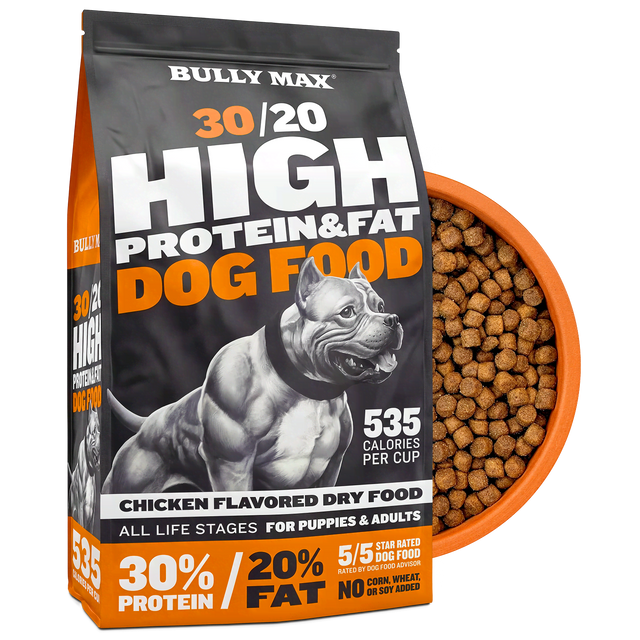
Fuel strength and energy with meat-based nutrition, 30% protein, 20% fat, and 535 calories per cup.
Feeding Trials vs. Formulated to Meet AAFCO
This is where most dog food marketing gets fuzzy, so here's the plain version.
Formulated to meet AAFCO. The recipe is built and checked against AAFCO's nutrient profiles, typically confirmed by nutrient analysis and expert review. This is how most dog foods on the market are substantiated.
AAFCO feeding trial. The finished food is fed to a group of dogs for a set period under AAFCO's protocol while veterinarians monitor health markers. Some veterinary schools, including NC State, call this the gold standard because it tests the food in real dogs.
Both routes are legitimate. The difference is what's being proven: a formulated diet proves the nutrient numbers are right; a feeding trial also shows how dogs do on the food over the trial period.
Where Bully Max stands: our dry and wet formulas are formulated to meet or exceed AAFCO Dog Food Nutrient Profiles and independently reviewed by veterinarians. Separately, a key ingredient in two of our dry foods, TruMune®, has its own published research in dogs, which we cover below.
Who Reviewed the Formula? Why It Matters
A label can say "vet approved" without naming anyone. Ask for names and credentials.
- DVM is a Doctor of Veterinary Medicine.
- DACVN means Diplomate of the American College of Veterinary Nutrition: a board-certified veterinary nutritionist.
Here's who reviewed Bully Max formulas, and when:
- September 21, 2022: our Puppy formula and 30/20 Performance formula were reviewed by Abrar Ahmad, DVM, RVMP.
- September 1, 2021: our dehydrated chicken formula, now part of our 26/12 wet food line, was reviewed by Renee Streeter, DVM, DACVN, a board-certified veterinary nutritionist. Her review compared the formulas to current AAFCO standards for the intended species and life stage and confirmed that all ingredients are defined.
Check Calories, Not Just Protein
Protein gets the headlines, but calories decide how much you feed and whether your dog holds weight. A high-drive dog that trains, pulls, runs or works burns far more than a couch dog of the same size. If the food is low in calories, you end up feeding huge portions, or your dog loses condition. For portion sizes by weight and activity, see how much to feed your dog.
Look for kcal per cup on the bag. Here's how our dry formulas compare:
| Formula | Protein | Fat | kcal / cup | Best for |
|---|---|---|---|---|
| PRO Series 31/25 | 31% | 25% | 600 | Hard keepers, heavy training, weight gain |
| 30/20 Chicken | 30% | 20% | 535 | Active and working dogs, muscle maintenance |
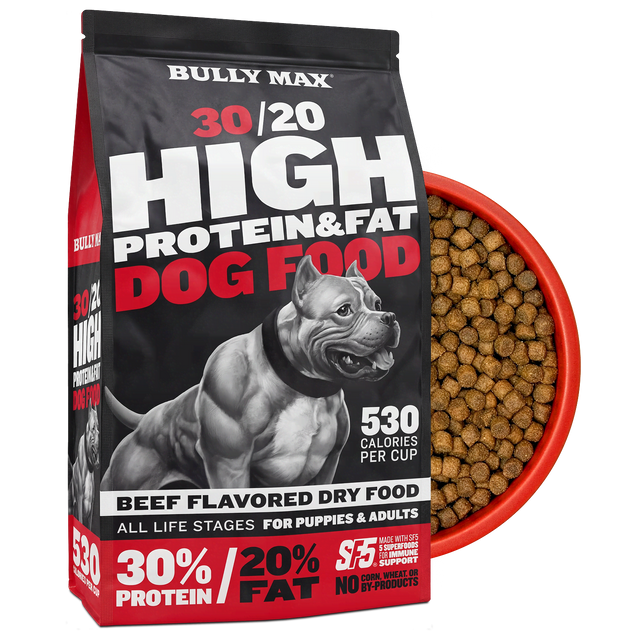
| 30/20 Beef | 30% | 20% | 530 | Active dogs that need chicken-free |
| 25/11 Lamb | 25% | 11% | 415 | Chicken-sensitive dogs, lower-fat diets |
Protein and fat are guaranteed minimums. Calories are per 8 oz cup.
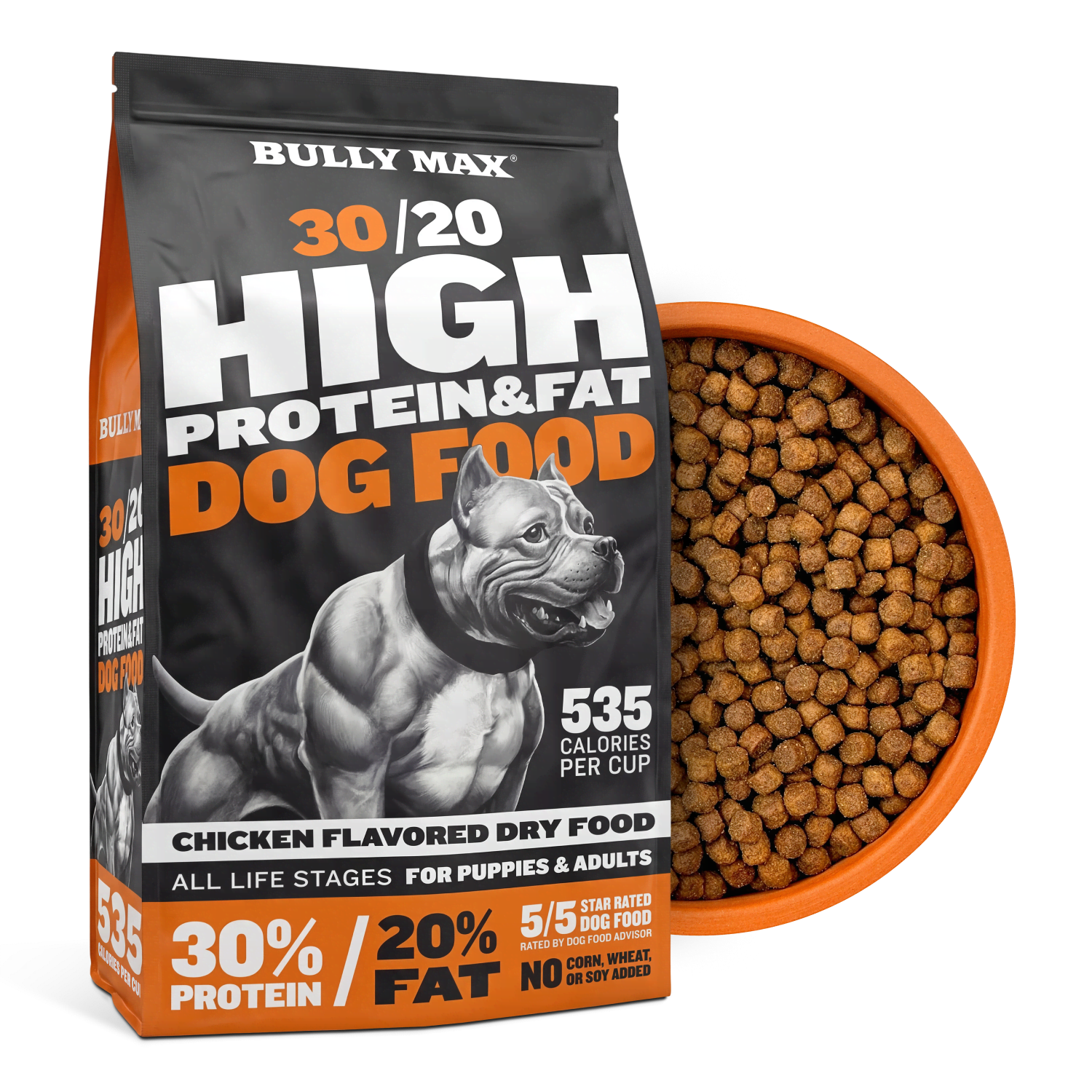
TRY BULLY MAX 30/20 HIGH-PROTEIN DOG FOOD
Fuel strength and energy with meat-based nutrition, 30% protein, 20% fat, and 535 calories per cup.
Match the Food to Your Dog
There's no single best dog food for every dog. Start with your dog's age, activity level and any sensitivities, then pick the formula built for that job.
Hard keepers and dogs that need to gain weight
Some dogs burn through food: high-drive athletes, dogs in heavy conditioning, or dogs coming back from a rough patch. A calorie-dense food lets you add weight and muscle without doubling portions. Check with your vet first if weight loss was unexplained.

PRO SERIES 31/25: 600 CALORIES PER CUP
Our most calorie-dense formula, with 31% protein and 25% fat for working and sport dogs.
Dogs that don't do well on chicken
Chicken is the most common protein in dog food, so a dog that doesn't tolerate it has fewer options. A food built on a different protein, with no poultry ingredients, is the simplest switch. Your vet can help confirm whether chicken is actually the problem.
Pick by workload: 30/20 Beef for active dogs that need the full 530 calories per cup, or 25/11 Lamb for dogs that need less fat.
Puppies
Puppies need a food that meets AAFCO's growth profile, not just adult maintenance. Feed measured meals, track weight weekly, and ask your vet about a target growth curve, especially for breeds expected to be large as adults.

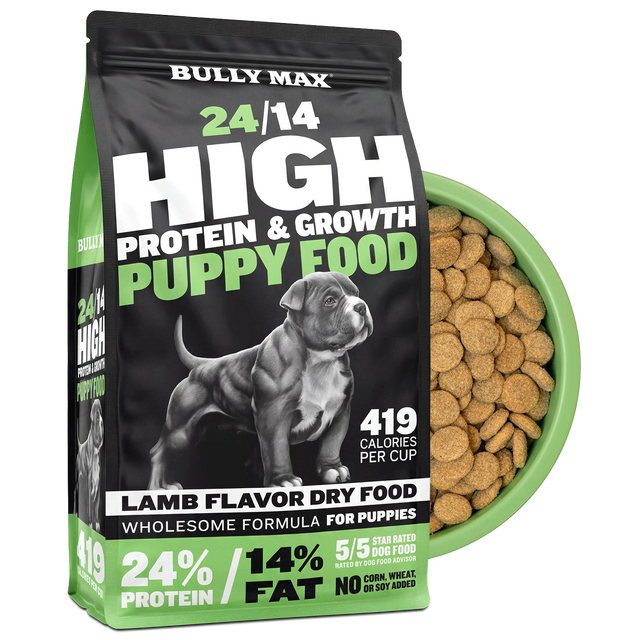
GIVE YOUR PUPPY BULLY MAX 24/14 PUPPY FOOD
Made for growing puppies with 24% protein, real lamb, and TruMune to support digestion and immune health.
Ingredient Research: TruMune® in Dogs
Feeding trials test a whole food. Ingredient studies test one component. Both are useful, and it's worth knowing which one a brand is talking about.
Two Bully Max foods (30/20 High Protein Chicken and 24/14 Puppy) include TruMune®, a yeast-based fermentation product. Researchers at the University of Illinois studied it in adult dogs:
- Design: 16 adult English Pointers, randomized crossover, 10-week feeding periods, control diet vs. the same diet with TruMune.
- Digestion: stool quality stayed stable in TruMune-fed dogs, while control dogs had looser stools.
- Immune and oxidative markers: TruMune-fed dogs held steadier than controls on markers of immune stress and oxidative stress.
- Skin and coat: a companion study reported higher skin oil (sebum) levels and increased antioxidant activity in blood.

These studies were on the ingredient, not on Bully Max food itself.
Questions to Ask Any Dog Food Company
The World Small Animal Veterinary Association (WSAVA) suggests owners ask brands direct questions before choosing a food. Any company should be able to answer these:
- Who formulates your foods, and what are their credentials?
- Is the food formulated to meet AAFCO profiles, or has it been through an AAFCO feeding trial?
- Where is the food made, and what quality-control steps do you use?
- What's the calorie content per cup?
- Have any of your products been recalled?
Our answers: our formulas were reviewed by the veterinarians named above and are formulated to meet or exceed AAFCO nutrient profiles. We're a family-owned U.S. company founded in 2009. Our food is made in the USA in FDA-registered facilities with globally sourced ingredients, and every batch is triple tested for safety. Calories are listed on every product page and in the table above. We've had zero recalls. Our 30/20 formula is rated 5/5 by Dog Food Advisor.
See how Bully Max is made, from ingredients to bag:
TRY BULLY MAX 30/20 HIGH-PROTEIN DOG FOOD
Fuel strength and energy with meat-based nutrition, 30% protein, 20% fat, and 535 calories per cup.
How to Switch Your Dog's Food
Changing food too fast is the most common cause of an upset stomach. Switch over about 7 days:
- Days 1-2: 25% new food, 75% old food
- Days 3-4: 50% new, 50% old
- Days 5-6: 75% new, 25% old
- Day 7: 100% new food
If your dog has a sensitive stomach, stretch each step out a few extra days.
Ready to put this into practice? Start your dog on a meat-based, high-protein food made in the USA by a family-owned company, with every batch triple tested for safety.
READY TO SWITCH? TRY BULLY MAX 30/20 HIGH-PROTEIN FOOD
Fuel strength and energy with meat-based nutrition, 30% protein, 20% fat, and 535 calories per cup.
Frequently Asked Questions
Is Bully Max AAFCO approved?
AAFCO doesn't approve individual dog foods. It sets nutrient profiles. Bully Max formulas are formulated to meet or exceed AAFCO Dog Food Nutrient Profiles and were reviewed by veterinarians.
How are Bully Max formulas checked?
Our formulas are formulated to meet or exceed AAFCO Dog Food Nutrient Profiles and reviewed by named veterinarians, including a board-certified veterinary nutritionist for our wet food. Every batch is triple tested for safety. TruMune®, an ingredient in two of our dry foods, has its own published research in dogs.
How many calories are in Bully Max?
Our dry formulas range from 415 kcal per cup (25/11 Lamb) to 600 kcal per cup (PRO Series 31/25). The 30/20 has 535 kcal per cup.
Which Bully Max food is chicken-free?
Two: 30/20 Beef and 25/11 Lamb.
Is high-protein dog food safe for all dogs?
Most healthy dogs handle high-protein diets well, especially active dogs. Dogs with kidney disease or other medical conditions may need a specific diet, so check with your vet.
The Bottom Line
A good dog food should be able to show its work: a clear AAFCO statement, named reviewers, honest calorie numbers and a clean safety record. Use the checklist above on any brand, including ours, then pick the formula that fits your dog's age, activity and sensitivities.
Not sure where to start? Compare all Bully Max dog foods.
Sources: FDA: "Complete and Balanced" Pet Food · NC State Veterinary Hospital: Evaluating Pet Food · WSAVA: Selecting a Pet Food · AAFCO