Best Large Breed Puppy Food: What to Feed, How Much and When to Switch
The best large breed puppy food is a complete puppy formula that meets AAFCO’s growth profile for dogs expected to weigh 70 pounds or more as adults. In practice that means controlled calcium, enough quality protein, and measured meals that keep your puppy lean so the skeleton grows at a steady pace. Feed it until your puppy is close to adult size, usually 12 to 18 months for large breeds and up to 24 months for giants.
Large breed puppy feeding at a glance
- Who needs it: any puppy expected to reach about 70 lb or more as an adult. Many owners play it safe from about 50 lb.
- What to look for: an AAFCO statement for growth that includes large size dogs (70 lb or more as an adult)
- Protein: at least 22.5% on a dry matter basis (the AAFCO growth minimum). The large-size rule limits calcium, not protein.
- Calcium: no added calcium supplements. A complete food already has what a growing puppy needs.
- Meals: 3 to 4 measured meals a day until about 6 months, then 2 to 3. No free feeding.
- Body condition: ribs easy to feel, a visible waist. Lean beats big.
- Switch to adult food: about 12 to 18 months for large breeds, up to 24 months for giants
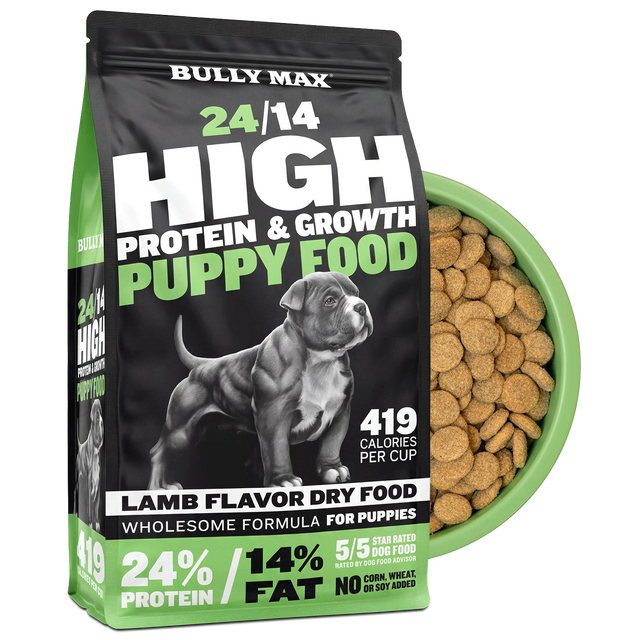
- Our pick: Bully Max 24/14 High Protein & Growth Puppy Food, 419 kcal/cup, suitable for large-breed puppies under AAFCO guidelines

Nutrition does a lot of the work here. A food built for growth gives your large-breed puppy the protein and calories a growing body needs, with TruMune to support digestion and immune health.

START YOUR PUPPY ON BULLY MAX 24/14 PUPPY FOOD
Made for growing puppies with 24% protein, real lamb, and TruMune to support digestion and immune health.
What Makes a Puppy Food “Large Breed”?
“Large breed” on a puppy food bag is not just marketing. AAFCO, the group whose nutrient profiles U.S. pet foods are built around, has a specific growth standard for large size dogs, defined as dogs expected to weigh 70 pounds or more as adults. A food that meets it says so in the nutritional adequacy statement on the bag, with wording like “including growth of large size dogs (70 lb. or more as an adult).”

RAISING A BULLY PUPPY?
See the Bully puppy feeding guide
The 24/14 Puppy formula, how much to feed by age and weight, and when to switch to adult food.
50,000+ five-star reviews
The biggest difference between that standard and the regular growth standard is calcium. Large size puppies get a lower ceiling on calcium, because big, fast-growing skeletons are more sensitive to getting too much of it. The rest of what a big puppy needs is the same as any puppy: complete and balanced nutrition, enough quality protein for growing muscle, essential fatty acids such as DHA, and the right number of calories.
So the label check is simple:
- Look for a growth claim. A food labeled only for “adult maintenance” is not made for puppies.
- Look for the large-size wording. “Growth” or “all life stages” alone is not enough for a big puppy unless the statement also covers large size dogs, or the brand confirms the food is suitable for them.
- Look at the first ingredients. A named animal protein near the top of the list gives growing muscle what it needs.
Every Bully Max dog food is suitable for large-breed dogs, including large-breed puppies, under AAFCO guidelines. That includes 24/14 Puppy, our growth formula, and 30/20 Beef, which is formulated to meet AAFCO Dog Food Nutrient Profiles for All Life Stages, including growth of large size dogs (70 lb. or more as an adult).
Does My Puppy Count as Large Breed?
Go by expected adult weight, not current size or breed name. If you don’t know your puppy’s parents, ask your vet for an estimate. When in doubt, treat a puppy that could reach 50 to 70 pounds as large breed. There is little downside to controlled growth, and a lot of downside to growing too fast.
| Breed | Typical adult weight | Use large-breed puppy rules? |
|---|---|---|
| Cane Corso | about 88-110 lb | Yes |
| Rottweiler | about 80-135 lb | Yes |
| Doberman Pinscher | about 60-100 lb | Yes |
| German Shepherd | about 50-90 lb | Yes |
| Great Dane, Mastiff, Boerboel, Presa Canario | 100 lb and up (giant) | Yes, and expect a longer growth period |
| XL American Bully | varies widely; many reach 70 lb or more | Yes, for most XLs |
| Standard American Bully, pit bull, AmStaff | often 40-70 lb | Often borderline. Use them if the parents are big. |
Approximate ranges based on published breed standards; males usually run larger than females. Individual dogs vary.
Comparing formulas? Start with our guide to the best puppy food. Have a specific breed in mind? See our breed guides for American Bully puppy food, Rottweiler puppy food (and the best dog food for Rottweilers once they are grown), the best dog food for Cane Corsos and the best dog food for Dobermans.
If you want a large-breed puppy food that also brings the protein and calories bully and guardian breeds need, this is the one we built for growing dogs.
FEED YOUR BIG PUPPY BULLY MAX 24/14
Lamb meal first, 24% protein, 14% fat and 419 calories per cup, with TruMune to support digestion and immune health. Suitable for large-breed puppies under AAFCO guidelines.
Protein in Large Breed Puppy Food: How Much Is Enough?
Protein is the part of large breed puppy food that gets the most mixed advice. An older idea held that a high-protein food makes big puppies grow too fast and strains their joints. Feeding research in large and giant breeds has not supported that. A 1991 study published in The Journal of Nutrition raised Great Dane puppies on diets with about 15%, 23% and 32% protein (dry matter) and found no difference in skeletal development between the groups. The drivers of developmental bone and joint problems in big puppies are excess calories and excess calcium, not protein.
AAFCO’s growth and reproduction profile sets a protein minimum of 22.5% crude protein on a dry matter basis, with no separate ceiling for large size dogs. In other words, the large-size rule in the AAFCO statement is about calcium. Protein is what builds the muscle on the frame, so a large breed puppy food should clear that minimum with named animal proteins near the top of the ingredient list. Most growth foods land in the mid-20s to low 30s.
- Bully Max 24/14 Puppy: 24% crude protein as fed (lamb meal first), 14% fat, 419 calories per cup. As-fed label numbers read higher once moisture is taken out, so 24% as fed clears the 22.5% dry matter minimum.
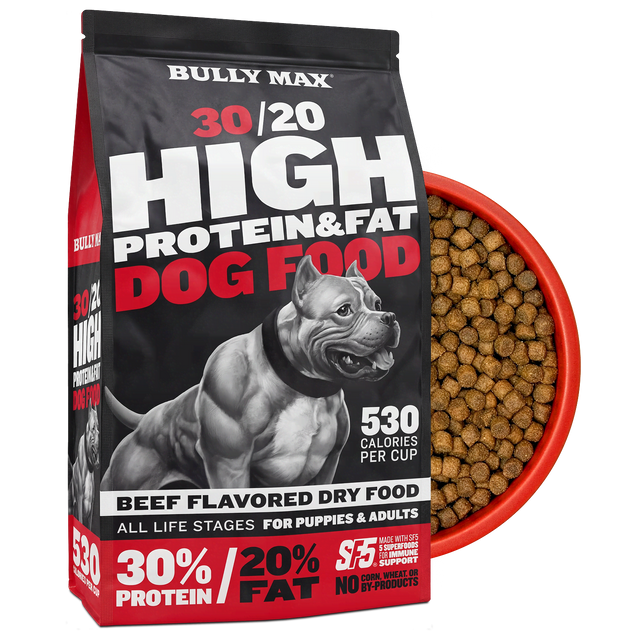
- Bully Max 30/20 Beef: 30% protein, 20% fat, 530 calories per cup; formulated to meet AAFCO nutrient profiles for All Life Stages, including growth of large size dogs. The extra protein is fine for a big puppy; the extra calories are what you manage by measuring.
The practical rule: pick protein for muscle, then control growth with the amount you feed and a food that respects the calcium limit.
Source: Nap et al., “Growth and skeletal development in Great Dane pups fed different levels of protein intake,” The Journal of Nutrition, 1991; AAFCO Dog Food Nutrient Profiles (growth and reproduction).
Calcium, Phosphorus and Controlled Growth
Large and giant breed puppies go from a few pounds to 70, 100 or more pounds in a year or two. Their bones, joints and growth plates are developing the whole time. Feeding research and veterinary nutrition guidance point the same way: too much calcium and too many calories during this window are linked with developmental orthopedic problems in big puppies. The goal is steady growth, not maximum growth.
What AAFCO Sets for Large Breed Puppies
AAFCO’s Dog Food Nutrient Profiles set these limits for foods intended for growth, on a dry matter basis:
| Nutrient (growth and reproduction) | AAFCO minimum | AAFCO maximum |
|---|---|---|
| Calcium | 1.2% | 1.8% for puppies expected to reach 70 lb or more as adults |
| Phosphorus | 1.0% | n/a |
| Calcium-to-phosphorus ratio | 1:1 | 2:1 |
Source: AAFCO Dog Food Nutrient Profiles, as revised in 2016 and summarized by Petfood Industry. Percentages are dry matter (DM).
“Dry matter” means the number with the water taken out. Bag labels list nutrients “as fed,” so the label number and the dry matter number are not the same. To convert, divide the label percentage by the food’s dry portion. For example, a kibble with 10% moisture is 90% dry matter, so a label value of 1.35% works out to 1.5% on a dry matter basis. You don’t need to do this math to pick a food. That’s what the large-size wording in the AAFCO statement is for.
Don’t Add Calcium
This is the most common well-meaning mistake. A complete and balanced puppy food already contains the calcium and phosphorus a growing puppy needs, in the right balance. Adding calcium powders, bone meal or extra dairy on top can push a big puppy past what’s safe. Unless your vet prescribes a supplement for a diagnosed reason, let the food do the job.
The same goes for mixing in lots of home-cooked food. A spoonful of a topper to get a picky puppy eating is fine. Replacing a large share of the complete food with meat and rice changes the calcium and phosphorus balance.

Why Growing Fast Is Not the Goal
Genetics decides how big your puppy will be. Food decides how fast it gets there. A puppy fed for slow, steady growth reaches the same adult size as a puppy pushed to grow fast. It just takes a little longer, with less stress on developing joints. If you want a big, solid adult, the path is lean growth now and muscle once the frame is finished.
Calorie Density and Lean Body Condition
Calorie density is how many calories are packed into each cup. Most of the calories in kibble come from fat, so a higher-fat food delivers more energy in a smaller scoop. That is not a problem for a large breed puppy as long as you measure. It is a problem if you scoop by eye or leave the bowl full all day.
Bully Max 24/14 High Protein & Growth Puppy Food has 419 calories per cup (3,550 kcal/kg), with 24% protein and 14% fat. That is moderate for a puppy food. It gives a growing dog real energy and protein without making portions so small that an extra handful matters too much.
| Bully Max food | Protein / Fat | Calories per cup | Best use for large breeds |
|---|---|---|---|
| 24/14 High Protein & Growth Puppy | 24% / 14% | 419 | Growing puppies, from weaning to the switch |
| 30/20 High Protein Beef | 30% / 20% | 530 | Chicken-free option; meets AAFCO All Life Stages including growth of large size dogs |
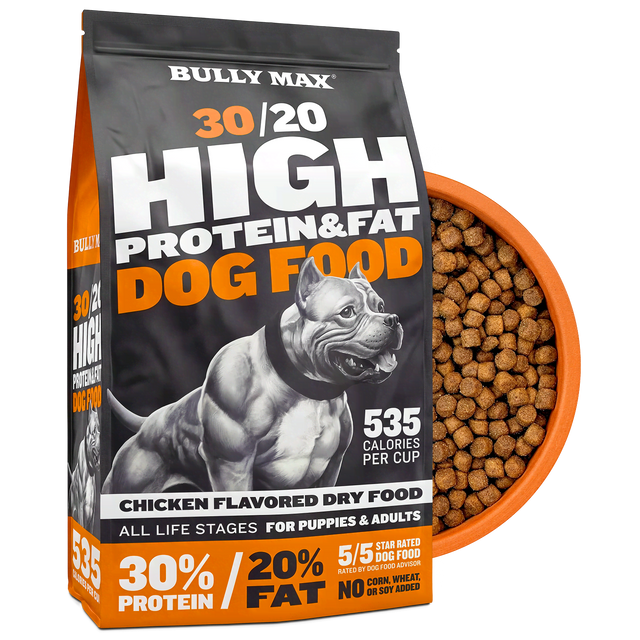
| 30/20 High Protein Chicken | 30% / 20% | 535 | Active adults after growth is done |
| 25/11 Lamb (45% less fat) | 25% / 11% | 415 | Adults that gain easily or are less active |
Calories per standard 8 oz measuring cup, from Bully Max product data.
How to Check Your Puppy’s Body Condition
The scale tells you whether your puppy is growing. Your hands tell you whether it’s growing the right way. Check every week or two:
- Ribs: you can feel them easily under a thin layer of padding, without pressing hard.
- Waist: looking down from above, there is a visible waist behind the ribs.
- Tuck: from the side, the belly tucks up toward the back legs.
If the ribs are hard to find, cut daily portions by about 10% and check again in two weeks. If the hip bones and spine are sharp, add about 10%. Our guide to determining your dog’s ideal weight has a body condition chart. Big puppies also go through gangly stages where they look leggy and narrow. That’s normal. A slightly lean puppy is right where you want it.
How Much to Feed a Large Breed Puppy
Start with the feeding chart on the bag, feed by your puppy’s current weight, then adjust by body condition. Here is the daily chart for Bully Max 24/14 Puppy, with calories worked out at 419 per cup.
| Puppy’s current weight | Cups per day | Calories per day (approx.) |
|---|---|---|
| 5-9 lb | ¾-1¼ | 314-524 |
| 9-14 lb | 1¼-1¾ | 524-733 |
| 14-18 lb | 1¾-2¼ | 733-943 |
| 18-23 lb | 2¼-2½ | 943-1,048 |
| 23-27 lb | 2½-3 | 1,048-1,257 |
| 27-32 lb | 3-3¼ | 1,257-1,362 |
| 32-36 lb | 3¼-3¾ | 1,362-1,571 |
| about 51 lb* | 3¾-4¼ | 1,571-1,781 |
| about 66 lb* | 4¼-4¾ | 1,781-1,990 |
| about 81 lb* | 4¾-5¼ | 1,990-2,200 |
From the Bully Max 24/14 Puppy feeding chart (standard 8 oz cup). *Rows above 36 lb use the bag’s rule of ½ cup more for each additional 15 lb. All amounts are estimates and starting points; split them across the day’s meals and adjust to body condition.
Two things to keep in mind with big puppies:
- Treats count. Keep treats and chews to about 10% of daily calories, and cut meals a little on heavy training days.
- Re-weigh often. A large breed puppy can gain several pounds in a couple of weeks. Re-check the chart every two weeks, or the portion you set last month will be too small, or too big once growth slows.
Want a number for your dog? Try our dog food calculator, or read how much should I feed my dog for the full method.

Feeding by Expected Adult Size
Current weight sets the daily amount. Expected adult size sets everything else: which food, how many meals, and how long to stay on puppy food. Use this as a planning guide.
| Expected adult weight | Example breeds | Puppy food | Meals per day | Typical switch to adult food |
|---|---|---|---|---|
| 50-70 lb (borderline) | Standard American Bully, larger pit bulls, Boxer | Puppy food suitable for large-breed puppies, to be safe | 3-4 until 6 months, then 2-3 | about 12 months |
| 70-100 lb (large) | Rottweiler, Doberman, German Shepherd, XL American Bully | Large-breed growth food | 3-4 until 6 months, then 2-3 | about 12-18 months |
| 100 lb and up (giant) | Cane Corso males, Mastiff, Great Dane, Boerboel | Large-breed growth food | 3-4 until 6 months, then 2-3 for life | about 18-24 months |
General guidelines. Your vet can confirm the best timing for your dog.
A Simple Daily Schedule
- 8 to 12 weeks: four small meals, for example 7 a.m., 11 a.m., 3 p.m. and 7 p.m.
- 3 to 6 months: three meals.
- 6 months on: two or three meals. Many owners of deep-chested breeds keep it at two or more meals for life.
Pick up the bowl after 15 to 20 minutes so meals stay meals. Deep-chested breeds such as Great Danes, Dobermans, German Shepherds and Rottweilers are at higher risk of bloat (GDV), a medical emergency. Splitting food into smaller meals and keeping hard exercise away from mealtimes are common vet suggestions. If your dog has a swollen belly, retches without bringing anything up, or seems restless and in pain after eating, call your vet or an emergency clinic right away. Our puppy daily schedule guide shows how to fit meals around training, play and sleep.
Picking the Right Food for Your Large Breed Puppy
Large-breed puppy owners who come to Bully Max usually want two things at once: safe, steady growth now, and a solid, muscular adult later. Here’s how our foods fit that.
Bully Max 24/14 High Protein & Growth Puppy Food
This is our puppy formula and our first pick for large breed puppies. Lamb meal is the first ingredient, followed by pork. It has 24% protein, 14% fat and 419 calories per cup, plus fish oil and menhaden fish meal as sources of omega-3s. It also contains TruMune, a postbiotic included to support digestion and immune health. It works from about 4 weeks old, once a puppy can eat solid food, and is suitable for large-breed puppies under AAFCO guidelines. If your puppy struggles with dry kibble, soak it in warm water first.
Want to know more about TruMune? This short video explains it, and our article on the benefits of TruMune in dog food goes deeper.
Bully Max 30/20 High Protein Beef: The Chicken-Free Option
Some puppies don’t do well on chicken, and some owners simply prefer to avoid it. 30/20 Beef is chicken-free and starts with beef meal. It is formulated to meet AAFCO Dog Food Nutrient Profiles for All Life Stages, including growth of large size dogs (70 lb. or more as an adult). At 530 calories per cup it is more energy-dense than our puppy food, so portions are smaller and measuring matters even more. Read more in our chicken-free dog food guide.
If your large breed puppy needs a chicken-free bowl, 30/20 Beef covers growth of large size dogs and carries on into adulthood.

NEED CHICKEN-FREE? TRY 30/20 BEEF
Chicken-free, with beef meal first, 30% protein, 20% fat and 530 calories per cup. Formulated to meet AAFCO nutrient profiles for all life stages, including growth of large size dogs.
When to Switch a Large Breed Puppy to Adult Food
Switch when your puppy is close to adult size, roughly 75 to 85% of expected adult weight. For most large breeds that lands between 12 and 18 months. Giant breeds often stay on puppy food until 18 to 24 months. Switching too early takes a big puppy off a growth formula while its skeleton is still developing. Switching very late usually just means extra calories, which you can manage by measuring.
Signs your large breed puppy is ready:
- Weight gain has slowed to a crawl for a month or more.
- Height has stopped changing.
- Your puppy is starting to look a little soft on the same portions.
- Your vet agrees growth is essentially done.
Make the change over 7 to 10 days. Start with about a quarter of the new food mixed into the old, then half and half, then three quarters, then all new food. Our full guide on when to switch to adult dog food has a breed-by-size table.

Which Adult Food Comes Next?
- Active, athletic or hard-to-keep-weight-on dogs: 30/20 High Protein Chicken (535 kcal/cup, with TruMune) or 30/20 Beef (530 kcal/cup, chicken-free).
- Easy keepers or less active dogs: 25/11 Lamb, with 45% less fat and 415 calories per cup.
- Already on 30/20 Beef as a puppy? You can stay on it. Just recheck portions as growth slows, because adult dogs need fewer calories per pound than growing puppies.
For an active large breed that has finished growing and needs to hold weight and muscle, 30/20 High Protein Chicken is the natural next step. Compare all of our adult formulas in the high-protein dog food collection.

GRADUATE TO BULLY MAX 30/20
Meat-based adult nutrition with 30% protein, 20% fat, 535 calories per cup and TruMune, for active large breeds that have finished growing.
Common Large Breed Puppy Feeding Mistakes
- Free feeding. A full bowl all day makes it almost impossible to control growth. Feed measured meals.
- Adding calcium. A complete puppy food already has it. Supplements on top can do harm.
- Feeding for size. Extra food makes a puppy heavier, not bigger. Size comes from genetics; heavy puppies put extra load on growing joints.
- Using an adult food that isn’t made for growth. Check that any food you use for a puppy covers growth, including large size dogs.
- Switching too early. Twelve months is not a magic number for a 110-pound breed.
- Ignoring treats. Training treats and chews add up quickly. Keep them to about 10% of daily calories.
- Too much hard exercise too soon. Long runs on pavement and lots of jumping put stress on growing joints. Ask your vet how much and what kind of exercise suits your puppy’s age.
Why Large-Breed Owners Choose Bully Max
Bully Max is a family-owned U.S. company founded in 2009, and our customers skew big. In our post-purchase survey of about 2,400 buyers, a third own American Bullies, about 31% own pit bulls or Staffies, and about 10% own Cane Corsos, plus Rottweilers, German Shepherds and the mastiff breeds. The most common reasons they gave for choosing us were reviews and visible results, dogs that actually love the food, protein and calories, and quality and trust.
“I have a big dog and I need a brand that's made for big dogs”
Bully Max customer, post-purchase survey
“Just looking for a good quality food for my new puppy and seen bullymax was one of the best. Figured we'd test it out”
Bully Max customer, post-purchase survey
Here’s a Cane Corso puppy on Bully Max at our training facility.
What backs that up:
- Over 50,000 5/5 reviews and millions of dogs served
- Dog Food Advisor 5/5 rating
- High-performance, meat-based nutrition, with protein and calories listed plainly on every bag
- Every batch triple tested for safety, zero recalls, and made in the USA
“Researched a bunch of puppy food and decided to give this one a shot and she loves it”
Bully Max customer, post-purchase survey
Feeding a big dog means going through a lot of food. Autoship saves 10% on every order, so you never run out halfway through a growth spurt.
Ready to get started? Give your large-breed puppy a puppy food built for growth, with real lamb and TruMune to support digestion and immune health.
A closer look at Bully Max puppy nutrition for growing large-breed pups:
READY TO START? TRY BULLY MAX 24/14 PUPPY FOOD
Made for growing puppies with 24% protein, real lamb, and TruMune to support digestion and immune health.
FAQ
What is the best large breed puppy food?
The best large breed puppy food is a complete puppy formula that meets AAFCO’s growth profile for large size dogs, has a named meat first, and lets you feed measured meals that keep your puppy lean. Our pick is Bully Max 24/14 High Protein & Growth Puppy Food: lamb meal first, 24% protein, 419 calories per cup, TruMune, and suitable for large-breed puppies under AAFCO guidelines.
Do large breed puppies need large breed food?
They need a food that is complete and balanced for growth of large size dogs. That can be a food labeled “large breed puppy,” or any growth or all life stages food whose AAFCO statement includes large size dogs (70 lb or more as an adult). Regular puppy foods without that wording may allow more calcium than a big puppy should have.
How long should a large breed puppy eat puppy food?
Usually until about 12 to 18 months for large breeds and 18 to 24 months for giant breeds, or until your puppy reaches roughly 75 to 85% of its expected adult weight. Then transition to adult food over 7 to 10 days. See when to switch to adult dog food.
Does large breed puppy food slow growth?
It controls the rate of growth, not the final size. A large breed puppy fed the right food in the right amounts still reaches its genetic adult size. It just gets there at a steadier pace, which is easier on developing bones and joints.
Should a pregnant dog eat large breed puppy food?
Pregnant and nursing dogs need a food that is complete and balanced for growth and reproduction (or all life stages), because their energy needs climb sharply, especially while nursing. Many breeders use a puppy food during late pregnancy and nursing. Because needs vary so much by breed and litter size, ask your vet which food and how much to feed.
Is Bully Max good for large breed puppies?
Yes. All Bully Max foods are suitable for large-breed dogs, including large-breed puppies, under AAFCO guidelines. For most puppies we recommend 24/14 Puppy. For a chicken-free option, 30/20 Beef is formulated to meet AAFCO nutrient profiles for All Life Stages, including growth of large size dogs.
Is there a large breed puppy food without chicken?
Yes. Bully Max 30/20 High Protein Beef is chicken-free, starts with beef meal and is formulated to meet AAFCO Dog Food Nutrient Profiles for All Life Stages, including growth of large size dogs (70 lb. or more as an adult). At 530 calories per cup it is denser than a typical puppy food, so measure portions and check body condition every couple of weeks. If your puppy has to avoid chicken, that is the formula to use.
What should I feed a Great Dane or Mastiff puppy?
The same rules as any large breed puppy, with more patience. Giant breeds such as Great Danes, Mastiffs, Boerboels and Cane Corsos can top 100 pounds by 18 months, so they need a growth food whose AAFCO statement covers large size dogs, no added calcium, measured meals, a lean frame, and puppy food until about 18 to 24 months. Every Bully Max food is suitable for large-breed puppies under AAFCO guidelines; for most giant-breed puppies we recommend 24/14 Puppy, with 30/20 Beef as the chicken-free option. See our guides to dog food for Mastiffs and dog food for Boerboels.
Can a small breed puppy eat large breed puppy food?
Usually, yes. A food whose AAFCO statement covers growth or all life stages is complete and balanced for any puppy; the large-size wording adds a calcium ceiling, it does not take anything away. The difference is portion size: a small puppy needs far fewer calories, so follow the bag chart for its current weight and adjust to body condition. Small puppies also finish growing sooner, usually by 9 to 12 months, so they move to adult food earlier.
Give Your Big Puppy a Strong Start
Large breed puppy feeding comes down to a few habits: a food made for growth of large size dogs, no extra calcium, measured meals, a lean body, and patience before the switch to adult food. Get those right and genetics will handle the size. Shop Bully Max 24/14 High Protein & Growth Puppy Food or browse all our high-protein puppy food, and set up autoship to save 10%. Questions about your puppy? Leave them in the comments below.