Best Dog Food for Dobermans: Puppy and Adult Feeding Guide
The best dog food for Dobermans is a complete, meat-based food with high-quality protein to hold that lean, athletic muscle, calories matched to how active your dog is, and a recipe your Doberman digests well enough to stay on long term. Doberman puppies need a food suitable for large-breed puppies, fed in measured meals so they grow lean and steady. This guide covers what to feed a Doberman, the best food for a Doberman puppy, how much to feed by weight, and the breed's health concerns that are worth discussing with your vet.
Short on time? Our Doberman dog food guide sums up the pick and the feeding math on one page.

Doberman feeding at a glance
- Puppies (8 weeks to about 12-18 months): a high-protein food suitable for large-breed puppies, 3-4 measured meals a day, dropping to 2-3 by about 6 months.
- Adults: a meat-based food with about 25-30% protein. A 70-90 lb adult Doberman needs roughly 1,500-2,250 calories a day, depending on activity (estimate).
- Stay lean: a fit Doberman shows a clear waist and a tucked belly. Extra weight is hard on joints and the heart.
- Feed for bloat safety: two or more meals a day, a calm mealtime and no hard exercise right before or after eating.
- Health first: Dobermans are prone to heart disease (DCM), bloat, low thyroid and wobbler syndrome. Ask your vet about screening. No food treats or prevents these.
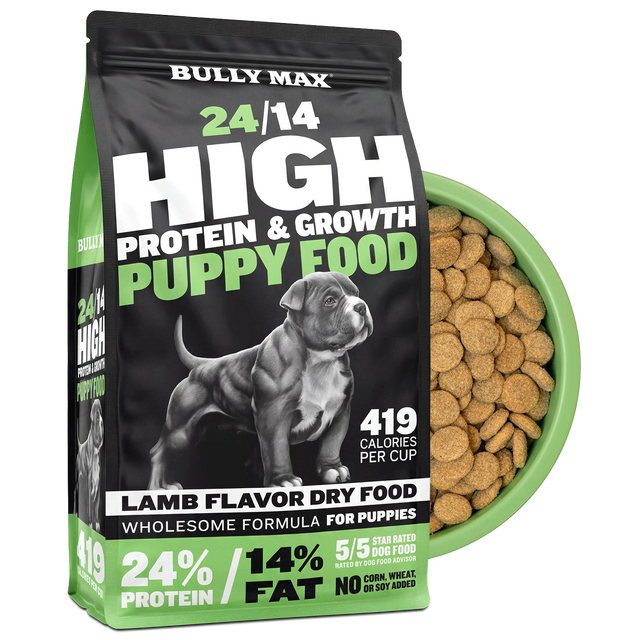
- Our picks: Bully Max 30/20 High Protein for active adults, 24/14 Puppy Food for puppies, and 25/11 Lamb for less active or weight-managed Dobermans.
What Makes Doberman Nutrition Different
The Doberman Pinscher was developed in Germany as a guard and protection dog. Today's Dobermans are still athletic, alert and quick, with a short coat that shows every bit of muscle and every lost or gained pound. The AKC standard puts males at 26 to 28 inches and females at 24 to 26 inches at the shoulder. Most adults weigh 60 to 100 pounds. That build and that job shape what a Doberman needs from its food.

FEEDING A DOBERMAN?
See the Doberman feeding guide
The 30/20 formula for a lean, athletic Dobe, cups per day by weight, and real owners’ results.
50,000+ five-star reviews
- Lean, defined muscle. A Doberman should look sleek and hard, not bulky. Quality animal protein supports the muscle the breed is known for.
- Energy for a working breed. Active Dobermans burn a lot of calories. A calorie-dense food keeps meals a reasonable size, which matters for a deep-chested dog.
- Weight that is easy to see. Some Dobermans run lean and are hard to keep weight on. Others get heavy fast once exercise drops. Feeding by body condition matters more than following the bag.
- Large-breed growth. Puppies grow from a few pounds to 60-100 pounds in about a year and a half. They need a food suitable for large-breed growth and measured portions.
- A deep chest. Dobermans are among the deep-chested breeds at higher risk of bloat (GDV), so how you feed matters as much as what you feed.
- Breed health concerns. Heart disease, low thyroid and wobbler syndrome all show up in Dobermans. Food doesn't treat any of them, but a healthy weight and regular vet checks help you catch problems early.
Before we go further, a quick note on fuel: if your Doberman needs more strength and energy from the bowl, a meat-based, high-protein food is the simplest place to start.

FUEL YOUR DOG WITH BULLY MAX 30/20 HIGH-PROTEIN FOOD
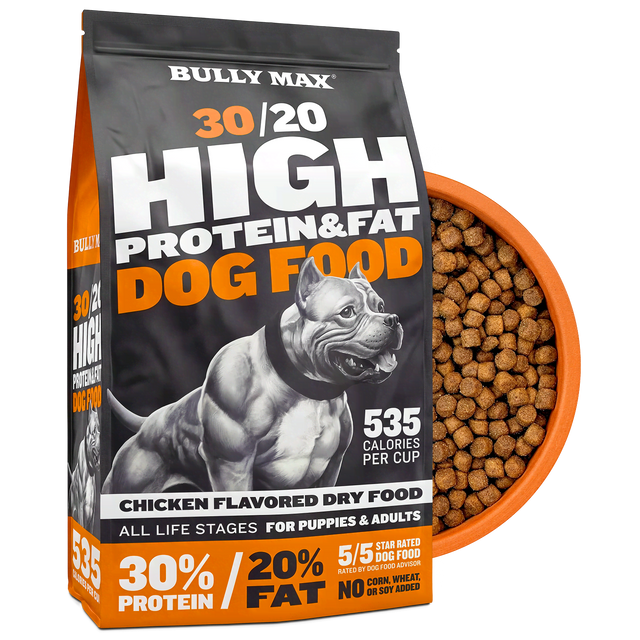
Fuel strength and energy with meat-based nutrition, 30% protein, 20% fat, and 535 calories per cup.
What to Look for in the Best Dog Food for Dobermans
Most of what matters is printed on the bag. Use this checklist before you buy.
Doberman food checklist
- A named meat first. Chicken, beef, lamb or a named meat meal near the top of the list, not vague “meat by-products.”
- Protein well above the minimum. AAFCO minimums are 18% protein for adult maintenance and 22.5% for growth (dry matter). An athletic breed like the Doberman usually does well at about 25-30% for adults.
- Fat and calories matched to activity. A Doberman that runs, trains or works every day needs more fat and calories than one that lounges most of the day.
- The right life stage. Until your puppy is grown, feed a food that is complete and balanced for growth, including large-size dogs.
- Digestibility. Quality protein and digestible carbohydrates like brown rice, so your dog gets the most from every cup.
- Omega fatty acids for skin and that short, glossy coat.
- A maker you trust. Consistent safety testing and a clean recall history.
- Your vet's input. If your Doberman has a heart, thyroid or other health condition, choose the food together with your vet.
How Bully Max Foods Compare for a Doberman
| Bully Max food | Key numbers | Best for |
|---|---|---|
| 30/20 High Protein Chicken | 30% protein, 20% fat, 535 kcal/cup, TruMune | Active adult Dobermans, dogs that need to keep weight on |
| 24/14 High Protein & Growth Puppy | 24% protein, 14% fat, 419 kcal/cup, real lamb, TruMune | Doberman puppies until growth slows |
| 25/11 Lamb, 45% less fat | 25% protein, 415 kcal/cup, chicken-free | Less active or weight-managed Dobermans, dogs that do better without chicken |
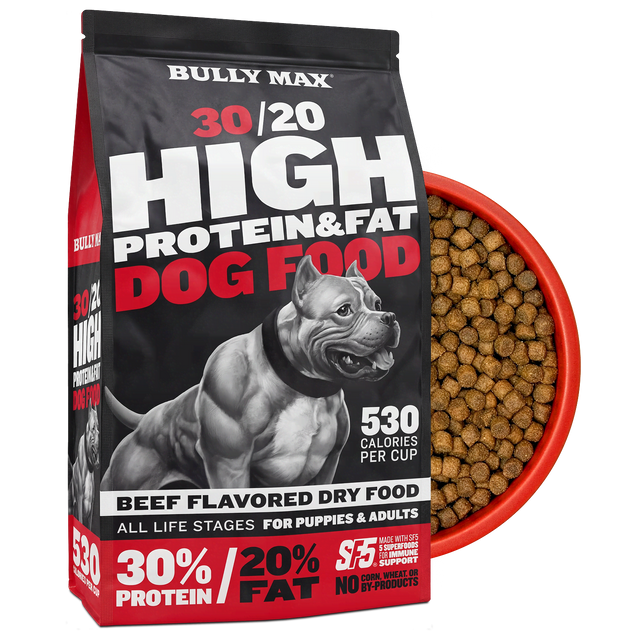
| 30/20 High Protein Beef | 30% protein, 20% fat, 530 kcal/cup, chicken-free | Active Dobermans that need a chicken-free food |
| PRO Series 31/25 High Calorie | 31% protein, 25% fat, 600 kcal/cup | Working and sport Dobermans, hard keepers |
Every Bully Max dog food is suitable for large-breed dogs, including large-breed puppies, under AAFCO guidelines.
See every formula side by side in our Bully Max dog food comparison chart.
Best Dog Food for Active Adult Dobermans
For most healthy, active adult Dobermans, we recommend Bully Max 30/20 High Protein. It is high-performance, meat-based nutrition with 30% protein, 20% fat and 535 calories per cup. A Doberman that trains, runs or works gets the fuel it needs without an oversized bowl, and owners of lean, hard-to-keep-weight-on Dobermans don't have to pile on extra cups. It also includes TruMune to support digestion and immune health. Learn more in the benefits of TruMune in dog food.

If your Doberman is underweight, the answer is usually more calories from a quality food, not more filler. Rule out a medical cause with your vet first, especially if the weight loss is sudden. Then see how to help your dog gain healthy weight.
Our top pick for active adult Dobermans: meat-based, calorie-dense and made in the USA, with TruMune to support digestion and immune health.
FUEL YOUR DOBERMAN WITH BULLY MAX 30/20
Meat-based nutrition with 30% protein, 20% fat, 535 calories per cup, and TruMune to support digestion and immune health.
Best Food for a Doberman Puppy
A Doberman puppy needs a high-protein food that is suitable for large-breed puppies, fed in measured meals. Our pick is Bully Max 24/14 High Protein & Growth Puppy Food. It is suitable for large-breed dogs, including large-breed puppies, under AAFCO guidelines. It has 24% protein and 14% fat with real lamb, 419 calories per cup, and TruMune to support digestion and immune health.
Doberman Puppy Feeding Rules
- Measure every meal. Free-feeding makes it easy to overdo calories, and large-breed puppies do best growing lean and steady.
- Don't add calcium. A complete puppy food already has what your puppy needs. Extra calcium can do harm in large-breed puppies unless your vet prescribes it.
- Keep the same food. Frequent changes are a common cause of loose stools. If you switch, do it over 7 to 10 days.
- Go easy on forced exercise. Free play is great. Long runs and repeated jumping can wait until your vet says growth is nearly done.
- Count the treats. Keep treats under about 10% of daily calories.
For more on growth, read our guide to large-breed puppy food.
This is the food we recommend for Doberman puppies. It comes in 5, 10 and 15 lb bags. See the full lineup in our high-protein puppy food collection.

GIVE YOUR DOBERMAN PUPPY BULLY MAX 24/14
24% protein, real lamb, and TruMune to support digestion and immune health. Suitable for large-breed dogs, including large-breed puppies, under AAFCO guidelines.
How Much to Feed a Doberman Puppy
How much to feed a Doberman puppy depends on its weight, age and activity, and on the calories in the food. Young puppies need about three times their resting energy. From about 4 months, they need about twice their resting energy until they near adult size. The table turns that into daily calories and cups of 24/14 Puppy (419 calories per cup) by your puppy's current weight.
| Puppy's current weight | Under 4 months (calories/day) | 24/14 cups/day (under 4 months) | 4 months and older (calories/day) | 24/14 cups/day (4 months+) |
|---|---|---|---|---|
| 10 lb | about 650 | about 1.6 | about 440 | about 1.0 |
| 15 lb | about 880 | about 2.1 | about 590 | about 1.4 |
| 20 lb | about 1,100 | about 2.6 | about 730 | about 1.7 |
| 25 lb | about 1,300 | about 3.1 | about 870 | about 2.1 |
| 30 lb | about 1,490 | about 3.6 | about 990 | about 2.4 |
| 40 lb | n/a | n/a | about 1,230 | about 2.9 |
| 50 lb | n/a | n/a | about 1,450 | about 3.5 |
| 60 lb | n/a | n/a | about 1,670 | about 4.0 |
| 70 lb | n/a | n/a | about 1,870 | about 4.5 |
Estimates only, based on a standard resting-energy formula (70 × body weight in kg0.75) times 3 under 4 months and times 2 from 4 months, and 419 calories per cup for Bully Max 24/14 Puppy. Every puppy is different. Adjust by body condition every week or two.
Split the daily amount across meals. The dog food calculator does the math for any food, and how much should I feed my dog explains the method.
Doberman Puppy Feeding Schedule
| Age | Meals per day | What to watch |
|---|---|---|
| 8-12 weeks | 4 | Firm stools and a steady appetite as your puppy settles in |
| 3-6 months | 3 | Fast growth. Check body condition weekly |
| 6-12 months | 2-3 | Legs and chest lengthen. Adjust portions to activity |
| 12-18 months | 2 | Growth slows. Plan the switch to adult food with your vet |
| 18 months and up | 2 | Adult portions. Many Dobermans keep filling out until about 2 years |
Check body condition, not just the scale. You should feel the ribs with light pressure and see a waist from above. On a short-coated breed like the Doberman, a faint outline of the last rib or two is normal for a fit dog. If you can't feel ribs, trim portions by about 10%. If the spine and hip bones stand out, add about 10% and check with your vet. Our guide to determining your dog's ideal weight shows what to look for.
When Should a Doberman Switch to Adult Food?
Most Dobermans are close to adult height at 12 to 18 months, and that's when most move to adult food. Ask your vet about timing for your dog, then switch over 7 to 10 days. See when to switch to adult dog food.
How Much to Feed an Adult Doberman
Adult Dobermans do best on two measured meals a day. The table below is an estimate for healthy adults using the same resting-energy formula. “Less active” is a dog that mostly walks and lounges, or one losing a little weight under your vet's guidance. “Typical” is a spayed or neutered pet with daily walks and play. “Active” is a working, sport or very high-energy Doberman.
| Adult weight | Less active (calories/day) | Typical (calories/day) | Active (calories/day) | 30/20 cups/day (typical-active) | 25/11 Lamb cups/day (less active) |
|---|---|---|---|---|---|
| 60 lb | about 1,170 | about 1,330 | about 1,670 | about 2.5-3.1 | about 2.8 |
| 70 lb | about 1,310 | about 1,500 | about 1,870 | about 2.8-3.5 | about 3.2 |
| 80 lb | about 1,450 | about 1,660 | about 2,070 | about 3.1-3.9 | about 3.5 |
| 90 lb | about 1,580 | about 1,810 | about 2,260 | about 3.4-4.2 | about 3.8 |
| 100 lb | about 1,710 | about 1,960 | about 2,450 | about 3.7-4.6 | about 4.1 |
Estimates only: resting energy times 1.4 (less active), 1.6 (typical) and 2.0 (active). Bully Max 30/20 High Protein has 535 calories per cup and 25/11 Lamb has 415. Treats count toward the total. Adjust by body condition.
Use these numbers as a starting point, then watch your dog. Weigh your Doberman every few weeks and adjust portions by about 10% at a time. If weight changes without a change in food or exercise, see your vet. In Dobermans, unexplained weight gain is one of the signs vets check thyroid function for.

Best Dog Food for Less Active or Weight-Managed Dobermans
Not every Doberman is a working dog. Older dogs, dogs recovering from an injury, and Dobermans that simply gain weight easily often do better on fewer calories per cup. That way they still get a satisfying bowl without the extra calories. Bully Max 25/11 Lamb has 25% protein with 45% less fat and 415 calories per cup. It is also chicken-free, which helps if your vet suspects a chicken sensitivity. Read more in our guide to chicken-free dog food.

For weight loss, cut portions slowly, keep protein up so your dog holds muscle, and get your vet to confirm a target weight. Losing about 1 to 2% of body weight per week is a common, gentle pace, but your vet may set a different goal.
For a less active or weight-managed Doberman, this is the food to try.

TRY BULLY MAX 25/11 LAMB FOR YOUR DOBERMAN
Chicken-free lamb recipe with 25% protein, 45% less fat, and 415 calories per cup for dogs that need a lighter bowl.
Doberman Health Concerns and Diet
Dobermans have several well-known breed health issues. Food is not a treatment for any of them, and none should be managed by diet alone. Here is what owners should know, and what to ask your vet about.
Heart Disease (DCM)
Dilated cardiomyopathy (DCM) is a disease of the heart muscle, and Dobermans are one of the breeds most affected by an inherited form of it. It can develop without obvious signs for a long time. Many Doberman owners ask their vet about regular heart screening, such as a Holter monitor and an echocardiogram. See your vet right away if your Doberman tires easily, coughs, breathes fast at rest, faints or collapses.
You may also have read about diet and DCM. Since 2018, the U.S. Food and Drug Administration (FDA) has been investigating a possible link between certain diets and DCM in dogs, including breeds that are not usually prone to it. Many of the diets named in reported cases listed peas, lentils, other legumes or potatoes high in their ingredient lists. The FDA has not concluded that any diet causes DCM, and in late 2022 it said it would share further public updates only when there is meaningful new science. Because Dobermans already carry a genetic risk, talk to your vet about diet choices, and follow your vet's advice if your dog has been diagnosed with heart disease.
Bloat (GDV)
Bloat, or gastric dilatation-volvulus (GDV), is when the stomach fills with gas and can twist. It is an emergency. Dobermans are among the deep-chested breeds at higher risk. Watch for unproductive retching, a swollen belly, restlessness, heavy drooling or collapse, and get to a vet or emergency clinic right away if you see them. No food can rule out bloat, but these habits help lower the risk:
- Feed two or more smaller meals instead of one big meal.
- Use a slow-feeder bowl for fast eaters.
- Avoid hard exercise for about an hour before and after meals.
- Keep mealtimes calm, especially in a multi-dog home.
- Ask your vet whether a preventive gastropexy makes sense for your dog.
Low Thyroid (Hypothyroidism)
Hypothyroidism is common in Dobermans. Signs can include weight gain without eating more, low energy, a dull or thinning coat and skin problems. These signs overlap with simple overfeeding, so if your Doberman gains weight on the same portions, see your vet for a blood test before you cut food sharply. Hypothyroidism is treated with medication from your vet, not with a diet change.
Wobbler Syndrome
Wobbler syndrome (cervical spondylomyelopathy) affects the spine in the neck, and the Doberman is one of the breeds most often affected. Signs include a wobbly or unsteady walk, especially in the hind legs, neck pain or scuffed nails. See your vet if you notice them. Diet doesn't treat wobbler syndrome. What you can control is keeping your puppy growing lean and your adult at a healthy weight, which takes strain off joints and the spine.
Sources: FDA investigation into a potential link between certain diets and canine dilated cardiomyopathy; AKC Doberman Pinscher breed information. This section is general information, not veterinary advice.
Treats, Training and Keeping a Doberman Fit
Dobermans are smart and eager to work, so food rewards go a long way in training. Just count them. Keep treats under about 10% of daily calories, use small pieces, and take big training days into account at dinner. Pair good food with real exercise. A Doberman needs daily walks, running and mental work to stay lean and settled. If your Doberman works or competes, read our guide to the best dog food for working dogs.

Is Bully Max Good for Dobermans?
Yes. Dobermans are lean, athletic dogs that need quality protein and calories that match their activity, which is exactly what Bully Max is built for. The proof starts with dogs and reviews: Bully Max has over 50,000 5/5 reviews, a Dog Food Advisor 5/5 rating, and has served millions of dogs. Doberman owners are a small but real part of our customers, and in our post-purchase survey they pointed to reviews and quality as the reasons they chose us. Owners of non-bully breeds put it this way:
“Good food is good food, regardless of breed”
Bully Max customer, post-purchase survey
“I honestly did not think at all that it was for "Just Bullies". I just figured it was palatable for all dogs regardless of breed.”
Bully Max customer, post-purchase survey
- Protein and calories for an athletic breed. High-performance, meat-based nutrition, with 30% protein and 535 calories per cup in 30/20.
- A food for every stage and activity level. 24/14 Puppy for growth, 30/20 for active adults and 25/11 Lamb for less active or weight-managed dogs. Every Bully Max dog food is suitable for large-breed dogs, including large-breed puppies, under AAFCO guidelines.
- Quality you can trust. Bully Max is a family-owned U.S. company founded in 2009. Our food is made in the USA, every batch is triple tested for safety, and we have zero recalls.
“Products for a healthy lean muscular dog.”
Bully Max customer, post-purchase survey
“0 recalls and over a decade of personal use”
Bully Max customer, post-purchase survey
Ready to put this into practice? Start your Doberman on a meat-based, high-protein food made in the USA by a family-owned company, with every batch triple tested for safety.
READY TO SWITCH? TRY BULLY MAX 30/20 HIGH-PROTEIN FOOD
Fuel strength and energy with meat-based nutrition, 30% protein, 20% fat, and 535 calories per cup.
Doberman Food FAQ
What is the best dog food for a Doberman?
A complete, meat-based food with high-quality protein, calories matched to the dog's activity, and a recipe your dog digests well. For most active adults we recommend Bully Max 30/20 High Protein. For less active or weight-managed Dobermans, try 25/11 Lamb. If your dog has a health condition, choose with your vet.
What is the best food for a Doberman puppy?
A high-protein puppy food that is suitable for large-breed puppies, fed in measured meals. We recommend Bully Max 24/14 High Protein & Growth Puppy Food, which is suitable for large-breed dogs, including large-breed puppies, under AAFCO guidelines.
How much food should a Doberman puppy eat per day?
As an estimate, a 20 lb Doberman puppy under 4 months needs about 1,100 calories a day (about 2.6 cups of 24/14 Puppy), and a 40 lb puppy over 4 months needs about 1,230 calories (about 2.9 cups). Split it into 3 to 4 meals for young puppies and 2 to 3 after about 6 months, then adjust by body condition.
How many cups of food should an adult Doberman eat?
As an estimate, a typical 80 lb adult needs about 1,660 calories a day, or about 3.1 cups of 30/20 High Protein. An active 80 lb Doberman may need about 3.9 cups. Check body condition and adjust by about 10% at a time.
When should a Doberman switch from puppy food to adult food?
Most Dobermans switch once growth slows, usually around 12 to 18 months. Ask your vet about timing and change foods over 7 to 10 days.
Does diet cause DCM in Dobermans?
Dobermans have an inherited risk of DCM. The FDA has been investigating a possible link between certain diets and DCM in dogs, but it has not concluded that any diet causes it. Ask your vet about heart screening and diet choices for your dog.
Dobermans are built to work, guard and move. Feed them like it. Start your puppy on Bully Max 24/14 Puppy Food, move to 30/20 High Protein once growth slows, or choose 25/11 Lamb for a less active dog. Save 10% on every order with Bully Max Autoship. Got a Doberman on Bully Max? Tell us about them in the comments below.