Is My Dog Underweight? Body Condition Chart and a 30-Day Weight-Gain Plan
See your vet first
Before you change your dog’s food to add weight, book a vet check if your dog is losing weight without a clear reason, is eating normally but still getting thinner, or has vomiting, diarrhea, extra thirst, coughing or low energy. Weight loss can be the first sign of parasites, dental pain or an illness that food alone won’t fix. A very thin dog (ribs, spine and hip bones all clearly visible) or a newly rescued, starved dog should gain weight only under a vet’s guidance, because feeding too much too fast can be dangerous.
Your dog is probably underweight if you can easily see the ribs, spine or hip bones, feel no fat over the ribs, and see a deep waist and tuck. On the 9-point body condition scale vets use, that is a score of 3 or below; 4 to 5 is ideal. Once your vet has ruled out a medical cause, most thin dogs gain best on a calorie-dense food fed for their target weight, adjusted in small steps and checked on the scale every week for 30 days.
Family-owned since 2009 · 50,000+ five-star reviews · Dog Food Advisor 5/5 · Zero recalls
For hard keepers, start with calories you can measure. 600 calories per cup means more fuel in every scoop:

PUT WEIGHT ON WITH PRO SERIES 31/25
31% protein, 25% fat and 600 calories per cup, so a thin dog gets more calories without a bigger bowl. Built for working, sport and hard-to-keep-weight-on dogs.
Feeding for weight gain takes more food. Subscribe & save 10% with Autoship.
Is my dog underweight? At a glance
- Check the ribs: you should feel them easily under a thin layer of fat, not see them from across the room.
- Check from above and the side: a waist and a tuck are normal; sharp hip bones and a visible spine are not.
- Score it: body condition 1 to 3 is too thin, 4 to 5 is ideal (9-point scale).
- Vet first: unexplained weight loss needs a checkup before a diet change.
- The plan: calorie-dense food fed for the target weight, 3 meals a day, weekly weigh-ins, small 10% adjustments.
- Top it up: a calorie topper or weight-gain chew if food alone isn’t enough.
How to Tell If Your Dog Is Underweight
The scale tells you a number, but your hands tell you more. Breeds and even littermates carry weight differently, so vets judge thinness by body condition: how the ribs, spine, hips and waist look and feel. Do these four checks with your dog standing.
- Ribs. Lay your flat hands on your dog’s sides and slide them back and forth. On a healthy dog the ribs feel like the back of your hand: easy to find under a light cover. If they feel like your knuckles, or you can see each rib, your dog is too thin.
- Spine. Run your fingers along the top of the back. The bumps of the spine should be covered. If they stick up sharply or you can see them, that’s a sign of low fat and possibly muscle loss.
- Hip bones. Feel the top of the hips near the tail. Sharp, prominent hip bones point to an underweight dog.
- Waist and tuck. From above, a healthy dog has a visible waist behind the ribs. From the side, the belly tucks up. An extreme hourglass or a severe tuck means there’s too little cover.
Short-coated, muscular breeds like pit bulls and American Bullies can look leaner than they are, because you see every muscle. A lean, fit dog has a waist and a hint of rib with good muscle over the back and thighs. An underweight dog also loses muscle, especially over the spine, hips and head.

Dog Body Condition Score Chart
Most vets use a 9-point body condition score (BCS). The WSAVA Global Nutrition Committee publishes the version below for dogs. A score of 4 or 5 is ideal. Anything at 3 or below is underweight, and 1 to 2 needs a vet’s help before you change the diet.
| Score | Condition | What you see and feel |
|---|---|---|
| 1 | Emaciated | Ribs, spine, hip bones and other bones visible from a distance. No body fat. Obvious loss of muscle. |
| 2 | Very thin | Ribs, spine and hip bones easily visible. No fat you can feel. Some muscle loss. |
| 3 | Thin | Ribs easily felt and may be visible, with no fat you can feel over them. Tops of the spine visible. Hip bones becoming prominent. Obvious waist and tuck. |
| 4 | Ideal (lean) | Ribs easily felt with a light fat cover. Waist easily seen from above. Belly tucked up. |
| 5 | Ideal | Ribs felt without excess fat. Waist seen behind the ribs from above. Belly tucked up from the side. |
| 6 | Slightly heavy | Ribs felt with a slight excess of fat. Waist visible but not prominent. |
| 7 | Heavy | Ribs hard to feel under heavy fat. Fat over the lower back and tail base. Waist barely visible or absent. |
| 8 | Obese | Ribs can’t be felt without firm pressure. Heavy fat over the back and tail base. No waist. |
| 9 | Severely obese | Large fat deposits over the chest, spine and tail base. No waist. Belly may hang down. |
Adapted from the WSAVA Global Nutrition Committee body condition score chart for dogs (9-point scale). Ask your vet to score your dog at the next visit and compare notes.
Write down the score along with your dog’s weight. Over the next 30 days, the goal is to move the score up toward 4 or 5, not just to make the number on the scale go up.
Why Dogs Get Too Thin
Sometimes the reason is simple: the dog burns more calories than it eats. Other times there’s a health problem underneath. Common causes include:
- Not enough calories. A low-calorie food, small portions or a feeding guide written for a less active dog.
- High activity. Working, sport and very active young dogs can burn through a normal portion.
- Picky eating. Some dogs walk away from the bowl before they’ve eaten enough. Picky eaters are one of the top reasons our customers switch: about 14% of surveyed buyers told us their picky dog finally eats.
- Competition at the bowl. In multi-dog homes, one dog may be eating another’s share.
- Stress and change. A new home, kennel stay or rescue situation can cut appetite for a while.
- Health problems. Parasites, dental pain, digestive problems and other illnesses can cause weight loss. These need a vet, not just more food.
Our guide to the causes of sudden weight loss in dogs covers the medical side in more detail.

The 30-Day Weight-Gain Plan
Once your vet has ruled out a medical cause, use this four-week plan. It works for most adult dogs that are a little to moderately thin (body condition 3). For very thin dogs, follow your vet’s feeding schedule instead.
| When | What to do | What to look for |
|---|---|---|
| Before you start | Vet check. Weigh your dog, take side and top-view photos, and score body condition with the chart above. Ask your vet for a target weight. | Baseline weight, photos, target |
| Week 1 | Move to a calorie-dense food over 7 to 10 days, mixing a little more of the new food in every day. Feed the amount for the target weight, split into 3 meals. | Firm stools, clean bowls |
| Week 2 | Weigh on the same scale, same time of day. No change? Add about 10% more food, or add a calorie topper like Liquid Weight Gainer. | First small gain on the scale |
| Week 3 | Keep meals consistent. Add a daily weight-gain chew if your dog needs more help. Keep exercise steady: walks and play build muscle; very long runs burn the calories you are adding. | Steady gain, more energy |
| Week 4 | Weigh, re-score body condition and retake photos. Close to target? Hold the amount. Still thin? Add another 10% and check in with your vet. | Body condition moving toward 4 to 5 |
General guidance. Your vet can set a safe target and rate of gain for your dog. Slow, steady gain is the goal.
Step 1: Feed for the target weight, not today’s weight
A thin dog fed the amount for its current weight will stay thin. Ask your vet what your dog should weigh, then feed the amount for that target weight. Split it into three meals: smaller meals are easier to finish and easier on the stomach than one big bowl.
Step 2: Choose calorie-dense food
The more calories in each cup, the less food your dog has to eat to get them. That matters most for picky dogs and dogs that fill up fast. This is where formulas differ the most:
| Bully Max formula | Protein / fat (min) | kcal per cup | Cups for 1,500 kcal |
|---|---|---|---|
| PRO Series 31/25 High Calorie | 31% / 25% | 600 | 2.5 cups |
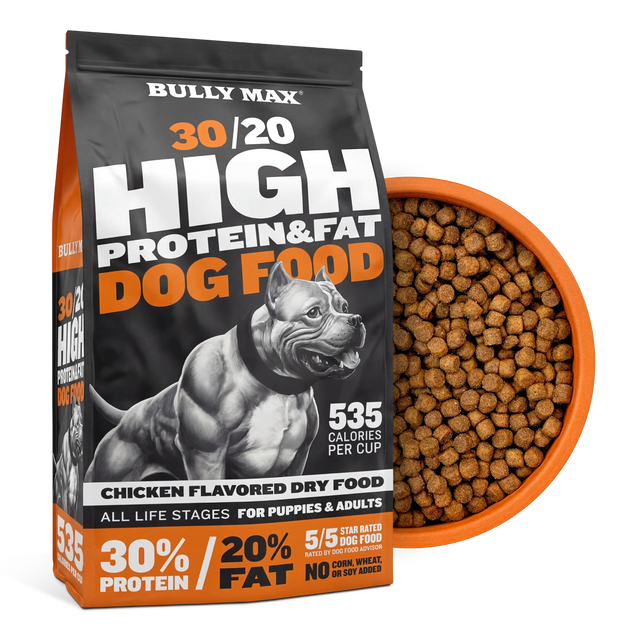
| 30/20 High Protein Chicken | 30% / 20% | 535 | 2.8 cups |
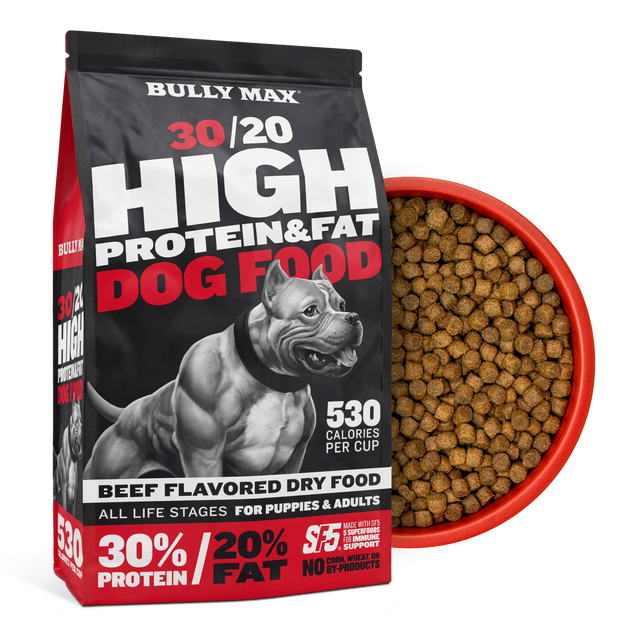
| 30/20 High Protein Beef | 30% / 20% | 530 | 2.8 cups |
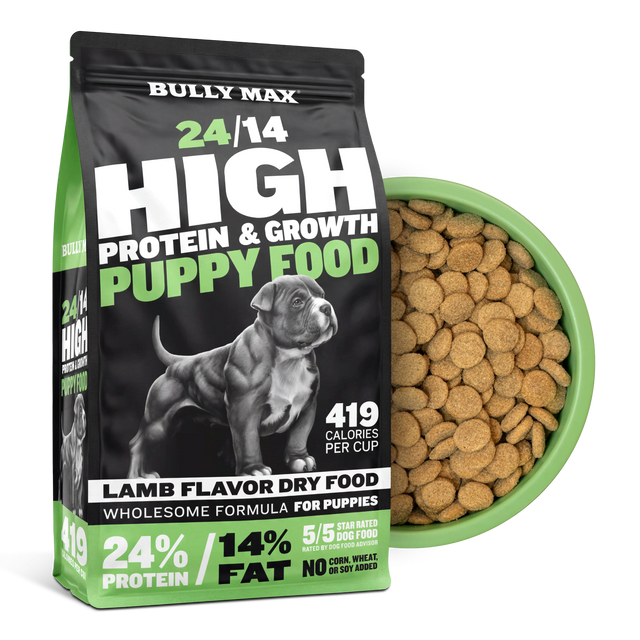
| 24/14 High Protein & Growth Puppy | 24% / 14% | 419 | 3.6 cups |
| 25/11 Lamb (45% less fat) | 25% / 11% | 415 | 3.6 cups |
From each product page. Cups for 1,500 calories is an estimate (1,500 ÷ kcal per cup), shown only to compare formulas.
PRO Series 31/25 packs 600 calories into each cup, about 12% more than our 30/20 formulas and about 45% more than 25/11 Lamb. Here is the PRO 31/25 feeding chart from its product page, by your dog’s target weight:
| Target weight | Cups of PRO 31/25 per day | Calories per day (estimate) |
|---|---|---|
| 20 lb | 1–1⅓ | 600–800 |
| 30 lb | 1⅓–1¾ | 800–1,050 |
| 40 lb | 2–2⅓ | 1,200–1,400 |
| 50 lb | 2⅓–2⅔ | 1,400–1,600 |
| 60 lb | 2⅔–3⅛ | 1,600–1,875 |
| 70 lb | 3¼–4 | 1,950–2,400 |
| 80 lb | 4–4⅔ | 2,400–2,800 |
Feeding amounts from the PRO Series 31/25 product page; calories = cups × 600, rounded. Estimates only: start in the range, then adjust about 10% at a time based on weekly weigh-ins.

Switch over 7 to 10 days so the change doesn’t upset your dog’s stomach. Our guide on how to switch your dog to Bully Max has a day-by-day mixing schedule. For a personal estimate, try the dog food calculator.
Step 3: Top up with extra calories if needed
If the scale hasn’t moved after a week or two, add calories on top of the food rather than just piling more kibble in the bowl. Liquid Weight Gainer adds about 150 calories per ounce from fish oil and whey protein. The label directions for adult dogs are 2 tablespoons per 30 lb of body weight, up to three times a day. Count those calories in the daily total.


ADD CALORIES WITH LIQUID WEIGHT GAINER
About 150 calories per ounce from fish oil and whey protein. Pour it over food to add calories without adding volume.
A daily weight-gain chew is an easy way to add support for dogs that won’t eat more at mealtime:

HELP YOUR DOG GAIN HEALTHY WEIGHT
A daily soft chew made to help support healthy weight gain, with probiotics to help support digestion. Give by body weight as directed on the bag.
Step 4: Weigh weekly and adjust
Weigh on the same scale at the same time of day, once a week. Gaining steadily? Keep going. No change after two weeks? Add about 10% more food. Gaining fast, or soft stools? Cut back a little. When your dog reaches body condition 4 to 5, go back to the amount for its ideal weight and keep it there.
Step 5: Build muscle, not just fat
Calories put weight on; activity decides where it goes. Daily walks, play and short strength sessions help your dog put on muscle as well as cover. Avoid very long runs during the plan, since they burn the calories you are adding. For more ideas, read how to fatten up a dog and how to help your dog gain weight the healthy way.
Get everything for weight gain in one place
PRO Series 31/25, Power Chews for Weight Gain and Liquid Weight Gainer, together in our weight gain food and supplements collection.
Shop weight gainWhat Owners Say
Proof first. Bully Max has over 50,000 5/5 reviews and a 5/5 rating from Dog Food Advisor, and has fed millions of dogs. We are a family-owned U.S. company founded in 2009, our food is made in the USA, every batch is triple tested for safety, and we have zero recalls. About 9% of the customers in our post-purchase survey bought Bully Max specifically to help a thin dog gain weight.
“Better results for her and keeping weight on her” — Bully Max customer, post-purchase survey
“Well I just adopted an American bully from a family that couldn’t take care of him anymore. When I got him he was skinny but I used your food and he’s getting muscles” — Bully Max customer, post-purchase survey
“my dog is a picky eater and I felt comfortable with wanting him to gain more weight” — Bully Max customer, post-purchase survey
“Quality of food, variety of food, works well with rescue refeeding” — Bully Max customer, post-purchase survey
Every dog is different, and results depend on the dog, its health and how closely the plan is followed. Rescues and very thin dogs should always gain weight under a vet’s care. Our post on helping a rescue pitbull gain weight and muscle safely covers that situation step by step.
FAQ
How can I tell if my dog is underweight?
Feel the ribs, spine and hip bones. If the ribs are easy to see, the spine and hip bones stick out, and you can feel no fat over the ribs, your dog is underweight. On the 9-point body condition scale, that is a 3 or lower.
What is a healthy body condition score for a dog?
A 4 or 5 out of 9. You can feel the ribs easily under a light layer of fat, see a waist from above and see the belly tuck up from the side.
How fast should an underweight dog gain weight?
Slowly and steadily. Ask your vet for a target weight and a safe pace. Weigh weekly and make small changes, about 10% at a time. Very thin or starved dogs need a vet-guided refeeding plan.
What can I feed my dog to gain weight?
A complete, calorie-dense food is the base: Bully Max PRO Series 31/25 has 600 calories per cup. Feed it for the target weight in three meals, and add a calorie topper such as Liquid Weight Gainer or a weight-gain chew if your dog needs more.
How much should I feed an underweight dog?
Feed the amount for the dog’s target weight, not its current weight. On PRO 31/25, a dog with a 50 lb target gets about 2⅓ to 2⅔ cups a day by the product’s feeding chart. Treat that as an estimate and adjust weekly.
When should I worry about my dog losing weight?
Any weight loss you can’t explain, weight loss while eating normally, or weight loss with vomiting, diarrhea, extra thirst, coughing or low energy needs a vet visit. Don’t wait for the 30-day plan to find out.
Start Your Dog’s 30-Day Plan
Vet check, baseline weigh-in and body condition score, then calorie-dense food fed for the target weight, weekly weigh-ins and small adjustments. For the food, start with PRO Series 31/25 High Calorie Dog Food. For extra help, add Liquid Weight Gainer or Power Chews for Weight Gain, or browse all weight gain food and supplements. Our high calorie dog food guide compares the options.
Try it for 30 days on Autoship
A weight-gain plan works best when you never run out. Put PRO Series 31/25 on Autoship and save 10% on every order.
Start Autoship and save 10%Sources
- WSAVA Global Nutrition Committee, Body Condition Score chart for dogs (9-point scale).
- Bully Max PRO Series 31/25 High Calorie Dog Food product page (600 kcal per cup; feeding chart).
- Bully Max Liquid Weight Gainer 2-in-1 product page (about 150 kcal per ounce; label directions).
- Bully Max post-purchase survey, Dec 2024 to Jun 2025 (reasons for buying).