How Big Do Cane Corsos Get? Full Grown Size and Growth Chart by Age
A full grown Cane Corso is a large dog, not a giant one: the AKC standard calls for males of 25 to 27½ inches at the shoulder and females of 23½ to 26 inches, with weight "proportionate to height," and the UKC standard puts that weight at 100 to 110 lb for males and 88 to 100 lb for females. Most Corsos reach their adult height by 12 to 14 months and keep filling out in chest, neck and muscle until about 2 years. The growth chart below gives typical weight and height ranges month by month, what changes them, and how to feed a Corso puppy so it grows steady instead of fast.
Family-owned since 2009 · Made in USA · Every batch triple tested · Zero recalls · 50,000+ 5-star reviews · Dog Food Advisor 5/5
Cane Corso size at a glance
- Adult height: males 25 to 27½ in, females 23½ to 26 in (AKC standard).
- Adult weight: males 100 to 110 lb, females 88 to 100 lb (UKC standard). Many American-bred Corsos run above this.
- Half grown: around 5 to 6 months a Corso puppy is usually close to half its adult weight (estimate).
- Height done: about 12 to 14 months. Frame done: 18 to 24 months.
- The real check: ribs you can feel with light pressure and a waist you can see from above beat any number on a chart.
- Feeding: a large-breed growth food in measured meals, no added calcium, adult food at 12 to 18 months.
What Is a Cane Corso?
The Cane Corso (plural Cani Corsi, usually just "Corsos") is an Italian mastiff-type guardian, which is why you will see it called the Italian Mastiff or the Cane Corso Mastiff. The AKC standard describes an "ancient Italian breed" of medium-large size, a Molossus dog that is "sturdy, with a strong skeleton," "muscular and athletic," and moves "with considerable ease and elegance." It descends from the Roman Molossian dogs and was kept in southern Italy to guard property and livestock and drive cattle; the name comes from the Latin "cohors," the guardian of the farmyard. The UKC recognized the breed in 2008, the AKC placed it in the Working Group in 2010, and the FCI lists it as standard No. 343 among the Molossian breeds.
So yes, a Cane Corso is a mastiff, but a lighter and more athletic one than an English Mastiff or a Neapolitan Mastiff. On temperament the AKC standard is specific: "intelligent, easily trained," and "docile and affectionate to his owner, loving with children and family," while "as a protector of his property and owners" the breed "is unequaled." The AKC breed page gives a life expectancy of about 9 to 12 years. In practice that means a dog that watches the door, needs early socialization and consistent training, and should come from a breeder who health tests. Mastiff breeds also hold most of the records in the strongest dogs in the world.
How Big Do Cane Corsos Get? Full Grown Size
Three registries publish a Cane Corso standard and they agree closely. The AKC sets height and leaves weight "proportionate to height"; the UKC and the FCI put numbers on the weight.
| Male Cane Corso | Female Cane Corso | |
|---|---|---|
| Height at the shoulder (AKC) | 25 to 27½ in | 23½ to 26 in |
| Weight (UKC) | 100 to 110 lb | 88 to 100 lb |
| Weight (FCI) | 45 to 50 kg (about 99 to 110 lb) | 40 to 45 kg (about 88 to 99 lb) |
| Build (AKC) | Slightly longer than tall; "muscular and athletic"; weight proportionate to height | |
AKC Official Standard of the Cane Corso; UKC Cane Corso Italiano standard; FCI standard No. 343. Individual dogs run above and below the standard.
Those are show-ring numbers. Pet and working Corsos in the United States often run above the standard, and some lines produce males well over 120 lb. Bigger is not better for a Corso: a dog well over the standard carries extra load on hips, elbows and cruciate ligaments in a breed that already has its share of joint disease. If your puppy's parents are in the standard, plan for the standard. If they are 125 lb dogs, plan for a bigger adult and be stricter about keeping the puppy lean on the way there.
Cane Corso Growth Chart by Age
There is no published, measured growth curve for the Cane Corso, so any chart you find online, including this one, is an estimate. Ours applies the typical large-breed growth curve described in the Merck Veterinary Manual and by VCA Animal Hospitals to the adult standards above: a large-breed puppy is near 50 percent of its adult weight at 5 to 6 months, around 75 percent at 9 months, about 90 percent by 12 months, and finishes its frame between 18 and 24 months. The low end of each range is a small female growing slowly; the high end is a big male growing fast.
| Age | Male weight (lb, estimate) | Female weight (lb, estimate) | Height at shoulder (in, estimate) | Share of adult weight |
|---|---|---|---|---|
| 8 weeks | 15 to 24 | 13 to 22 | 10 to 13 | about 15 to 22% |
| 3 months | 25 to 36 | 22 to 33 | 13 to 16 | about 25 to 33% |
| 4 months | 35 to 50 | 31 to 45 | 16 to 19 | about 35 to 45% |
| 5 months | 44 to 60 | 39 to 55 | 18 to 21 | about 44 to 55% |
| 6 months | 52 to 69 | 46 to 63 | 20 to 23 | about 52 to 63% |
| 7 months | 60 to 77 | 53 to 70 | 21 to 24 | about 60 to 70% |
| 8 months | 66 to 84 | 58 to 76 | 22 to 25 | about 66 to 76% |
| 9 months | 72 to 89 | 63 to 81 | 22 to 26 | about 72 to 81% |
| 10 months | 77 to 95 | 68 to 86 | 23 to 26 | about 77 to 86% |
| 12 months | 85 to 102 | 75 to 93 | 23 to 27 | about 85 to 93% |
| 15 months | 90 to 107 | 79 to 97 | 23½ to 27½ | about 90 to 97% |
| 18 months | 94 to 110 | 83 to 100 | 23½ to 27½ | about 94 to 100% |
| 24 months (adult) | 100 to 110 | 88 to 100 | 23½ to 27½ | 100% |
Estimates, not targets. Adult rows are the UKC weight and AKC height standards; puppy rows apply the typical large-breed growth curve (Merck Veterinary Manual; VCA Animal Hospitals) to those adult ranges. Heights are at the top of the shoulder, both sexes combined. A healthy Corso can sit above or below every row. Judge by body condition, and ask your vet if growth looks too fast or too slow.
How to read it: at 4 months a Corso puppy is usually 35 to 50 lb, already the size of many adult pit bulls. By 6 months the fastest part of growth is over; the weight keeps climbing but the pace slows every month. At 12 months most Corsos are within 10 percent of their adult weight and almost at full height, and the last 10 to 15 lb come on slowly as chest, neck and muscle over the second year. If your puppy came from oversize parents, shift every row up; if the parents were small for the standard, shift them down. The parents predict your dog better than any chart.

When Do Cane Corsos Stop Growing?
In two stages. Height comes first: the long bones grow from growth plates near each joint, and in a large breed those plates close somewhere between 12 and 18 months. Most Corsos are at or within an inch of their adult height by 12 to 14 months (estimate). Weight comes second. The Merck Veterinary Manual puts the end of growth for large and giant breeds at 10 to 16 months or later, and VCA notes that the biggest breeds can take up to two years to reach adult weight. For a Corso that means the rib cage deepens, the neck thickens, the head broadens and the muscle fills in through the second year. A 14-month-old Corso that looks tall, narrow and a little gangly is normal; an 18-month-old that has started to look like the adults in the ring is on schedule.
Two things follow. Do not push food during the lanky phase to "fill the dog out": muscle comes with maturity and exercise, and extra calories at 14 months turn into fat, not frame. And protect the joints while the growth plates are open: free play and walks are fine, but hold off on repetitive jumping, long runs on hard ground and any pulling sport until your vet confirms the plates have closed.
Male vs Female Cane Corso Size
The standards separate the sexes by about an inch and a half in height and 10 to 12 lb in weight: males 25 to 27½ inches and 100 to 110 lb, females 23½ to 26 inches and 88 to 100 lb. Males also carry a broader head, a thicker neck and more bone. On the growth chart the sexes track together for the first three or four months, then males pull ahead and finish roughly 10 percent heavier. A big female can outweigh a small male; the ranges overlap in the middle. Both sexes finish on the same timeline: height by 12 to 14 months, frame by 18 to 24.
Is My Cane Corso Puppy Too Small or Too Big?
Probably neither. Puppies from the same litter land at different points in the range, and a dog at the bottom of the chart is not behind. Before you change anything, run the body condition check that veterinarians use:
- Ribs. Run your fingers along the side of the chest with light pressure. You should feel each rib under a thin layer of cover. If you have to press to find them, the puppy is carrying too much. If you can see them from across the room, too little.
- Waist. Look down from above. There should be a visible tuck behind the ribs. A straight line from chest to hips means too heavy.
- Belly. From the side, the belly should rise from the chest toward the hind legs rather than hang level.
A puppy that passes that check is growing right, whatever the scale says; our guide to body condition and underweight dogs has the full chart. Weigh on the same scale every one to two weeks and watch the trend, not one reading. If a Corso puppy is losing weight, refusing food, has diarrhea or vomiting, or seems sore or stiff when it gets up, that is a vet visit, not a food change.

What Changes How Fast a Cane Corso Grows
- Genetics. The parents set the ceiling. A puppy from standard-sized parents will not become a 130 lb dog without becoming a fat one.
- Sex. Males finish taller and roughly 10 percent heavier, and they keep adding bulk a little longer.
- Spay and neuter timing. Sex hormones help close the growth plates, so dogs altered early tend to grow slightly taller and leggier. UC Davis researchers (Hart et al., 2020) found that in several large breeds, spaying or neutering before about a year was associated with more joint disorders; the Cane Corso was not in that study, so take the timing question to your vet.
- Nutrition. A complete growth food that is suitable for large-breed puppies under AAFCO guidelines, in measured amounts, produces steady growth. Too few calories or a poor-quality protein slow growth; too many calories speed it up.
- Overfeeding and extra calcium. The one you control. In large breeds, excess calories and calcium during growth are linked to developmental orthopedic disease, which is why veterinary nutritionists at Tufts and VCA say to keep large-breed puppies lean and never add calcium to a complete puppy food.
- Health. Parasites, a poor start before eight weeks and illness all cost growth. Most puppies catch up once treated; one that keeps falling off its curve needs a vet.
Feeding a Cane Corso Puppy for Steady Growth
The feeding plan for a Corso puppy is the large-breed plan: a steady pace, not the fastest pace. The rules:
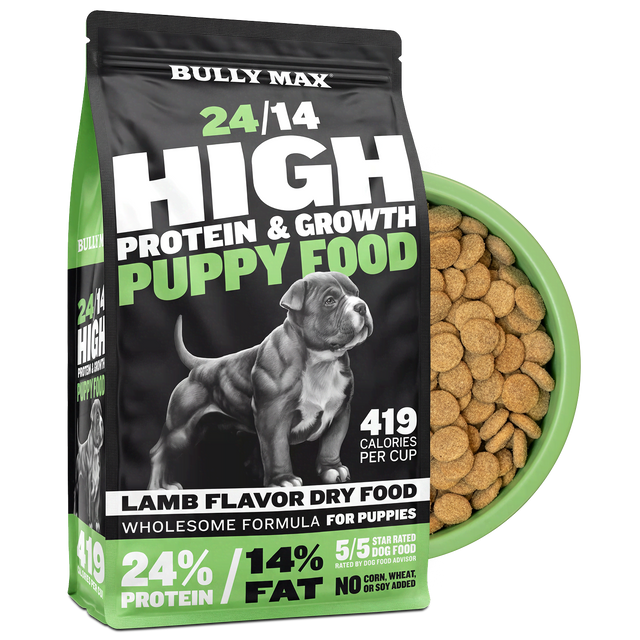
- Feed a growth or all-life-stages food whose label says it is suitable for large-breed puppies under AAFCO guidelines (growth of large size dogs, 70 lb or more as an adult). Bully Max 24/14 High Protein & Growth Puppy Food is one: 24% protein, 14% fat, 419 calories per cup, lamb meal first, with TruMune to support digestion and immune health.
- Measure every meal: three a day to about 6 months, then two a day for life. In a deep-chested breed, one large meal a day is also a bloat risk.
- Do not free feed, do not add calcium or bone meal, and do not try to grow the biggest dog in the litter.
- Feed to body condition. Start from the chart, then adjust about 10 percent at a time to keep the ribs easy to feel.
Here is a compact version of the 24/14 feeding chart at the weights a Corso puppy passes through. Feed by today's weight, not by age.
| Puppy's weight today | Typical Corso age (estimate) | Cups of 24/14 per day | Calories per day (estimate) |
|---|---|---|---|
| 14 to 18 lb | 8 to 10 weeks | 1¾ to 2¼ | 733 to 943 |
| 18 to 23 lb | 10 to 12 weeks | 2¼ to 2½ | 943 to 1,048 |
| 27 to 32 lb | 3 to 4 months | 3 to 3¼ | 1,257 to 1,362 |
| 32 to 36 lb | 4 months | 3¼ to 3¾ | 1,362 to 1,571 |
| about 51 lb | 5 to 6 months | 3¾ to 4¼ | 1,571 to 1,781 |
| about 66 lb | 7 to 8 months | 4¼ to 4¾ | 1,781 to 1,990 |
| about 81 lb | 9 to 12 months | 4¾ to 5¼ | 1,990 to 2,200 |
Estimates from the Bully Max 24/14 Puppy Food feeding chart (standard 8 oz cup; the chart adds ½ cup for each additional 15 lb over 36 lb). Calories = cups × 419. Split the day's total into meals and adjust to keep the puppy lean. Ages are typical, not targets. Ask your vet if you are unsure.
The full feeding schedule, label rules and mistakes to avoid are in Cane Corso puppy food: what to feed and how much; the calcium and AAFCO detail is in large breed puppy food; the dog food calculator gives a personal number and puppy schedule 101 fits the meals into the day. If you are raising a Corso puppy now, Bully Max 24/14 Puppy Food is the formula built for this curve; switch over 7 to 10 days as in how to switch your dog to Bully Max.
When to switch a Cane Corso to adult food
Between 12 and 18 months, once height has stopped and weight gain has slowed to a crawl. Because 24/14 is formulated for all life stages, including growth of large size dogs, there is no rush. When you do switch, a young adult Corso that trains or works does well on a meat-based 30/20 at 535 calories per cup in two meals; a Corso that gains easily does better on 25/11 Lamb at 415. The signs are in when to switch to adult dog food, and the adult options are compared in best dog food for Cane Corsos.
What a Full Grown Cane Corso Looks Like on Bully Max
This is where the chart ends: an adult Corso with a deep chest, a thick neck, hard muscle and a waist you can still see. The clip below is Hank the Tank, an adult Cane Corso fed Bully Max, and the card under it is the adult food.

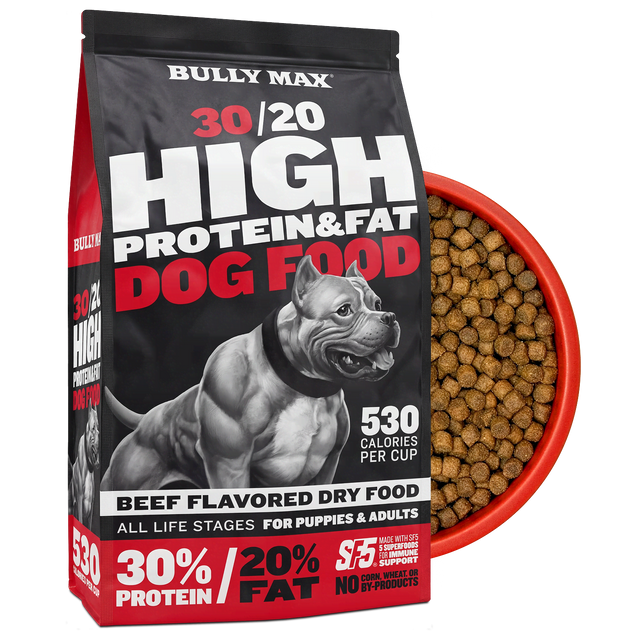
BULLY MAX 30/20 HIGH-PROTEIN CHICKEN
30% protein, 20% fat and 535 calories per cup from real chicken, with TruMune to support digestion and immune health. Made in the USA.
Save 10% with autoship on every bag.
About one in ten Bully Max customers in our post-purchase survey owns a Cane Corso. In their words:
In our customers' words
“I have a big dog and I need a brand that’s made for big dogs”
Bully Max customer, post-purchase survey
“My dog has been eating this since he was 6 weeks old. He is now 4 years old and is solid, muscle definition in his legs.”
Bully Max customer, post-purchase survey
“Better results for her and keeping weight on her”
Bully Max customer, post-purchase survey

FEEDING A CANE CORSO?
See the Cane Corso feeding guide
The 30/20 formula for a 100 lb guardian, cups per day by weight, and real Corso owners’ results.
50,000+ five-star reviews
FAQ
How big is a full grown Cane Corso?
By the standards, a full grown male Cane Corso stands 25 to 27½ inches at the shoulder and weighs 100 to 110 lb; a female stands 23½ to 26 inches and weighs 88 to 100 lb (AKC height, UKC weight). Many pet and working Corsos in the United States run heavier than the standard.
How much should a 6 month old Cane Corso weigh?
Typically about 52 to 69 lb for a male and 46 to 63 lb for a female (estimate), which is a little past half of the adult weight. A puppy outside that range can still be healthy; check body condition and the weight of the parents before worrying.
At what age is a Cane Corso full grown?
Height is mostly finished by 12 to 14 months, with the growth plates closing between 12 and 18 months. Weight, chest depth and muscle keep filling in until about 2 years, so most Corsos look fully mature at 18 to 24 months.
How tall is a Cane Corso?
The AKC standard calls for 25 to 27½ inches at the shoulder for males and 23½ to 26 inches for females. Dogs an inch over or under are not unusual.
How big do female Cane Corsos get?
Females are the smaller sex: 23½ to 26 inches and 88 to 100 lb under the standards, with a narrower head and less bone than a male of the same height. A big female can still outweigh a small male.
Is a Cane Corso a mastiff?
Yes. The Cane Corso is an Italian mastiff-type (Molossian) breed, often called the Italian Mastiff, and the FCI lists it among the Molossian breeds. The AKC shows it in the Working Group. It is lighter and more athletic than the English Mastiff, whose males commonly weigh 160 lb or more.
The Short Answer
A Cane Corso grows into a 100 lb dog, give or take, over about two years: half its weight by 6 months, almost full height by a year, the rest as muscle and frame through the second year. Use the chart as a guide, the parents as the forecast and the rib check as the final word, and feed a large-breed growth food in measured meals so the puppy gets there steady: Bully Max 24/14 for the puppy, 30/20 fed by calories for the adult it becomes.
Sources
- American Kennel Club, Official Standard of the Cane Corso (approved 2009; Working Group 2010): height, proportion, temperament; AKC Cane Corso breed page: life expectancy. akc.org
- United Kennel Club, Cane Corso Italiano breed standard (2008): weight ranges. ukcdogs.com
- FCI, Cane Corso Italiano standard No. 343: weight in kg. fci.be
- Merck Veterinary Manual, Feeding Practices in Small Animals: puppy growth rate, end of growth in large and giant breeds (10 to 16 months or later), calcium in large-breed growth. merckvetmanual.com
- VCA Animal Hospitals, Nutritional Requirements of Large and Giant Breed Puppies: up to two years to adult weight, keep puppies lean, no calcium supplementation. vcahospitals.com
- Linder, D. E., Cummings School of Veterinary Medicine at Tufts University, Petfoodology: large-breed puppy feeding rules and the AAFCO large-size growth statement (70 lb or more as an adult). sites.tufts.edu/petfoodology
- Hart, B. L., et al., "Assisting Decision-Making on Age of Neutering for 35 Breeds of Dogs," Frontiers in Veterinary Science, 2020: neuter timing and joint disorders in large breeds (Cane Corso not studied).
- Bully Max 24/14 High Protein & Growth Puppy Food and 30/20 High Protein Chicken product pages: label analysis, calories per cup, feeding charts, AAFCO statements.
- Bully Max YouTube, Dog Muscle Building: Hank the Tank on Bully Max (35ephjHSB40); Bully Max post-purchase survey, Dec 2024 to Jun 2025 (customer quotes and breed share).