Salmon Oil for Dogs: Benefits, How Much to Give, and What to Look For
Salmon oil is a fish oil rich in EPA and DHA, the omega-3 fatty acids that help support healthy skin, a shiny coat and joints. Most dogs can take it every day on their food at the amount on the label. Start low, build up slowly, and talk to your vet first if your dog has a health condition, takes medication or has surgery coming up.
Salmon oil for dogs at a glance
- What it is: oil from salmon, naturally rich in the omega-3s EPA and DHA.
- What it's used for: helps support skin, a soft and shiny coat, joints in active and older dogs, and brain development in puppies.
- How much: follow the label and your vet. The Bully Max label says ½ teaspoon per 10 lbs of body weight, added to food.
- Side effects: usually mild, like loose stool or fishy breath. More is not better, so stick to the label.
- What to look for: EPA and DHA listed on the label, a named fish source, a natural preservative and clear dosing by weight.
What Is Salmon Oil for Dogs?
Salmon oil is the fat pressed from salmon. Like other fish oils, its value comes from two long-chain omega-3 fatty acids:
- EPA (eicosapentaenoic acid), the omega-3 most often used to help support joints and skin.
- DHA (docosahexaenoic acid), a building block of the brain and eyes, which is why it matters for puppies.
Plants have omega-3s too, but a different kind. Flaxseed and chia contain ALA. Dogs can turn ALA into EPA and DHA, but not very efficiently, so plant oils are not a stand-in for fish oil. If you want EPA and DHA, fish oil is the direct route.

Salmon oil also has a smell and taste most dogs love. That makes it one of the easier supplements to get into a dog, even a picky one.
One easy daily habit for your dog: a pour of wild-caught salmon oil on the food.

ADD OMEGA-3S WITH BULLY MAX SALMON OIL
Wild-caught Alaskan salmon oil with omega-3, 6, and 9 plus EPA and DHA. An easy daily pour for skin, coat, and overall health.
Here is what that looks like in the bowl: Bully Max Omega-3 Salmon Oil poured straight over kibble at mealtime. See how much to give by weight.
Benefits of Salmon Oil for Dogs
Salmon oil is a supplement, not a medicine. Here is what owners use omega-3s from fish oil for, and what to keep realistic.
Skin and a shiny coat
This is the reason most owners start. Omega-3 and omega-6 fatty acids are part of healthy skin, and skin health shows up in the coat. Dogs on a diet with enough of the right fats tend to have a softer, glossier coat and less dry, flaky skin.
Coat is something our customers talk about a lot. In our post-purchase survey of about 2,400 customers, around 10% named coat, skin, digestion or overall health as a reason they buy Bully Max. Here is how two of them described it:
"I saw online how people fed their dogs bully max and they looked amazing. Their muscles were very toned, coat looked nice and shiny, the dogs looked like they were full of energy."
Bully Max customer, post-purchase survey
"I began to notice the positive change in their coats, build, and digestion"
Bully Max customer, post-purchase survey
A dull coat isn't always a fat problem, though. If your dog's coat is dry, thin or patchy, or the skin is red and itchy, see your vet. Parasites, allergies, infections and hormone problems can all show up in the coat. Our guide to coarse, brittle dog hair covers the common causes, and if your vet points to a food trigger, see our guide to the best dog food for allergies.

Joints in active and older dogs
EPA is the omega-3 most often used to help support joint comfort and mobility. That's why fish oil shows up in routines for working dogs, sport dogs and seniors. Salmon oil is daily support, not a treatment. If your dog is limping, stiff or slow to get up, see your vet first, and if your dog has a joint condition, ask your vet whether fish oil fits the plan and at what amount. Learn more about osteoarthritis in dogs.

Dogs with a medical condition
Vets sometimes include omega-3s in the care plan for dogs with heart, kidney or other conditions. That is your vet's call, including the amount. Don't use salmon oil to manage a medical condition on your own.
Brain and eye development in puppies
DHA is a key fat in the brain and retina, which is why many puppy foods add it. A small amount of salmon oil can be part of a puppy's diet, but check with your vet first, especially if your puppy food already includes DHA. Our guide to puppy health covers the basics.
Picky eaters
About 14% of our survey respondents said they chose Bully Max because their dog loves the taste or a picky eater finally ate. A pour of salmon oil is one of the simplest ways to make a bowl more appealing. For more ideas, see the best dog food for picky eaters.
Salmon Oil vs. Fish Oil: What's the Difference?
"Fish oil" is a broad term, and salmon oil is one kind. What matters most is how much EPA and DHA you get and how fresh the oil is, not the fish name on the front.
| Source | EPA and DHA? | Notes |
|---|---|---|
| Salmon oil | Yes | Popular, palatable, easy to pour. Check the label for EPA and DHA amounts. |
| Pollock and whitefish oil | Yes | Often blended with salmon oil. |
| Anchovy, sardine, menhaden ("fish oil") | Yes | Small oily fish. Common in fish oil capsules and in dog food. |
| Krill oil | Yes | Usually sold in small capsules and costs more per serving. |
| Algae oil | Mostly DHA | A non-fish source of DHA. |
| Cod liver oil | Yes | Also high in vitamins A and D. Too much can be harmful, so use it only with your vet's advice. |
| Flaxseed, chia, hemp oil | No (ALA only) | Dogs convert ALA to EPA and DHA poorly. |
General comparison. Exact EPA and DHA content varies by product, so read the label.
What is the best salmon oil for dogs?
The best salmon oil for your dog is one that lists its EPA and DHA, comes from a named fish, is fresh, and that your dog will actually eat. Pour bottles are easiest for big dogs. Capsules can work for small dogs or for owners who want an exact amount. Use the checklist further down to compare products.
How Much Salmon Oil Should I Give My Dog?
Follow the label on your product and your vet's advice. Products differ in strength, so an amount that's right for one bottle can be wrong for another. Your vet may suggest a different amount for a dog with a health condition.
For Bully Max Omega-3 Salmon Oil, the label direction is ½ teaspoon per 10 lbs of body weight, added to food at mealtime. Here's what that works out to:
| Dog's weight | Daily amount (label direction) |
|---|---|
| 10 lbs | ½ teaspoon |
| 20 lbs | 1 teaspoon |
| 30 lbs | 1½ teaspoons |
| 40 lbs | 2 teaspoons |
| 50 lbs | 2½ teaspoons |
| 60 lbs | 3 teaspoons (1 tablespoon) |
| 80 lbs | 4 teaspoons |
| 100 lbs | 5 teaspoons |
For Bully Max Omega-3 Salmon Oil only. Other products have different strengths. Ask your vet before giving salmon oil to a dog with a medical condition.

Tips for adding salmon oil
- Start low. Begin with part of the label amount and build up over a week or two. Going slowly helps avoid loose stool.
- Measure it. Use a real teaspoon, not a guess. A few extra pours a day add up.
- Count the calories. Oil is almost pure fat. As an estimate, one teaspoon of fish oil adds about 40 calories, so 5 teaspoons for a 100 lb dog is roughly 200 calories a day. If your dog starts gaining weight it doesn't need, adjust the food. Our guide on how much to feed your dog shows how.
- Don't double up. If your dog already gets a fish oil, cod liver oil or a supplement with omega-3s, tell your vet before adding another.
Curious how much EPA and DHA that is? The Bully Max label lists at least 6.0% EPA and 5.5% DHA in a 4.5 gram teaspoon. As an estimate from those minimums, that's roughly 500 mg of combined EPA and DHA per teaspoon. Your vet can use that number if they want to set a specific amount.
Salmon Oil Side Effects and Safety
At label amounts, most dogs do fine on salmon oil. The most common issues are mild:
- Loose stool or diarrhea, usually from starting too fast
- Fishy breath or a fishy smell to the coat
- Vomiting in some dogs
- Weight gain from the extra calories
Higher amounts carry more risk. Veterinary reviews of omega-3 safety list concerns such as changes in blood clotting, digestive upset, slower wound healing, rancid oil, weight gain and interactions with some medications. That is why the label amount matters.
Talk to your vet before giving salmon oil if your dog
- Has a bleeding or clotting disorder, or takes a blood thinner
- Has surgery or a dental procedure coming up
- Has a history of pancreatitis or does poorly on high-fat foods
- Has diabetes, or heart, kidney or liver disease
- Takes any regular medication or other supplements
- Is pregnant, nursing or a very young puppy
Stop the oil and call your vet if your dog has ongoing vomiting or diarrhea, unusual bruising or bleeding, or seems unwell. And use a product made for dogs. Flavored human supplements can contain ingredients that aren't safe for dogs, such as xylitol.
What to Look for in a Salmon Oil for Dogs
Salmon oil buying checklist
- EPA and DHA on the label. A guaranteed analysis that lists both tells you what you're paying for.
- A named source. "Salmon oil" or "wild Alaskan salmon oil" beats an unnamed "fish oil".
- A short ingredient list with a natural preservative like mixed tocopherols.
- Clear dosing by body weight so you're not guessing.
- Made for dogs. No sweeteners or flavors meant for people.
- Storage guidance. Oils go rancid, so the brand should tell you how long an opened bottle lasts.
- A brand you trust. Look at where it's made and how it's tested.
How to store salmon oil
Air, heat and light break down omega-3s. Keep the bottle tightly closed and out of the sun. For Bully Max Omega-3 Salmon Oil, store it in a cool, dry place below 86°F. Once opened, use it within 45 days at room temperature or within 90 days if refrigerated. An unopened bottle has a two-year shelf life from the date of production. If the oil ever smells sharp or paint-like instead of fishy, it has gone off. Throw it out.
Bully Max Omega-3 Salmon Oil
The people who push dogs hardest use it. Travis Torrez of PresaMania Kennels, whose Presa Canario Amarillo won Most Weight Pulled at the ADBA Nationals, lists Omega-3 Salmon Oil among his top three Bully Max products. Read the PresaMania story.

Katie McCutcheon of The Incredibullz, ABKC champion American Bully breeders, has fed Bully Max for nine years. In this short, she talks about what it does for her dogs, including their coats.
ADD BULLY MAX OMEGA-3 SALMON OIL
Wild-caught Alaskan salmon oil blended with pollock oil, with omega-3, 6 and 9 plus EPA and DHA. Pour it on food once a day.
Here's what's in the bottle:
| Bully Max Omega-3 Salmon Oil | |
|---|---|
| Ingredients | Salmon oil, pollock oil, mixed tocopherols (preservative) |
| Source | Wild-caught Alaskan salmon oil, blended with pollock oil |
| EPA (min) | 6.0% |
| DHA (min) | 5.5% |
| Total omega-3 (min) | 18.0% |
| Omega-6 (min) | 1.8% |
| Omega-9 (min) | 14.0% |
| Directions | ½ teaspoon per 10 lbs of body weight, on food at mealtime |
| Who it's for | Puppies, adults and seniors of any breed or size |
From the Bully Max Omega-3 Salmon Oil label and product page. Guaranteed analysis is per 4.5 g teaspoon. It is a supplement for intermittent or supplemental feeding, so keep feeding a complete and balanced food.
Build a Shiny-Coat Routine
Salmon oil works best on top of a good diet and basic grooming. It can't make up for a food that's short on protein or fat.
- Feed a complete, meat-based diet with enough protein and fat. Hair is mostly protein.
- Add omega-3s from fish oil at the label amount.
- Brush weekly. It spreads natural oils and removes dead hair. Short-coated bully breeds benefit too.
- Bathe only when needed with a gentle dog shampoo. Over-bathing dries skin. Try our homemade dog shampoo recipe.
- Keep up with flea and tick prevention and see your vet for itching, hair loss or odor. If your dog smells, our guide on why dogs smell can help.
Want one daily chew instead? 9-in-1 Vitality Chews combine a multivitamin, omega-3 fish oil and probiotics in one bacon-flavored soft chew. Our guide to the best multivitamin for dogs explains when that makes sense.
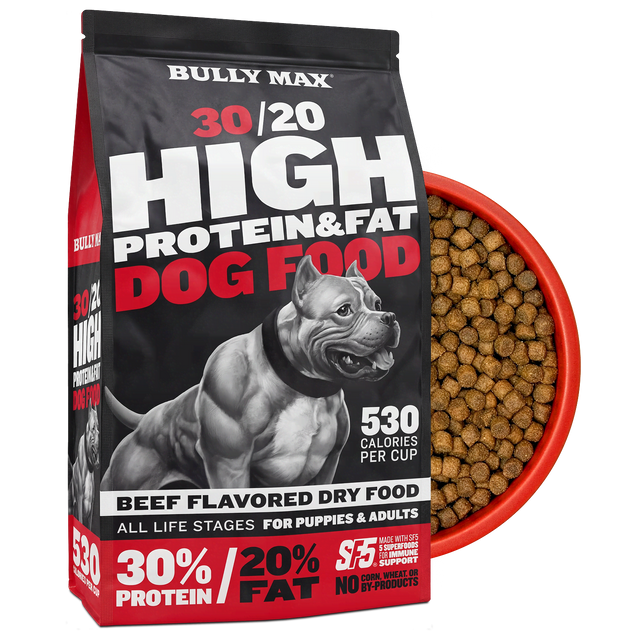
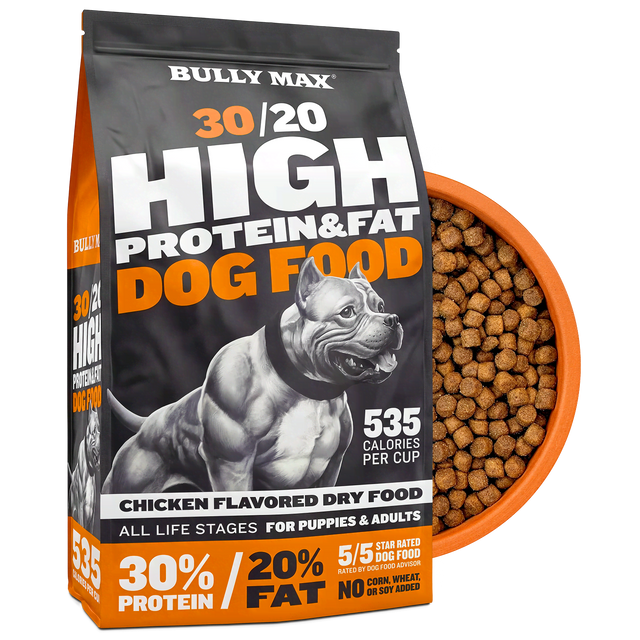
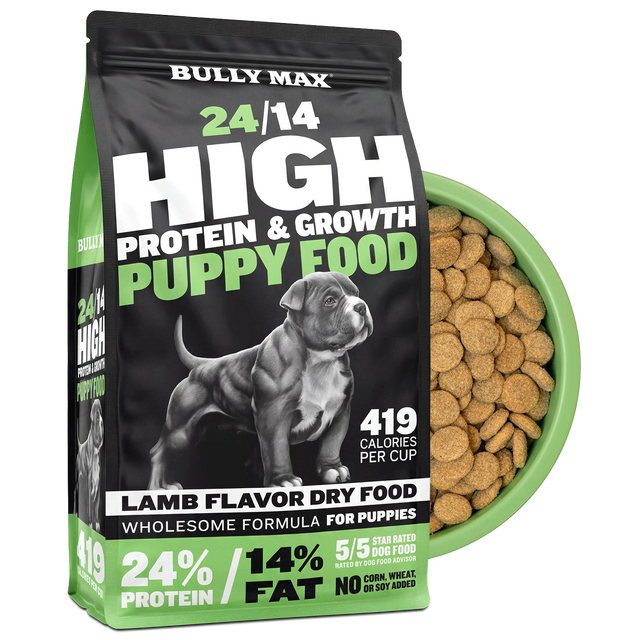
And it all starts with the bowl. Bully Max 30/20 High Protein is our flagship food: high-performance, meat-based nutrition from a family-owned U.S. company founded in 2009. It's made in the USA, every batch is triple tested for safety, and we have zero recalls. Bully Max has over 50,000 5/5 reviews and a 5/5 rating from Dog Food Advisor. Avoiding chicken? Choose our chicken-free 30/20 Beef or 25/11 Lamb instead.

TRY BULLY MAX 30/20 HIGH-PROTEIN DOG FOOD
The base of a shiny-coat bowl: meat-based nutrition with 30% protein, 20% fat and 535 calories per cup.
Salmon Oil for Dogs: FAQ
Is salmon oil good for dogs?
For most healthy dogs, yes. Salmon oil supplies the omega-3s EPA and DHA, which help support skin, coat, joints and brain health. Dogs with bleeding disorders, pancreatitis, upcoming surgery or other medical conditions should only get it with their vet's approval.
How much salmon oil should I give my dog?
Follow your product's label and your vet. Strength varies between products. For Bully Max Omega-3 Salmon Oil, the label direction is ½ teaspoon per 10 lbs of body weight, added to food. Start with less and build up over a week or two.
Can I give my dog salmon oil every day?
Yes. Salmon oil is meant to be given daily on food at the label amount. Just count the extra calories and adjust food if your dog starts gaining weight it doesn't need.
Is salmon oil or fish oil better for dogs?
Salmon oil is a type of fish oil. Neither is automatically better. Compare the amount of EPA and DHA per serving, the freshness and the ingredient list, and choose one your dog will eat.
How long does it take for salmon oil to work on a dog's coat?
Expect weeks, not days. New hair has to grow in, so give it at least a month or two of daily use. If the coat or skin isn't improving, or your dog is itchy, see your vet.
What are the side effects of salmon oil for dogs?
The most common are loose stool, fishy breath and weight gain from the extra calories. Starting slowly and staying at the label amount helps. Stop and call your vet if your dog has ongoing vomiting or diarrhea, or unusual bruising or bleeding.
Can puppies have salmon oil?
Yes, in the right amount. DHA plays a role in brain and eye development, and Bully Max Omega-3 Salmon Oil is labeled for puppies, adults and seniors. Ask your vet before starting a young puppy, especially if the puppy food already contains DHA.
Give Your Dog a Shinier Coat
Salmon oil is one of the simplest upgrades you can make to your dog's bowl. Choose a product that lists its EPA and DHA, follow the label, start slowly and check with your vet if your dog has a health condition. Then give it time. A coat grows in cycles, so judge the results over a couple of months, not a couple of days.
Ready to start? Add Bully Max Omega-3 Salmon Oil to your next order, and set your food and supplements on Autoship to save 10% so you never run out.
GET STARTED WITH BULLY MAX OMEGA-3 SALMON OIL
Wild-caught Alaskan salmon oil with omega-3, 6, and 9 plus EPA and DHA. An easy daily pour for skin, coat, and overall health.