Ear Cropping: Essential Tips for Puppy Owners

Ear cropping is a surgery, done by a veterinarian under general anesthesia, that trims and shapes the outer ear so it stands upright. For pitbulls and American Bullies, most vets that crop do it between about 7 and 12 weeks of age, and the most common styles are the battle, short, show and long crop. Below you'll find each crop style, the best age, how to choose a vet, what recovery and aftercare look like, and the legal and welfare questions to think through first.
Ear cropping is permanent and it is not medically necessary, so it is worth understanding the facts, the welfare concerns and the law before you decide anything. This guide is informational; your veterinarian is the right person to advise on your own dog.
Is Ear Cropping Right for Your Dog?
Before you pick a style, decide whether to crop at all. Ear cropping is cosmetic. It does not make a dog healthier, and a pitbull or bully with natural ears is every bit as much of the breed. Keep these points in mind:
- It is surgery. It needs general anesthesia, pain control and weeks of aftercare.
- Laws differ by country and state. Cosmetic ear cropping is banned in the UK, Australia and much of Europe, and some Canadian provinces restrict it. In the U.S. there is no federal ban, but some states regulate who may perform it and how. Check your local rules.
- Veterinary groups oppose cosmetic cropping. The American Veterinary Medical Association opposes ear cropping done only for appearance, and many vets will not perform it.
- Natural ears are always an option. Many bully shows accept natural ears. Check your registry's breed standard if you plan to show.
If you are still considering it, the sections below explain the styles, timing and recovery that owners usually discuss with their vet. Every medical and aftercare decision belongs to your veterinarian.
The Best Age for Ear Cropping
Most vets that crop prefer to do it between 7 and 12 weeks of age. At that age the ear cartilage is still soft enough to train upright, the puppy is big enough for anesthesia, and recovery tends to be easier.
You may hear that a dog's ears will only stand if they're cropped as a young puppy. That isn't strictly true. Older dogs can be cropped, but it is a bigger, more painful surgery with a longer recovery, and the ears can be harder to get standing because the cartilage is firmer.
Is There an Age Limit for Cropping Your Dog's Ears?
Many vets set their own cut-off. A common limit is somewhere around 12 to 16 weeks, and some vets also set a weight limit. Others have no cut-off and will crop at any age. If your puppy is past the usual window, ask the vet directly how they handle older dogs and what recovery will involve.
Pitbull and American Bully Ear Crop Styles
Crop styles are usually described in four broad groups for American Pit Bull Terriers and American Bullies. Not every vet performs every style.
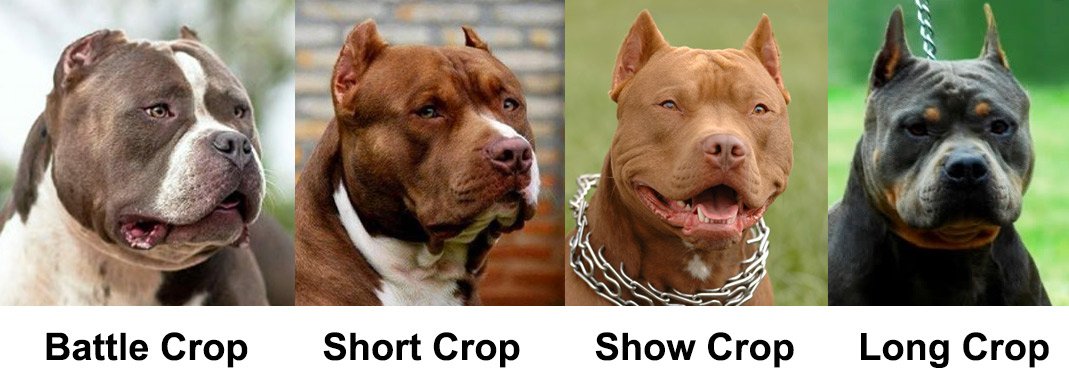
Battle Crop
The shortest style. Most of the ear flap is removed, leaving a small, rounded ear close to the head. It needs little or no posting, but it removes the most ear and offers the least protection from dirt and debris.
Short Crop
A little longer than a battle crop, with a short, upright point. It is a popular, low-maintenance look on pitbulls and bullies and usually stands without a long posting period.
Show Crop
A medium-length crop with a clean, tapered point. This is the style most people picture on a show American Bully. It balances length and stand-up reliability, but it needs a period of posting or taping after surgery.
Long Crop
The longest style, with a tall, elegant point. It needs the longest posting period and is the most likely to fail to stand if aftercare slips.
Crop names vary from vet to vet. Short crops and show crops have the greatest chance of standing erect. Ears that are cropped too long, or too short, are less likely to stand erect.
When a dog's ears are cropped too short, they are more likely to lay flat on the dog's head. When a dog's ears are cropped too long, the cartilage within the pinna may be too thin to support the weight of the ear.
Choosing a Vet
If you go ahead, the procedure must be done by a licensed veterinarian, under anesthesia, where it is legal. Many vets do not perform cosmetic cropping.
Ask your breeder, or other local breeders, where they get their dogs' ears done. They usually know who does consistent work. You can also find local vets that perform ear cropping here: Vets That Crop Ears in the United States.
When you talk to the vet, ask about:
- The all-in price. Costs vary widely by region and clinic, and a more expensive vet does not always mean a better crop. Ask for one quote that covers the exam, anesthesia, surgery, pain medication, follow-up visits and posting or taping.
- Experience. Ask how often they perform the procedure and what outcomes and complications they see.
- Anesthesia and monitoring. Ask how your puppy will be monitored and whether pre-surgery bloodwork is included.
- Aftercare. Ask who handles posting or taping, how often you'll come back, and who to call after hours.
Initial Visit
Once you've chosen a vet, your puppy will usually have an exam so the vet can make sure they're healthy enough for anesthesia. Some vets run a blood test at this point.
The vet will also tell you what to do the night before surgery. Puppies usually have food restricted for a set time before anesthesia, but young puppies have different rules than adult dogs, so follow your vet's exact instructions.
After the Procedure
Your vet may keep your puppy overnight, or you may be able to take them home the same day. Your vet will explain pain control and any supports, posts or tape used to hold the ears in position.
Your puppy will likely be groggy and out of sorts for a night or two. The anesthetic makes them drowsy, and their ears will be sore. Follow your veterinarian's instructions for pain relief, and don't give your puppy any medicine your vet has not approved. If your puppy seems to be in a lot of pain, call your vet.

Aftercare Tips
1) Follow the Vet's Instructions.
Your vet's aftercare plan comes first, and every step below is "follow your veterinarian's instructions." Your puppy has just had surgery, and the next few weeks matter for healing.
2) Use the Cone as Directed.
Most vets send puppies home with a cone (e-collar) so they can't scratch or rub the incisions. Follow your veterinarian's instructions on when it stays on.
3) Incision Care: Follow Your Vet's Instructions.
Your vet will tell you whether and how the incisions should be cleaned. Don't put any product on the ears that your vet has not recommended.
Handling, ear checks and vet visits all go more smoothly when your puppy expects a reward. A soft, bite-sized treat helps keep them calm and cooperative.

MAKE PUPPY TRAINING MORE REWARDING
Soft bite-sized treats with real beef, 22% protein, and DHA to support growth and brain development while your puppy learns.
4) Ask Your Vet About Scabs.
Scabs can form along the cut edge. Don't pick at them. Follow your veterinarian's instructions.
5) Stick to the Posting or Taping Schedule.
Most crops, especially show and long crops, need the ears posted or taped for several weeks, and sometimes a few months, while the cartilage firms up. Follow your veterinarian's schedule, go to every re-taping appointment, and don't remove or change posts yourself.
6) Watch for Infections.
Check your puppy's ears as your vet directs and look for signs of infection: redness, swelling, heat, discharge, a bad smell, increasing pain, or red streaks spreading from the incision. If you see any of these, or your puppy stops eating or seems lethargic, call your vet right away.
7) Nourish Your Puppy Through a Healthy Diet.
Make sure your puppy is eating well and getting the nutrients they need while they heal. Keep feeding a complete puppy food on their normal schedule, usually three measured meals a day, unless your vet tells you otherwise. Our guide to the best pitbull puppy food explains what to look for.
Young puppies need complete nutrition made for their growth stage, before and after the procedure.

GIVE YOUR PUPPY BULLY MAX 24/14 PUPPY FOOD
Made for growing puppies with 24% protein, real lamb, and TruMune to support digestion and immune health.
Ear Cropping FAQ
What is the best age to crop a pitbull's ears?
Most vets that crop prefer 7 to 12 weeks of age. Many have a cut-off around 12 to 16 weeks. Older dogs can be cropped by some vets, but recovery is harder.
How much does ear cropping cost?
Prices vary a lot by region and clinic. Ask for an all-in quote that includes anesthesia, pain medication, follow-up visits and posting or taping, so there are no surprises.
Does ear cropping hurt?
The surgery is done under general anesthesia, but recovery is painful for the first several days. Follow your veterinarian's instructions for pain relief. Healing and posting take several weeks.
How long until cropped ears stand up?
It depends on the crop length and the dog, and some ears never stand. Short crops often stand sooner. Show and long crops usually need several weeks to a few months of posting or taping.
Is ear cropping legal?
Cosmetic ear cropping is banned in many countries, including the UK and Australia. In the U.S. it is legal at the federal level, but some states regulate it. Check your local laws. The AVMA opposes cropping done only for appearance.
More for New Pitbull and Bully Owners
Getting your puppy settled? Read our pitbull puppy guide, our step-by-step guide on how to train a pitbull puppy, and our breakdown of American Bully vs pitbull. For everyday feeding, Bully Max high-protein puppy food is made in the USA with meat-based nutrition, and every batch is triple tested for safety.






109 comments
And here we go with the people who all of a sudden are dog experts lol
First off cruelty is cruelty regardless if it’s human caused or not. Because humans have different stance on what is or isn’t cruelty, it can have various meanings. I would say unnatural-unnecessary cruelty for pleasure of torcher is cruelty to an ultimate level. When a human have intend to do cosmetic cruelty they escape some cruelty by talking steps to make the cruelty quick, safest and less painful. Now, neutered dogs purposes is beneficial to a human in terms of population control. It has no benefits to a dog who will most likely care for its young. Cropped ears is no different. It’s a cosmetic that benefits the owners emotional state which could enhance the owners love or connection to the dog. At the end of the day the dog is still under the control and ownership of humans regardless of the human stance of what should or shouldn’t be done to a dog. With that said, if you are a animal rights fighter and animal protector I suggest you start by banning dog ownership altogether and allow dogs to go back to wolves. Then ban farming and force the world into vegan diets. Then go out and monitor the entire ecological systems and prevent rats from being snake food so snakes can died from hunger…oh wait you have to protect snakes too…damn! I guess we can’t win as long as it’s a natural system of prey vs. predators, kill or be killed, apex vs. the less fortunate, superior intelligence vs. less intelligent and only the strong survives. Oh yeah, make sure you get those animals that would chew off their own feet when trapped in something that not an human error and is caused by nature the get those crocodiles and Komodo dragons fully convince cannibalism is inhumane. I guess it all boils down to what humans think about nature and animals and what humans want even disregarded nature however humans can’t a agree on what a pet owner should or shouldn’t do to their pet because if we can’t control nature so controlling other humans will do fine.
Jeff I agree with you totally! To have the power, technology and resources to prevent long term damage and suffering by committing short term and controlled suffering in the less painful manner is noble especially when you intent is positive and the end result is most beneficial. But to allow damage when it can be prevented is the ultimate cruelty. Even if cropping is to benefit an dog owners emotional satification it brings you more emotional attached to your pet because the physical enhancement of your dog enhanced your connection to the dog. The opposite is having a deaf dog will also enhance your connection too but in a negative manner because you are suffering by going through the painful process of aiding an incurable dog that’s also suffering.
P.S. a dog is a domesticated wolf. A wolfs ear is naturally upright-erected and pointed to better and naturally assist the wolf. If humans are going to take a God-made life-form such as the wolf and make it an unnatural dog, you should at least corrrct the dogs unnatural flopping ears. Moreover, you should leave nature alone altogether and nature will do the best thing for all natural life. So when you think of animal cruelty start by campaigning domestication of all animals and that will prevent animal ownership thus preventing what an animal owner can or cannot do with the animal
I agree! Did somebody really say that since they are born that way it’s suppose to be that way… Then justified having them fixed in the same breath to stop “unwanted litters”??? Based on that argument you don’t even need a valid reason. We can crop to stop “unwanted cartilage”. We messed up the circle of life with domestication. In the reality a bigger predator or lack of food supply would be responsible for those “unwanted” puppies… Not a vet.