Best Dog Food for Sensitive Stomach: A Buyer's Guide
The best dog food for a sensitive stomach is a complete and balanced diet your dog digests well: a clearly named animal protein, a moderate fat level that suits your dog, some fiber, and no long list of extras. For many dogs that means trying a food with a different main protein, such as lamb or beef instead of chicken, and switching to it slowly. If your dog has ongoing vomiting, diarrhea, blood in the stool or weight loss, see your vet before you change foods.
Sensitive stomach dog food at a glance
- Vet first: repeated vomiting or diarrhea, blood, black stool, weight loss, low energy or a dog that won’t eat all need a vet visit, not a new bag of food.
- Read the label: look for a named meat first, few animal protein sources, a fat level that fits your dog, fiber and probiotics.
- Chicken-free options: if you want to move away from chicken, look past the front of the bag for chicken fat, chicken meal and “poultry”.
- Switch slowly: 7 to 10 days, and longer for touchy dogs.
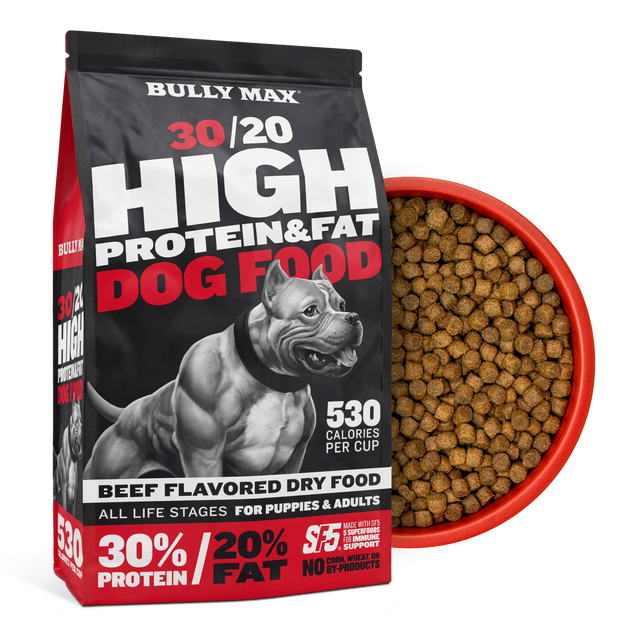
- Bully Max fits: 25/11 Lamb (leaner, 415 kcal/cup), 30/20 Beef (beef is the only named meat, 530 kcal/cup) and 24/14 Puppy for growing dogs.
What Does “Sensitive Stomach” Mean in Dogs?
“Sensitive stomach” isn’t a diagnosis. It’s the phrase owners use for a dog whose digestion seems easy to upset. One dog gets loose stool after any change in food. Another has gas every evening. Another throws up bile in the morning or picks at meals.
Lots of things can be behind it, and only some of them have to do with the food in the bowl:
- Sudden food changes. Switching foods overnight is one of the most common reasons for an upset stomach.
- Too many extras. Table scraps, rich treats, chews and toppers add fat and new ingredients that the main food doesn’t.
- Eating things they shouldn’t. Trash, grass, sticks, toys and other dogs’ food.
- Food that doesn’t suit the dog. A recipe that’s too rich for a less active dog, or an ingredient a particular dog doesn’t handle well.
- Food intolerance or allergy. Less common than most owners think, and something to work out with your vet.
- Stress. Travel, boarding, a new home or a new pet can all show up in the stool.
- Medical problems. Parasites, infections, pancreatitis, inflammatory bowel disease and other conditions can all look like a “sensitive stomach”. Your vet can test for them.
That list is why food is only part of the answer. A better food can be the right move for a dog that is otherwise healthy. It is not a substitute for finding out what’s going on with a dog that is sick.
Signs of a Sensitive Stomach (and When to See Your Vet)
Signs owners commonly notice include:
- Soft or loose stool, or stool that changes a lot from day to day
- Gas, gurgling stomach noises or burping
- Occasional vomiting, often after meals or on an empty stomach
- Eating grass, licking the floor or seeming uncomfortable after eating
- Picky or skipped meals
Our guides on how to firm up your dog’s stool, common causes of dog diarrhea and helping your dog’s upset stomach go deeper on each of these.
Call your vet, don’t switch food, if you see
- Vomiting more than once or twice, or vomiting and diarrhea together
- Diarrhea that lasts more than a day or two
- Blood in the vomit or stool, or black, tarry stool
- Weight loss, or a dog that stops eating
- Lethargy, weakness, a painful or swollen belly, or signs of dehydration
- Any of these in a puppy, a senior dog or a dog with a health condition
Puppies and small dogs can get dehydrated fast, so don’t wait it out with them. If your vet rules out a medical problem and says your dog simply does better on some foods than others, that’s when choosing the right everyday food matters most.
What to Look For in Dog Food for a Sensitive Stomach
There is no single “sensitive stomach” ingredient. What you’re looking for is a food that is complete, consistent and simple enough that you can tell what your dog does and doesn’t handle. Read the full ingredient list and the guaranteed analysis on the bag, not just the front.

1. A named animal protein first, from few sources
Look for a specific meat at the top of the list: “lamb meal” or “beef meal”, not “meat meal” or “animal digest”. Ingredients are listed by weight, so the first few tell you what the food is built on. Our guide to what “meat meal” means explains why a named meal is a concentrated protein source.
Then count the animal protein sources. Many foods mix chicken, beef, fish, egg and more. Fewer animal proteins make it easier to tell what your dog does well on, and easier to avoid one if your vet asks you to.
2. Chicken-free options, if you want them
Chicken is the most common protein in dry dog food, and it suits most dogs. But if your dog has been on chicken-based foods and still has digestive trouble, many owners and vets try a different protein. If you go that way, check for chicken fat, chicken broth and “poultry” ingredients too. A “lamb recipe” can still have chicken further down the list. Our chicken-free dog food guide shows what to look for line by line.
If your vet suspects a true food allergy, they will usually want a strict elimination diet trial instead. Follow their plan and ask before adding anything else.
3. A fat level that fits your dog
Fat is the most calorie-dense part of a dog’s food, and rich, high-fat meals and treats are a common trigger for upset stomachs. Some dogs, especially those with a history of pancreatitis, need a lower-fat diet; your vet will tell you if that applies to your dog.
That doesn’t mean every dog with a touchy stomach needs a low-fat food. Hard-working, athletic and underweight dogs need fat for energy, and many handle a richer food well. The point is to match the fat level to the dog, then keep the extras lean.
4. Fiber
Fiber helps shape stool and feeds the bacteria in the gut. On a label you might see beet pulp, oats, barley, flaxseed, sweet potato or inulin (a prebiotic fiber). The guaranteed analysis lists a maximum crude fiber percentage. More isn’t always better, but a food with a moderate amount of fiber from recognizable sources is a good sign.
5. Probiotics
Many dry foods now add probiotics, live bacteria such as Lactobacillus and Bifidobacterium. Check the guaranteed analysis for “total microorganisms” and a number in CFU per pound. If it’s not listed, you don’t know how much is in there.
6. Calories per cup and a clear feeding guide
Overfeeding is an easy way to get soft stool. You need the calories per cup on the bag to feed the right amount. Our dog food calculator gives you a starting estimate.
7. Consistency and a brand you trust
A dog with a sensitive stomach does best on the same food, made the same way, every bag. Look at recall history, testing and where it’s made. For more, see our guide to dog food ingredients to look for and avoid.
| On the label | What it tells you |
|---|---|
| First ingredient | A named meat or meat meal (for example lamb meal, beef meal) is what you want. |
| Animal ingredients in the full list | Count them. Fewer sources make it easier to see what your dog handles. |
| Crude fat (min) | Compare to your dog’s activity level. Lower for easy keepers and less active dogs. |
| Crude fiber (max) | Look for fiber sources you recognize, such as beet pulp, oats, flaxseed or inulin. |
| Total microorganisms | Shows the probiotic count, usually in CFU per pound. |
| Calories (kcal/cup) | Needed to feed the right amount and avoid overfeeding. |
| AAFCO statement | Confirms the food is complete and balanced for your dog’s life stage. |
General label guidance. Your vet’s advice for your dog comes first.
How to Switch Dog Food Without an Upset Stomach
Even the right food can cause soft stool if you switch overnight. Dogs with sensitive stomachs need a slow, boring transition.

| Days | Old food | New food |
|---|---|---|
| 1–2 | 75% | 25% |
| 3–5 | 50% | 50% |
| 6–8 | 25% | 75% |
| 9–10 | 0% | 100% |
A common 7–10 day schedule. If stools get soft, stay at the current step for a few extra days.
- Go slower for touchy dogs. Some do better with a two-week switch.
- Hold the extras. Don’t add new treats, chews or toppers during the switch, or you won’t know what caused a problem.
- Measure every meal. Use a measuring cup, not a guess.
- Keep notes. Stool, gas, vomiting and appetite, once a day. It helps you and your vet see real patterns.
- Call your vet if vomiting or diarrhea starts and doesn’t settle within a day or two, or if you see any of the warning signs above.
Switching to Bully Max? Our step-by-step guide on how to switch your dog to Bully Max covers the full transition, how much to feed and what to expect in the first weeks.
Feeding Tips for Dogs With Sensitive Stomachs

- Split the day into two or three meals. Smaller meals are easier on the stomach than one big one. Some dogs that vomit bile in the morning do better with a small evening snack; ask your vet.
- Keep a routine. Same food, same times, same amounts.
- Limit treats to about 10% of daily calories, and choose simple ones. Skip fatty table scraps.
- Slow down fast eaters with a slow-feeder bowl or by scattering kibble.
- Fresh water, always. Dogs with loose stool lose more water.
- Store food properly. Keep it in the original bag inside a sealed container, and use it within the time on the bag.
- Don’t keep switching. Changing foods every few weeks makes it hard to know what works. Give a new food a fair trial of several weeks once the switch is done.
- Add one thing at a time. If you add a topper or supplement, add only one and wait before adding anything else.
What about sensitive skin and stomach?
Owners often search for “sensitive skin and stomach” food because itching, ear trouble and soft stool can show up together. Those signs have many possible causes, from fleas and environmental allergies to food. Your vet is the right person to sort that out. On the food side, the same label rules apply: a named protein, few animal protein sources and omega-3 and omega-6 fatty acids for skin and coat.
Which Bully Max Formulas Fit a Sensitive Stomach?
Bully Max doesn’t make a prescription or veterinary diet, and no food fixes a medical problem. What we can do is tell you exactly what’s in each bag, so you can match it to the label checklist above. Three of our dry foods line up well with what owners of sensitive dogs look for. All three have no chicken on the ingredient list, all three list probiotics in the guaranteed analysis, and all three include inulin, a prebiotic fiber.
| 25/11 Lamb, 45% less fat | 30/20 High Protein Beef | 24/14 Puppy | |
|---|---|---|---|
| First ingredient | Lamb meal | Beef meal | Lamb meal |
| Animal ingredients listed | Lamb meal, pork, menhaden fish meal, salmon oil | Beef meal, beef tallow | Lamb meal, pork, menhaden fish meal, fish oil |
| Chicken on the ingredient list | No | No | No |
| Protein (min) | 25% | 30% | 24% |
| Fat (min) | 11% | 20% | 14% |
| Fiber (max) | 5.0% | 4.5% | 5.0% |
| Calories per cup | 415 | 530 | 419 |
| Probiotics (min) | 10 million CFU/lb | 10 million CFU/lb | 10 million CFU/lb |
| Fiber sources include | Oats, barley, flaxseed meal, sweet potato, inulin | Dried beet pulp, flaxseed, inulin | Oatmeal, barley, whole flaxseed, sweet potato, inulin |
| TruMune | No | No | Yes |
| Best for | Less active dogs, small breeds, Frenchies, easy keepers | Active, working and underweight dogs that handle a richer food | Growing puppies, including large breeds |
From the current ingredient lists and guaranteed analyses on the Bully Max product pages. Each recipe also lists “natural flavor” without naming the source.
Proof matters when you’re choosing a food for a dog that’s hard to feed. Bully Max has over 50,000 5/5 reviews, a 5/5 rating from Dog Food Advisor, and has served millions of dogs. In our post-purchase survey of about 2,400 customers, around 10% named coat, skin, digestion or overall health as a reason they bought, and owners describe results in their own words, like “poops less” and “no gas”. That’s their experience, not a promise for every dog. Every dog is different.
25/11 Lamb: the leaner, chicken-free choice
If you want one place to start, this is it. 25/11 Lamb has 45% less fat than our 30/20 formulas: 11% fat (min) and 415 calories per cup, with lamb meal first and pork second. There is no chicken and no beef on the ingredient list. It also includes oats, barley, flaxseed meal and sweet potato, inulin, and four probiotic strains at 10 million CFU per pound.
It’s a good fit for dogs that do better on a lighter bowl: less active dogs, easy keepers, small breeds and Frenchies. It still has 25% protein to help maintain lean muscle. Keep in mind it contains pork and fish (menhaden fish meal and salmon oil), so check with your vet if your dog needs to avoid either.

For a dog that needs a leaner, chicken-free food, start here.

TRY BULLY MAX 25/11 LAMB DOG FOOD
A leaner, chicken-free recipe with lamb meal first: 25% protein, 11% fat, 415 calories per cup and 10 million CFU/lb of probiotics.
30/20 Beef: chicken-free with beef as the only named meat
Some dogs with touchy stomachs are also high-energy athletes that burn through calories. For them, a low-fat food can mean feeding huge portions, which brings its own problems. 30/20 High Protein Beef keeps the animal ingredients simple: beef meal is first, beef tallow is third, and those are the only named animal ingredients on the label. There’s no chicken, fish or pork listed.
It has 30% protein, 20% fat and 530 calories per cup, so most dogs need fewer cups than they would of a typical lower-calorie kibble. Dried beet pulp, flaxseed and inulin add fiber, and it has 10 million CFU per pound of probiotics. It also contains soybean meal, field peas and chickpeas. If your vet has told you to avoid soy or legumes, choose 25/11 Lamb instead. Because it’s a richer food, switch over the full 10 days or longer.

TRY BULLY MAX 30/20 HIGH-PROTEIN BEEF DOG FOOD
Chicken-free, meat-based nutrition with beef meal as the first ingredient: 30% protein, 20% fat and 530 calories per cup.
24/14 Puppy: for growing dogs
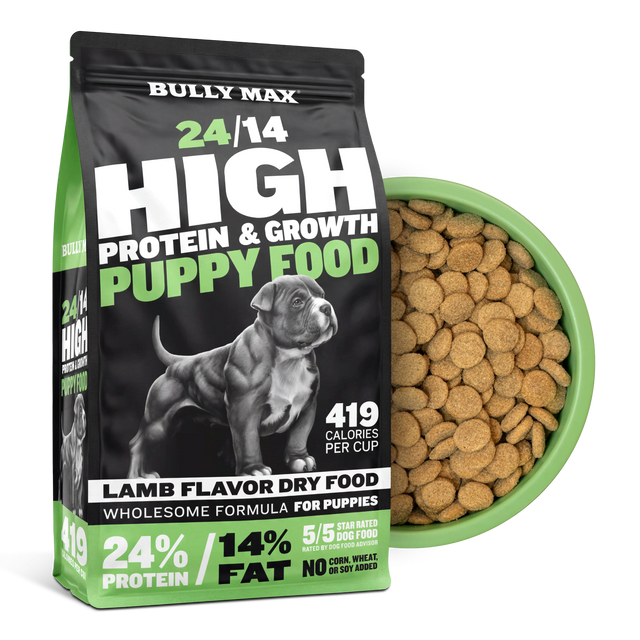
Puppies with soft stool need extra care. They can get dehydrated quickly, so check with your vet first. Once your vet gives the all-clear, a puppy still needs a growth food. 24/14 High Protein & Growth Puppy Food has lamb meal first, no chicken on the ingredient list, 24% protein, 14% fat and 419 calories per cup. It adds TruMune, a postbiotic, plus probiotics at 10 million CFU per pound and inulin. It is formulated to meet AAFCO nutrient profiles for all life stages, including growth of large size dogs (70 lb or more as an adult), so it suits big bully and guardian-breed puppies too. See our large breed puppy food guide for feeding amounts as they grow.


START YOUR PUPPY ON BULLY MAX 24/14 PUPPY FOOD
Lamb meal first, no chicken on the ingredient list, 24% protein, 14% fat and 419 calories per cup, with TruMune and 10 million CFU/lb of probiotics.
Quality you can check
Bully Max is a family-owned U.S. company founded in 2009. Our high-performance, meat-based nutrition is made in the USA, every batch is triple tested for safety, and we have zero recalls. That consistency matters most for dogs whose stomachs notice every change. Compare every formula side by side in the Bully Max dog food comparison chart.
How much to feed
As an estimate, a dog that needs about 1,400 calories a day would eat roughly 3.4 cups of 25/11 Lamb (415 kcal/cup), 3.3 cups of 24/14 Puppy (419 kcal/cup) or 2.6 cups of 30/20 Beef (530 kcal/cup). Real needs depend on size, age and activity, so treat these numbers as a starting point, split them into two or three meals, and adjust to your dog’s body condition and stool. Picky eaters too? See our guide to the best dog food for picky eaters.
Find the Right Food for Your Dog’s Stomach
Start with your vet if your dog is sick. Then read the whole label, pick a food that fits your dog’s activity level, switch slowly and give it time.
- Less active, small breed, Frenchie or easy keeper? Start with 25/11 Lamb.
- Active, working or hard to keep weight on? Try 30/20 High Protein Beef.
- Puppy? Go with 24/14 Puppy.
Once you find the food that works, don’t risk running out and grabbing something different in a pinch. Set it up on Autoship and save 10% on every order.
FAQ
What is the best dog food for a sensitive stomach?
The one your dog digests well. Look for a complete and balanced food with a named meat first, few animal protein sources, a fat level that suits your dog, fiber and listed probiotics. Many owners start with a different protein, such as lamb instead of chicken. If your dog has ongoing vomiting or diarrhea, see your vet first.
What should I feed a dog with an upset stomach?
Call your vet for advice on your dog. For a short, mild upset in an otherwise healthy adult dog, vets often suggest small, bland meals for a day or two before slowly returning to the regular food. Don’t switch to a new food during an active upset; wait until stools are normal, then switch slowly. See your vet right away for blood, repeated vomiting, lethargy or a puppy with diarrhea.
Is lamb or chicken better for a sensitive stomach?
Neither is better for every dog. Chicken suits most dogs. Lamb is a common choice for owners who want to move away from chicken. The right protein is the one your dog does well on, and your vet can help you work that out if you suspect a food reaction.
Is low-fat dog food better for sensitive stomachs?
Often, but not always. Rich, high-fat meals are a common trigger, and some dogs need a lower-fat diet for medical reasons. Active and working dogs may need more fat to hold their weight. Match the fat level to your dog and ask your vet if your dog has had pancreatitis.
Can puppies have sensitive stomachs?
Yes. Puppies often get soft stool from food changes, too many treats or eating things they shouldn’t. Because they can get dehydrated fast, call your vet about puppy diarrhea or vomiting. Keep them on a growth food and switch slowly.
How long does it take for a new food to settle a dog’s stomach?
Plan on 7 to 10 days for the switch itself, then a few more weeks to judge how your dog does. Keep notes on stool and appetite. If things get worse, stop and call your vet.
Questions about which formula fits your dog? Tell us about your dog in the comments below.