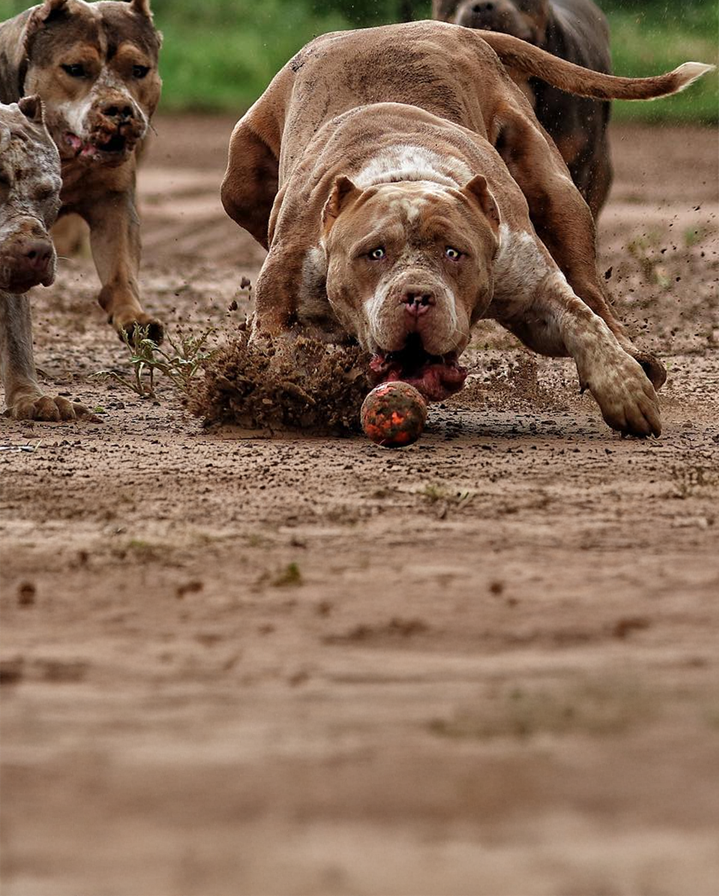
Cane Corso vs Presa Canario: Size, Temperament, Cost and Which One Fits Your Home
The Cane Corso and the Presa Canario are both large mastiff-type guardians, but they are not the same dog. The Corso is Italian, taller and more athletic in outline, and an AKC Working Group breed since 2010; the Presa is from the Canary Islands, shorter, wider and usually heavier, recorded in the AKC Foundation Stock Service and fully recognized by the UKC and the FCI. Both need an experienced owner, early socialization and a feeding plan built for a 90 to 125 lb working dog. Here is how they compare, and what to feed either one.
Family-owned since 2009 · Made in USA · Every batch triple tested · Zero recalls · 50,000+ 5-star reviews · Dog Food Advisor 5/5
Cane Corso vs Presa Canario at a glance
- Origin: Cane Corso, Italy. Presa Canario, the Canary Islands of Spain.
- Height: Corso males 25 to 27½ in, females 23½ to 26 in (AKC). Presa males 23 to 26 in, females 22 to 25 in (UKC).
- Weight: Corso males 100 to 110 lb, females 88 to 100 lb (UKC). Presa males 100 to 125 lb, females 85 to 100 lb (UKC).
- Look: Corso taller and athletic, in black, gray, fawn, red or brindle. Presa lower, wider and heavier in bone, with a required black mask, in fawn, black or brindle.
- Temperament: both are devoted guardians, reserved with strangers. The Presa standard adds that the breed can be aggressive with other dogs.
- Lifespan: Corso about 9 to 12 years; Presa about 9 to 11 years.
- Feeding: the same for both: a large-breed growth food to 12 to 18 months, then a meat-based 30/20 adult food fed by calories in two or more meals.
Cane Corso vs Presa Canario: Side-by-Side Comparison
| Cane Corso | Presa Canario | |
|---|---|---|
| Country | Italy | Spain (Canary Islands) |
| AKC | Working Group, recognized 2010 | Foundation Stock Service (not yet fully recognized) |
| Male height | 25 to 27½ in (AKC) | 23 to 26 in (UKC) |
| Male weight | 100 to 110 lb (UKC) | 100 to 125 lb (UKC) |
| Female height | 23½ to 26 in (AKC) | 22 to 25 in (UKC) |
| Female weight | 88 to 100 lb (UKC) | 85 to 100 lb (UKC) |
| Head | Wide skull, as wide as it is long; muzzle about one third of head length | Cube-shaped, slightly domed skull; flat, straight muzzle bridge |
| Colors | Black, shades of gray, shades of fawn, red; brindle on fawn or gray (FCI, UKC) | Any shade of fawn, black, brindle; black mask required; white limited |
| Temperament (standard) | "Intelligent, easily trained," "docile and affectionate" with family | "Affectionate, docile" with family; wary of strangers; can be aggressive with other dogs |
| Lifespan | About 9 to 12 years | About 9 to 11 years |
Heights and weights from the AKC Cane Corso standard and the UKC standards for both breeds; individual dogs run above and below them.
Origins: Italy vs the Canary Islands
The Cane Corso descends from the old Roman Molossian and was kept in Apulia and southern Italy to guard property and livestock, drive cattle and hunt big game; the name comes from the Latin "cohors," the guardian of the farmyard. The AKC approved its standard in 2009 and the breed entered the Working Group in 2010; the UKC recognized it in 2008 and the FCI lists it in Group 2, the Molossian breeds.
The Presa Canario comes from Spain's Canary Islands, mainly Gran Canaria and Tenerife. Its ancestors arrived with the Spanish conquistadors in the early 1400s and were crossed with the islands' cattle dogs to guard farms, control cattle and remove stray dogs. Numbers collapsed in the 1940s and breeders rebuilt the breed in the 1970s. The UKC recognized it in 2003, the AKC has recorded it in the Foundation Stock Service since 1996, and the FCI lists it as the Presa Canario (formerly Dogo Canario). The registry difference matters only if you plan to show: a Corso can earn AKC conformation titles; a Presa shows under the UKC.
Size and Weight by Breed Standard
Both are large, in different directions. The Corso is taller: the AKC standard calls for males of 25 to 27½ inches and females of 23½ to 26 inches, with weight "proportionate to height"; the UKC puts that at 100 to 110 lb for males and 88 to 100 lb for females. The Presa is shorter and heavier: the UKC asks for males of 23 to 26 inches at 100 to 125 lb and females of 22 to 25 inches at 85 to 100 lb.
So a Presa male at the top of its standard outweighs a top-of-standard Corso male by about 15 lb while standing an inch or two shorter: a wider chest, heavier bone and a thicker neck on the Presa, a longer leg and a more rectangular, athletic outline on the Corso. Working dogs often run bigger: the PresaMania Presas in our PresaMania breeder story are listed at 105, 114 and 128 lb and 25 to 27 inches.
Head, Body and Look: How to Tell Them Apart
The head is the fastest tell. The Cane Corso's skull is wide and slightly curved, as wide as it is long, with a well-defined stop and a muzzle about one third of the total head length. The UKC describes the Presa Canario's skull as cube-shaped, broad and slightly domed, with a muzzle that forms a smaller cube and a flat, straight bridge. Side by side, the Presa looks blockier and the Corso longer in the face.
Color is the second tell. The Presa standard allows any shade of fawn, black and brindle, requires a black mask, and disqualifies white over 20 percent. The Corso's palette is wider: black, shades of gray, shades of fawn, red, and brindle over fawn or gray. A gray or "blue" dog is a Corso; the Presa standard has no gray. A fawn dog with a heavy mask could be either, so look at the frame.

Both may be shown with cropped or natural ears; the Presa standard disqualifies a docked tail. On looks alone, the Corso is the sleeker, more upright dog and the Presa the wider, lower, more massive one.
Temperament and Guarding Instinct
Both were kept to guard, and both still do it without being asked. The AKC Cane Corso standard says that "as a protector of his property and owners" the breed "is unequaled," and calls it "docile and affectionate to his owner, loving with children and family." The UKC Presa Canario standard describes a dog "extremely affectionate, docile and well behaved with its owner and family" but wary of strangers, and adds that the breed is aggressive with other dogs; viciousness or extreme shyness is a disqualification.
In practice both watch the door, follow the family from room to room and take a while to accept a visitor. The difference is intensity. The Presa carries more dog aggression and prey drive, which is why its veterinarian-reviewed breed profile suggests it does best as the only pet and is not ideal for a home with very young children. The Corso is generally more tolerant of animals it was raised with and a little easier to settle, but it is still a guardian that will act on a threat it perceives. Guarding instinct is not the same as being trained to protect: an untrained guardian decides for itself what counts as a threat; a trained one waits for the handler.
Trainability and Who Should Own One
The AKC standard calls the Cane Corso "intelligent" and "easily trained": the breed learns quickly and wants a job. The Presa learns just as fast but is less forgiving of inconsistent handling; start socialization and obedience early, use positive reinforcement, and bring in a certified trainer if the dog gets ahead of you. For either breed, the first year is the work. A 20 lb puppy that jumps on guests gets excused; a 110 lb adult that does it is a liability.
Our honest take on who should own which:
- Choose the Cane Corso if this is your first large guardian breed, you have other animals at home, you want to show in AKC events, or you want an athletic dog for hiking, conditioning and obedience.
- Choose the Presa Canario if you have owned a guardian or bully breed before, can manage a dog-selective dog, want a weight pull or protection sport prospect, and the dog will be the only pet.
- Choose neither if you cannot commit to daily training for the first 18 months, a secure fence and a leash every time the dog leaves it. Check local breed laws and your homeowner's insurance first; some places restrict one or both breeds.
Exercise and Work: Weight Pull and Protection Sport
Neither is a marathon dog: a Presa is not especially high-energy and a Corso needs a couple of miles a day split into walks, plus play and mental work. What both need is purpose. On the Bully Max Sports team the Presa Canario is a staple of two sports: weight pull and protection sport. PresaMania's Wendy moved 16,884 lb on her final official pull at the UPF-sanctioned Bully Max Weight Pull II, Hamilton and Amarillo put up a 19,834 lb pull on a UPF track (released on the Bully Max channel as a world record pull), and Amarillo took Most Weight Pulled at the ADBA Nationals.
To try the sport with either breed, start with how to train your dog to weight pull, and see the full record list in the strongest dogs in the world.

Protection sport is where the Presa's grip and the Corso's drive both show. PresaMania conditions its dogs with swimming, drag work, treadmill work and varied routines so they build durability without burning out; the same program fits a Corso. Avoid repetitive high-impact work on a young dog of either breed: growth plates in a 100 lb breed close late, so keep puppies to free play, walks and short sessions until your vet clears harder work.
Health and Lifespan
These are big, deep-chested dogs with the health profile that goes with it. Veterinarian-reviewed breed profiles list the Cane Corso's common concerns as hip dysplasia, bloat (gastric dilatation-volvulus), eyelid problems (entropion, ectropion, cherry eye), epilepsy and obesity, with a life expectancy of about 9 to 12 years. The Presa Canario's list is similar: hip and elbow dysplasia, patellar luxation, idiopathic epilepsy, entropion, hypothyroidism and bloat, with about 9 to 11 years.
Two of those you can influence from the bowl:
- Hip and elbow dysplasia. Genetics come first, which is why the breeder question below matters. Growth rate and weight matter too: veterinary guidance is to keep large-breed puppies lean and on a large-breed growth diet through the first year. In one study cited by veterinarians, about two thirds of at-risk puppies on unrestricted food developed hip dysplasia against about one third on controlled portions.
- Bloat. Large, deep-chested dogs are most at risk. The Cornell Riney Canine Health Center lists eating fast, one large meal a day and exercise soon after eating among the risk factors, and recommends two or more smaller meals and no hard exercise right after a meal. Unproductive retching, a swollen painful belly, drooling and restlessness are an emergency. Ask your vet about a preventive gastropexy at spay or neuter.
None of this is a reason to skip either breed; it is a reason to buy from a breeder who health tests, keep the dog lean and feed measured meals. For anything beyond that, see your vet.
Cost and Finding a Breeder
Purchase price varies so much by bloodline, region and pet versus working quality that any number we printed would be wrong for most readers; ask the breeders. The costs that do not vary come after the sale: a 100 lb dog on a 535 calorie per cup food eats roughly 3¾ to 4½ cups a day, so a 40 lb bag lasts five to six weeks; vet work is priced by weight; every piece of gear is the largest size. Budget for a big dog for 10 years, then decide.
Finding a breeder is the same job for both breeds, and the two best examples on this site are working kennels. PresaMania, Travis and Kassidy Torrez's Presa Canario kennel in Texas, breeds for protection, weight pull and the show ring and health tests through OFA and Embark; their story is in Built to Work: PresaMania's Presa Canarios. Cold River Boerboels works a different mastiff breed on the same principle: genetics create potential, training develops it, nutrition helps unlock it. Use both as the benchmark, then read our guide to getting references from a breeder. The short checklist:
- Hip and elbow results (OFA or PennHIP) on both parents.
- Parents you can meet, and dogs that do something: show, pull, protection sport, farm work.
- A written contract with health and take-back clauses; puppies raised in the house and not released before eight weeks.

The Cane Corso Presa Canario Mix
A Cane Corso x Presa Canario mix crosses two mastiff-type guardians, so there are fewer surprises than in most designer crosses. Expect a dog of 90 to 130 lb, usually brindle, fawn or black, often masked, somewhere between the Corso's height and the Presa's width. Expect the guarding instinct of both parents, and plan for the Presa's dog-selectiveness and prey drive, because you will not know which parent the puppy takes after until it is grown. No registry has a standard for the cross, so there is no ring for it and no type to breed toward; what you get is whatever the two parents were.
That makes the parents the whole decision: ask for the same hip, elbow and temperament evidence you would ask for in a purebred. Raised well, the mix is a capable guardian and a strong sport prospect. Feed, exercise and train it exactly as you would either parent.
Feeding a Cane Corso or a Presa Canario
Feeding is where the two breeds stop being different. Both carry a lot of muscle on a frame that takes 18 to 24 months to finish, and both face the same two nutrition-linked risks: joints that grow too fast and a stomach that twists. The plan is the same for a Corso, a Presa or the mix.
Puppies: large-breed growth rules to 12 to 18 months
Feed a growth food that is suitable for large-breed puppies under AAFCO guidelines, in three measured meals a day to about six months and two after that, and keep the puppy lean enough to feel ribs with light pressure. Do not free feed, do not add calcium, and do not try to grow the biggest dog in the litter. Bully Max 24/14 High Protein & Growth Puppy (24% protein, 14% fat, 419 calories per cup, real lamb, with TruMune) is suitable for large-breed puppies under AAFCO guidelines. Month-by-month amounts for a Corso puppy, which work for a Presa of the same weight, are in Cane Corso puppy food: what to feed and how much; the calcium and switch-over detail is in large breed puppy food.
This is the growth food we recommend for a Cane Corso or Presa Canario puppy, in 5, 10 and 15 lb bags:

BULLY MAX 24/14 HIGH PROTEIN & GROWTH PUPPY FOOD
24% protein, real lamb and 419 calories per cup, with TruMune to support digestion and immune health. Suitable for large-breed puppies under AAFCO guidelines.

Adults: feed by calories, not by the scoop
Adult amounts start from the formula vets use: resting energy requirement = 70 x (body weight in kg)0.75, times about 1.6 for a neutered pet, 1.8 for an intact adult and 2 or more for a dog in work:
| Adult weight | Pet, moderate exercise (1.6 x RER) | Intact or daily trainer (1.8 x RER) | Weight pull or protection sport in season (2 x RER) | Cups of 30/20 (535 kcal) | Cups of PRO 31/25 (600 kcal) |
|---|---|---|---|---|---|
| 85 lb | about 1,730 | about 1,950 | about 2,170 | 3¼ to 4 | 3 to 3½ |
| 100 lb | about 1,960 | about 2,200 | about 2,450 | 3¾ to 4½ | 3¼ to 4 |
| 110 lb | about 2,100 | about 2,370 | about 2,630 | 4 to 5 | 3½ to 4½ |
| 120 lb | about 2,240 | about 2,530 | about 2,810 | 4¼ to 5¼ | 3¾ to 4¾ |
| 130 lb | about 2,380 | about 2,680 | about 2,980 | 4½ to 5½ | 4 to 5 |
Estimates, rounded to the nearest quarter of an 8 oz cup; cup columns run from the pet figure to the working figure. Individual dogs can need up to 30 percent more or less; adjust to body condition every two weeks. Two or more meals a day, an hour between a meal and hard exercise.
Calorie density matters because of bowl size: a 110 lb Presa in pull season needs around 2,600 calories, which is six and a half cups of a 400 calorie food or five of a 535 calorie food, and smaller meals in a deep-chested dog are a bloat precaution. For a working adult Corso or Presa, a meat-based 30/20 is the standard choice: 30 percent protein for the muscle, 20 percent fat for the calories, 535 per cup. The clip below is Hank the Tank, a Cane Corso fed Bully Max; the card under it is the food.

BULLY MAX 30/20 HIGH-PROTEIN CHICKEN
30% protein, 20% fat and 535 calories per cup from real chicken, with TruMune to support digestion and immune health. Made in the USA.
Save 10% with autoship on every bag.
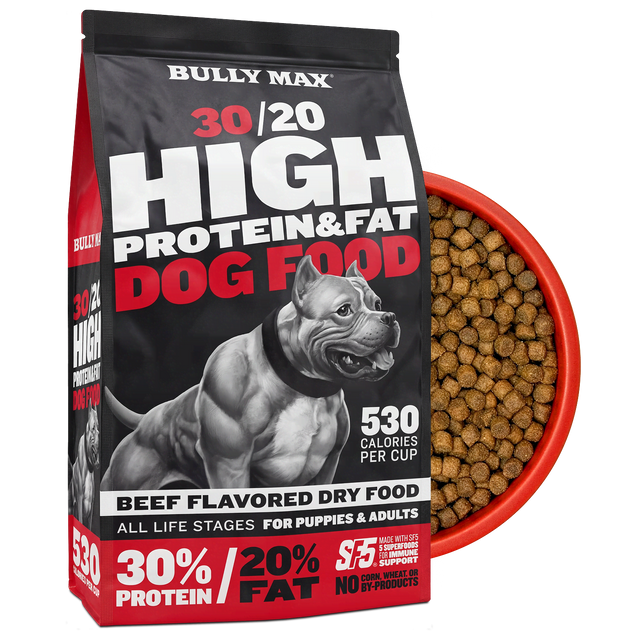
Three adjustments cover most dogs. A dog that does better without chicken goes on 30/20 Beef (530 calories per cup, chicken-free, formulated for all life stages including large-breed growth), one of PresaMania's go-to picks. A dog in heavy pull or protection training that eats the full portion and still loses condition moves up to PRO Series 31/25 at 600 calories per cup. A retired, injured or easy-gaining dog moves down to 25/11 Lamb at 415. The full breed guide is our Cane Corso feeding guide, and if you are switching foods, do it over 7 to 10 days as in how to switch your dog to Bully Max.
FAQ
What is the difference between a Cane Corso and a Presa Canario?
Country, build and registry. The Cane Corso is Italian, taller (males 25 to 27½ inches), more athletic in outline, available in gray, and an AKC Working Group breed. The Presa Canario is from the Canary Islands, shorter (males 23 to 26 inches), wider and heavier (up to 125 lb under the UKC standard), always black-masked, and an AKC Foundation Stock Service breed fully recognized by the UKC. Both are guardian breeds for experienced owners.
Which is bigger, a Cane Corso or a Presa Canario?
The Corso is taller; the Presa is heavier. A top-of-standard Corso male is 27½ inches and about 110 lb; a top-of-standard Presa male is 26 inches and 125 lb, and working Presas often exceed that.
Presa Canario vs Cane Corso: who would win?
That is the wrong contest. The two breeds compete side by side on the weight pull track and in the protection sport ring, where results are measured in pounds moved and clean outs; see every weight pull world record set on the Bully Max track. If you want a dog that wins, buy a working pedigree and train it.
Is a Cane Corso Presa Canario mix a good dog?
In the right home, yes. The mix is a 90 to 130 lb guardian with the instincts of both parents, so it needs the same experienced owner, early training and single-pet planning as a Presa. Judge it by its parents: health-tested, stable, working dogs produce good crosses.
Do Cane Corsos and Presa Canarios eat the same food?
Yes. Both need a large-breed growth food to 12 to 18 months, then a meat-based adult food fed by calories in two or more meals: roughly 1,960 to 2,450 a day for a 100 lb dog depending on work (estimate). Bully Max 24/14 Puppy for growth and 30/20 for adults cover both breeds and the mix.
The Short Answer
Pick the Cane Corso for a taller, more trainable, more adaptable guardian and the Presa Canario for a heavier, more intense working dog that will be the only animal in the house. Buy either from a breeder who health tests and works the dogs, train hard for the first 18 months, and keep the dog lean. Both breeds and the mix eat the same way: a large-breed growth food as puppies, then Bully Max 30/20 High Protein fed by calories as adults, with PRO Series 31/25 for the ones that pull.
Sources
- AKC, Official Standard of the Cane Corso (approved October 20, 2009; Working Group 2010) and AKC Presa Canario breed page (Foundation Stock Service since 1996). akc.org
- UKC, Cane Corso Italiano standard (2008) and Perro de Presa Canario standard (2003). ukcdogs.com
- FCI, Cane Corso standard No. 343 and Presa Canario standard No. 346. fci.be
- Chewy, "Cane Corso," reviewed by Barri Morrison, DVM; PetMD, "Presa Canario," reviewed by Hannah Hart, DVM (2025): lifespan, health, temperament.
- Cornell Riney Canine Health Center, "Gastric dilatation-volvulus (GDV or bloat)"; VCA Animal Hospitals, "Hip Dysplasia in Dogs" (Llera, Hunter, Ward, DVM).
- Merck Veterinary Manual, Nutritional Requirements of Small Animals: RER = 70 x kg^0.75; multipliers 1.6, 1.8, 2+.
- Bully Max, "Built to Work: PresaMania's Presa Canarios"; Bully Max YouTube K7acfllYTfc, _qArGfO3OhA, 35ephjHSB40; Bully Max product pages (label analysis, calories, AAFCO statements).