Doberman Puppy Food: What to Feed, How Much and When to Switch
A Doberman puppy needs a food formulated for growth that is suitable for large-breed puppies: about 22 to 28% protein from named meat, 12 to 16% fat, controlled calcium and a known calorie count per cup, fed in three or four measured meals a day. Feed by calories for the puppy's current weight and age, not by the scoop, and check body condition every two weeks so the puppy grows lean and steady rather than fast. Most Dobermans stay on puppy food until 12 to 18 months. This guide covers what the breed needs in its first year, which Bully Max formula fits, how much to feed an 8 week, 3 month, 6 month and 12 month old Doberman puppy, how many meals a day, and how to make the switch to adult food.
Family-owned since 2009 · Made in USA · Every batch triple tested · Zero recalls · 50,000+ 5-star reviews · Dog Food Advisor 5/5
Doberman puppy feeding at a glance
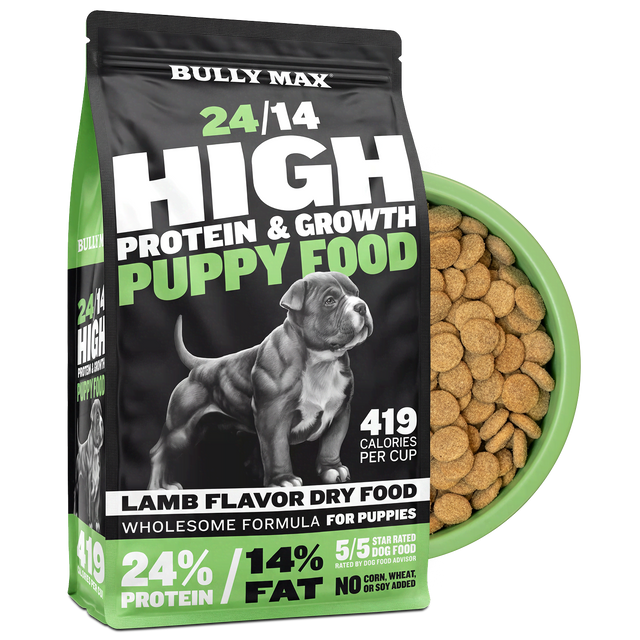
- Food: a growth formula suitable for large-breed puppies. Our pick is Bully Max 24/14 High Protein & Growth Puppy (24% protein, 14% fat, 419 calories per cup, real lamb, TruMune).
- Meals: four a day at 8 to 12 weeks, three from 3 to 6 months, two or three from 6 to 12 months, two after that.
- How much: about 3 times resting energy under 4 months and about 2 times from 4 months to adult size (table below). A 20 lb puppy under 4 months eats about 2½ cups of 24/14 a day; a 50 lb puppy over 4 months about 3½ cups. Estimates.
- Growth target: lean and steady. You should feel ribs under a thin layer with light pressure and see a waist from above. Fast growth, not slow growth, is the risk in this breed.
- Switch to adult food: 12 to 18 months, when height has stopped, over 7 to 10 days. Most Dobermans keep filling out until about 2 years.
- Never: add calcium, free-feed, or exercise hard right before or after a meal (the Doberman is a deep-chested, bloat-prone breed).
Why a Doberman Puppy Counts as a Large-Breed Puppy
The AKC standard puts an adult male Doberman at 26 to 28 inches and 75 to 100 lb, and a female at 24 to 26 inches and 60 to 90 lb. A puppy that weighs about a pound at birth reaches that size in roughly 18 months, and gets most of its height in the first 12. AAFCO defines a large-breed puppy as one that will weigh 70 lb or more as an adult, so almost every Doberman qualifies, and the small females sit right at the line. That matters because large-breed growth is where feeding mistakes do lasting damage.
In a large-breed puppy, too many calories and too much calcium during the fast-growth window (roughly 3 to 8 months) push the skeleton to grow faster than it can mineralize properly. Vets group the results under developmental orthopedic disease: hip and elbow dysplasia expressed earlier and worse, osteochondrosis, and panosteitis, the painful shifting-leg lameness that fast-growing large-breed pups get between about 5 and 18 months. None of this is caused by a food alone, and genetics load the dice, but the research on large-breed puppies is consistent: puppies raised lean on a controlled-calcium growth food have fewer skeletal problems than puppies raised fat on a free-fed bowl. A Doberman puppy that looks a little lean at 6 months is on track. A round one is not.
The second breed-specific point is the deep chest. Dobermans are among the breeds at higher risk of bloat (gastric dilatation-volvulus), and that risk starts young enough that feeding habits should be set from the first week home: smaller meals, a calm mealtime and no hard play for an hour either side of eating.

What a Doberman Puppy Needs From Its Food
A growth formula, stated on the bag
Look for an AAFCO statement that says the food is formulated for growth or for all life stages, and ideally one that adds "including growth of large size dogs (70 lb or more as an adult)". That second phrase means the food meets the tighter calcium limits for large-breed growth. An adult maintenance food is not a puppy food, whatever the protein number says.
Protein: 22 to 28% from named meat
AAFCO's minimum for growth is 22.5% protein on a dry matter basis. A Doberman puppy building the muscle that defines the breed does well a little above that, from a named meat source (lamb, chicken, beef, fish, or their meals) rather than a plant protein boosted with concentrates. Very high protein does not make a puppy grow too fast; calories do. The protein guide at how much protein does a dog need explains why the percentage on the bag understates what a dry food delivers.
Fat: 12 to 16%
Fat carries the calories and the essential fatty acids. Around 14% suits a growing Doberman: enough energy density that a 50 lb puppy is not eating five cups a day, not so much that it is easy to overfeed. Fish oil or another named omega-3 source supports the coat and, with DHA, early brain and eye development.
Calcium: controlled, never added
For foods labeled for large-breed growth, AAFCO caps calcium at 1.8% of dry matter (versus 2.5% for other growth foods), with a floor of 1.2%. A complete large-breed growth food sits inside that range on purpose. Adding a calcium supplement, bone meal, eggshell or "joint" powder with calcium on top of it breaks the balance and is one of the few feeding mistakes that can hurt a Doberman puppy for life. Do not add any unless your vet prescribes it.
Calories per cup: the number you actually feed by
Two puppy foods with the same 24/14 on the front can differ by 80 calories a cup. The calorie line near the guaranteed analysis is what turns "how much to feed a Doberman puppy" into a number of cups. Our guide to how many calories a dog needs has the formula used in the table below.
Digestion
Puppies leave the litter, change homes, change water and often change food in the same week, and loose stool follows. A food with a postbiotic such as TruMune, or prebiotic fiber, helps a young gut hold its footing through that. It also makes the switch to the adult food smoother later.
Which Bully Max Formula for a Doberman Puppy
Bully Max makes one food for this job and the rest of the line is where the puppy goes next:
Bully Max formulas for a Doberman, puppy to adult
| Bully Max formula | Protein | Fat | kcal/cup | Best for |
|---|---|---|---|---|
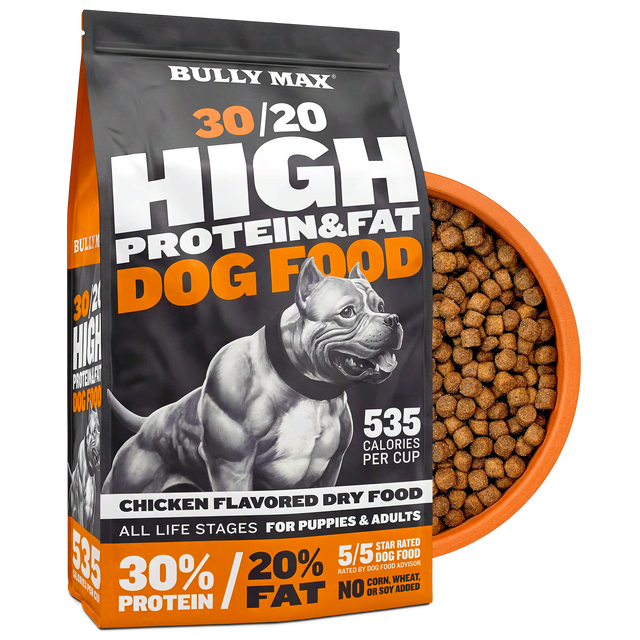
| 30/20 High Protein Chicken | 30% | 20% | 535 | The adult food after the switch: active adult Dobermans |
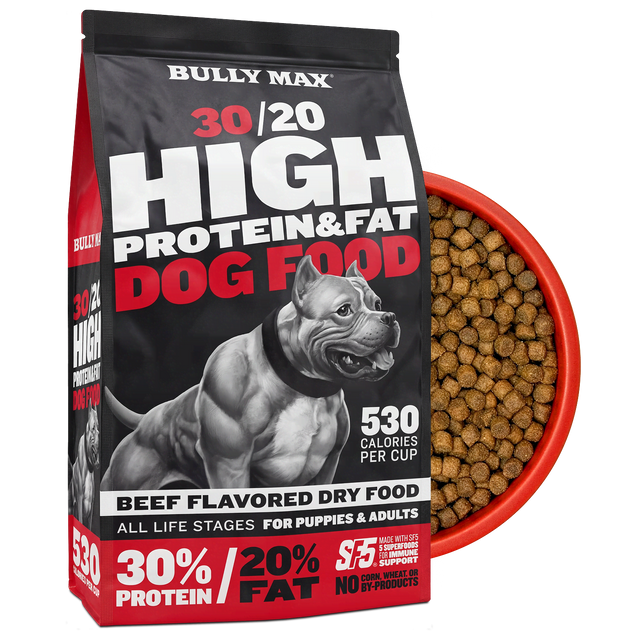
| 30/20 High Protein Beef | 30% | 20% | 530 | Chicken-free adult food for active Dobermans |
| PRO Series 31/25 High Calorie | 31% | 25% | 600 | Adult working, sport and hard-keeping Dobermans |
| 25/11 Lamb, 45% less fat | 25% | 11% | 415 | Adult Dobermans that gain easily or do less work |
| 24/14 High Protein & Growth Puppy | 24% | 14% | 419 | Doberman puppies from weaning to 12 to 18 months; large-breed growth statement on the label |
Protein and fat are guaranteed-analysis minimums; calories per 8 oz cup. Figures from each product's label data on shop.bullymax.com.
Bully Max 24/14 Puppy is 24% protein and 14% fat with real lamb and pork, 419 calories per cup, TruMune to support digestion and immune health, and no corn, wheat or soy. Its label states it is formulated to meet the AAFCO Dog Food Nutrient Profiles for All Life Stages including growth of large size dogs (70 lb or more as an adult), which is the statement a Doberman puppy needs. Dog Food Advisor rates it 5 out of 5. It comes in 5, 10, 15, 20, 30 and 40 lb bags; a Doberman puppy will go through about a 15 lb bag every two to three weeks by 5 months, so the autoship saving adds up fast.

START YOUR DOBERMAN PUPPY ON BULLY MAX 24/14
24% protein and 14% fat with real lamb, 419 calories per cup and TruMune to support digestion and immune health. Label formulated for all life stages including growth of large size dogs.
Save 10% with autoship and get each bag delivered before the last one runs out.
How Much to Feed a Doberman Puppy
The quick version is the chart on the bag: about 1¼ to 1¾ cups a day at 9 to 14 lb, 2¼ to 2½ cups at 18 to 23 lb, 3 to 3¼ cups at 27 to 32 lb, and half a cup more for every extra 15 lb. The chart below is the longer version, because a puppy's calorie need changes with age as well as weight. It uses the formula vets use: resting energy requirement (RER) = 70 x (body weight in kg)0.75, times about 3 for a puppy under 4 months and about 2 from 4 months to adult size, then divided by 419 calories per cup of 24/14.
| Puppy's current weight | Under 4 months (calories a day) | Cups of 24/14 a day (under 4 months) | 4 months to adult size (calories a day) | Cups of 24/14 a day (4 months and up) |
|---|---|---|---|---|
| 10 lb | about 650 | about 1½ | about 440 | about 1 |
| 15 lb | about 880 | about 2 | about 590 | about 1½ |
| 20 lb | about 1,100 | about 2½ | about 730 | about 1¾ |
| 25 lb | about 1,300 | about 3 | about 870 | about 2 |
| 30 lb | about 1,490 | about 3½ | about 990 | about 2¼ |
| 35 lb | about 1,670 | about 4 | about 1,110 | about 2¾ |
| 40 lb | n/a | n/a | about 1,230 | about 3 |
| 50 lb | n/a | n/a | about 1,450 | about 3½ |
| 60 lb | n/a | n/a | about 1,670 | about 4 |
| 70 lb | n/a | n/a | about 1,870 | about 4½ |
Estimates, rounded to the nearest quarter of a standard 8 oz cup. Individual puppies vary by up to 30%. Where the bag chart and this table disagree, start between them and let body condition decide within two weeks. Treats count toward the total.
Split the daily amount across the day's meals. The dog food calculator does the same math for any food and any age.
How much to feed by age: 8 weeks to 12 months
Owners ask the question by age more often than by weight, so here is the same table read the other way. The weights are rough ranges for the breed (males run heavier, and lines differ); weigh your puppy and use its real weight in the table above.
| Age | Rough weight | Daily food (24/14, estimate) | Meals a day | What to watch |
|---|---|---|---|---|
| 8 weeks | about 12 to 20 lb | about 1¾ to 2½ cups | 4 | Settling in: keep the breeder's food for the first week, then switch over 7 to 10 days. Firm stool, steady appetite. |
| 3 months | about 25 to 35 lb | about 3 to 4 cups | 3 | The fastest growth starts now. Measure every meal; a round belly at this age is overfeeding, not a healthy puppy. |
| 4 months | about 30 to 45 lb | about 2¼ to 3¼ cups | 3 | The multiplier drops from 3 to 2, so the daily amount levels off or dips even though the puppy is bigger. This surprises most owners; it is correct. |
| 5 months | about 40 to 55 lb | about 3 to 3¾ cups | 3 | Teething: a puppy that goes off its food for a few days is usually sore, not sick. Soak the kibble a little. |
| 6 months | about 45 to 65 lb | about 3¼ to 4¼ cups | 2 to 3 | Legs and chest lengthen; the puppy looks gangly. Check ribs weekly. Ask your vet about panosteitis if the puppy goes lame on different legs. |
| 9 months | about 60 to 80 lb | about 4 to 5 cups | 2 | Height is nearly done. Hold the line on calories; this is when Dobermans start to get heavy if the bowl grows with them. |
| 12 months | about 65 to 90 lb | about 4¼ to 5½ cups | 2 | Plan the switch to adult food with your vet, 12 to 18 months. A female at adult height can switch earlier than a big male still growing. |
Weights are approximate ranges, not targets; your breeder's records for the line are a better guide than any chart. Food amounts come from the calorie table above at the midpoint of each weight range.
Doberman puppy feeding schedule
Four meals a day until about 12 weeks, three from 3 to 6 months, then two or three until a year, and two a day from then on for life. The reason to keep meals small and frequent in this breed is not only digestion; it is bloat. A deep-chested dog with a full stomach that then plays hard is the classic bloat picture. Use a slow-feeder bowl for a puppy that bolts its food, feed in a quiet spot, and leave an hour between a meal and hard play on either side. The adult guide covers the warning signs of bloat in detail: best dog food for Dobermans.
Switching From the Breeder's Food
Keep whatever the breeder sent home for the first several days; a new house is enough change. Then move to the new food over 7 to 10 days: a quarter new for two or three days, half, three quarters, then all new, watching the stool at each step and holding a step longer if it softens. A puppy that gets loose on day one is not rejecting the food; it is reacting to the pace. Step-by-step: how to switch your dog to Bully Max.
Is Your Doberman Puppy Growing Right? The Two-Week Check
Weigh the puppy every two weeks (a bathroom scale and a bit of patience works until about 40 lb; then the vet's scale or a feed-store scale). Write it down. You are looking for a steady upward line, not a steep one, and a puppy that stays lean through it. The hands-on check beats the scale: ribs you can feel with light pressure under a thin cover, a waist from above, a tuck from the side. On a short-coated breed like the Doberman the last rib or two may show faintly at 6 to 9 months; that is a fit puppy, not a thin one. If you cannot feel ribs, cut the daily amount by about 10% and check again in two weeks. If the spine and hip bones stand out, add about 10% and mention it to your vet.
Our puppy growth chart explains how to read a growth curve for a large breed, and large breed puppy food: what to feed, how much and when to switch covers the calcium and switch-over science in more depth.

Common Doberman Puppy Feeding Problems
"My Doberman puppy is skinny"
First, decide whether it is. A gangly 6 to 9 month old with a faint rib outline is normal for the breed. If hip bones and spine stand out, rule out worms and other medical causes with your vet, then raise the daily amount by about 10% and recheck in two weeks. Do not jump to an adult high-fat food to fatten a puppy; it loses the growth balance. More cups of the puppy food, or an extra meal, is the right lever.
"My Doberman puppy will not eat"
Dobermans are not usually picky, so a sudden drop in appetite has a reason: teething at 4 to 6 months, a day of too many treats, heat, or a stressful change. Pick the bowl up after 15 minutes and offer it again at the next meal. A puppy that skips more than two meals, or has vomiting, diarrhea or lethargy with it, goes to the vet the same day.
Loose stool
Usually the switch was too fast, the treats were too rich, or the puppy ate something in the yard. Slow the switch, cut treats for a few days and keep the water fresh. Blood, black stool, or diarrhea that lasts more than a day in a young puppy is a vet visit; puppies dehydrate fast.
Eating too fast
A slow-feeder bowl or a snuffle mat, smaller meals, and feeding away from other dogs. Fast eating is a bloat habit, and this is the breed to break it in early.
What Not to Do
- Do not add calcium or bone meal. The food already has the right amount for large-breed growth; extra does harm.
- Do not free-feed. A bowl that is always full is how a Doberman puppy gets fat and grows too fast. Measured meals only.
- Do not feed an adult maintenance food. Wait for the vet's word that growth is done, then switch.
- Do not let treats run past 10% of the day's calories. Dobermans learn fast and training eats a lot of treats; make them small and take them out of dinner.
- Do not force exercise. Free play is fine. Long runs, repeated jumping and long stairs can wait until the growth plates close; ask your vet when.
- Do not change the diet without a word to your vet if there is heart disease in the line. Dobermans carry an inherited risk of dilated cardiomyopathy, and since 2018 the FDA has been looking at a possible link between some diets, many of them heavy in peas, lentils and potatoes, and DCM in dogs. The FDA has not concluded that any diet causes it. Bully Max 24/14 Puppy is a lamb-based kibble with no corn, wheat or soy; show your vet the label and let them weigh in.
When to Switch a Doberman to Adult Food
When height stops, which for most Dobermans is between 12 and 18 months, and only after your vet agrees growth is done. A female at her adult height at 12 months can switch earlier; a big male still gaining height at 15 months stays on the puppy food. Make the switch over 7 to 10 days the same way as the first one. The natural next food for an active young Doberman is Bully Max 30/20 Chicken (30% protein, 20% fat, 535 calories per cup): a 70 lb young adult that trains or runs daily needs about 1,500 to 1,870 calories, which is roughly 2¾ to 3½ cups. A quieter or easy-gaining Doberman does better on 25/11 Lamb. The adult guide has the full portion tables: best dog food for Dobermans: puppy and adult feeding guide.
Time the switch so you are not also changing anything else that week: no new house, no neuter surgery, no new training class. One change at a time is the rule for every switch in a Doberman's life.

What Bully Max Puppy Owners Say
Doberman owners are a small part of our customers, but the puppy owners who buy Bully Max tend to have done the same homework you are doing now. From our post-purchase survey:
In our customers' words
“Researched a bunch of puppy food and decided to give this one a shot and she loves it”
Bully Max customer, post-purchase survey
“My dog has been eating this since he was 6 weeks old. He is now 4 years old and is solid, muscle definition in his legs.”
Bully Max customer, post-purchase survey

FEEDING A DOBERMAN?
See the Doberman feeding guide
The 30/20 formula for a lean, athletic Dobe, cups per day by weight, and real owners’ results.
50,000+ five-star reviews
FAQ
How much should I feed my 8 week old Doberman puppy?
By weight, about 3 times resting energy: a 15 lb puppy needs about 880 calories a day, which is about 2 cups of Bully Max 24/14 Puppy (419 calories per cup), split into four meals. Estimates; check ribs and waist every two weeks and adjust by about 10% at a time.
How many times a day should a Doberman puppy eat?
Four meals a day until about 12 weeks, three from 3 to 6 months, two or three from 6 to 12 months, and two a day from a year on. Small, frequent meals also lower bloat risk in this deep-chested breed.
How long should a Doberman eat puppy food?
Until height has stopped and your vet agrees growth is done, usually 12 to 18 months. Females often switch earlier than large males. Switch over 7 to 10 days.
How fast do Doberman puppies grow?
From about a pound at birth to roughly 45 to 65 lb at 6 months and most of their adult height by 12 months, then filling out to 60 to 100 lb by about 18 to 24 months. Ranges are approximate; males run heavier. Steady growth on a controlled-calcium food is the goal, not fast growth.
Does a Doberman puppy need large-breed puppy food?
Yes. AAFCO defines large-breed growth as 70 lb or more as an adult, which covers almost every Doberman. A food labeled for growth of large size dogs keeps calcium inside the tighter range (1.2 to 1.8% dry matter) that protects a fast-growing skeleton. Bully Max 24/14 Puppy carries that statement on its label.
Can a Doberman puppy eat adult dog food?
Not as its main food. Adult maintenance foods are not balanced for growth, and the calcium can be outside the large-breed range. Keep a Doberman on a growth formula until 12 to 18 months, then switch to the adult food.
The Short Answer
Put your Doberman puppy on a growth food with a large-breed statement, feed it in measured meals by calories for its weight and age, keep it lean through the fast-growth months, never add calcium, and switch to the adult food when height stops. Start with Bully Max 24/14 High Protein & Growth Puppy, weigh the puppy every two weeks, and let body condition, not the chart, make the final call.
Sources
- American Kennel Club, Doberman Pinscher breed standard: males 26 to 28 inches, 75 to 100 lb; females 24 to 26 inches, 60 to 90 lb. akc.org
- AAFCO Dog Food Nutrient Profiles: growth and reproduction minimums (crude protein 22.5%, crude fat 8.5%, calcium 1.2% dry matter) and the 1.8% calcium maximum for growth of large size dogs (70 lb or more as an adult). aafco.org
- Merck Veterinary Manual, Nutritional Requirements of Small Animals: RER = 70 x kg^0.75; about 3 x RER for puppies under 4 months, about 2 x RER from 4 months to adult size; individual variation up to 30%. merckvetmanual.com
- Merck Veterinary Manual, Developmental Orthopedic Disease and Gastric Dilatation and Volvulus in dogs: large and giant breed risk, overnutrition and excess calcium during growth. merckvetmanual.com
- U.S. Food and Drug Administration, FDA Investigation into Potential Link between Certain Diets and Canine Dilated Cardiomyopathy (2018 to 2022 updates). fda.gov
- Bully Max 24/14 High Protein & Growth Puppy Food product page: guaranteed analysis, 419 kcal per cup, AAFCO statement, bag feeding chart, bag sizes and prices (checked Nov 21, 2026).
- Bully Max post-purchase survey, Dec 2024 to Jun 2025 (customer quotes).